

Indian Polity Set 19: Section 1: The Definition of State (Article 12)
Core Focus: In-depth coverage of Articles 12–13, judicial review, and constitutional doctrines.
Landmark Case Law: Includes crucial rulings like R.D. Shetty, Ajay Hasia, and Kaushal Kishor.
Enforcement & Remedies: Comprehensive comparison of Article 32 vs Article 226 writ jurisdictions.
Exam Relevance: Ideal high-yield practice for UPSC CSE, State PSCs, and judicial services.
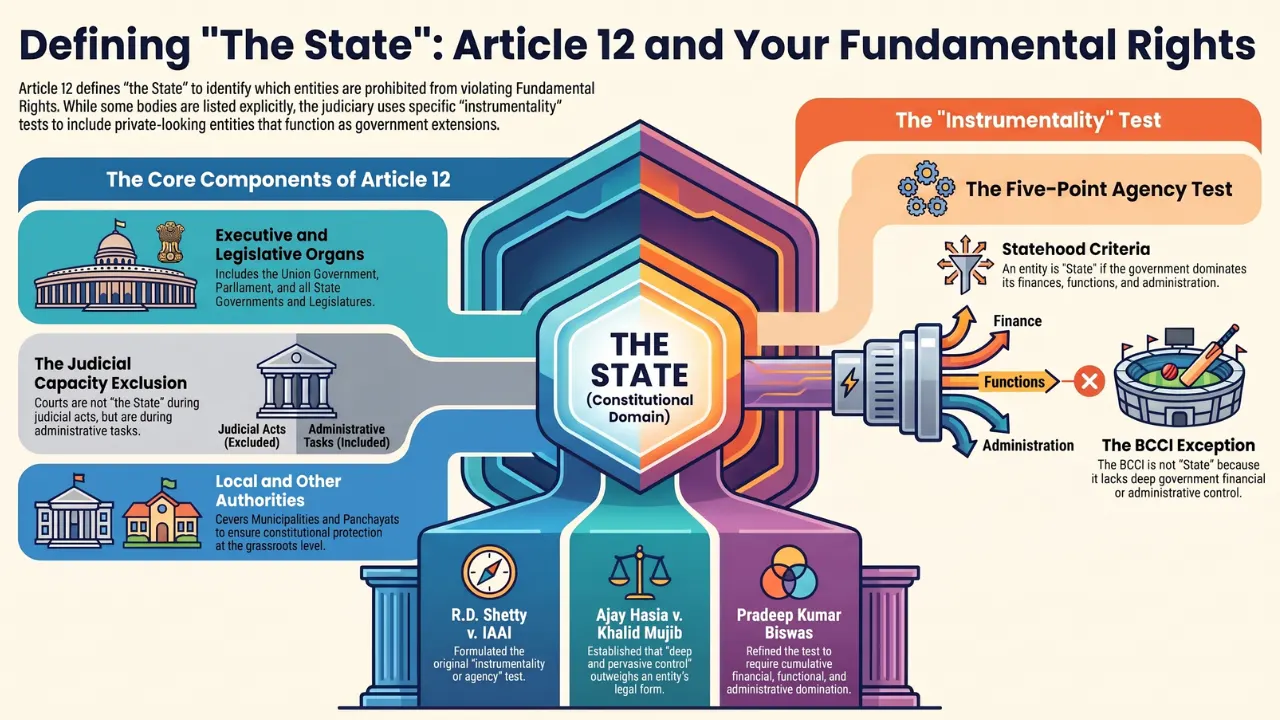
📌 Definition of State (Article 12): Quick Summary & Study Notes
Explores Article 12 and the evolution of judicial interpretations defining what constitutes the 'State' under the Indian Constitution.
- Article 12 Scope: Defines the State explicitly for Part III, including executive and legislative organs but intentionally omitting purely judicial functions.
- Instrumentality Test: Established in the R.D. Shetty case to determine if seemingly private bodies with deep government control qualify as the State.
- Local Authorities: Includes democratically elected bodies with distinct legal statuses operating in specific geographic areas to enforce grassroots compliance.
Laws Inconsistent with Rights (Article 13)
Examines Article 13 and the legal doctrines utilized by courts to manage conflicts between legislation and Fundamental Rights.
- Doctrine of Severability: Allows courts to surgically remove only the unconstitutional parts of a law while preserving the rest of the statute.
- Doctrine of Eclipse: Renders pre-constitutional laws dormant if they violate Fundamental Rights, with potential for revival upon constitutional amendment.
- Doctrine of Waiver: Prohibits citizens from voluntarily relinquishing their Fundamental Rights, protecting vulnerable populations from state exploitation.
Features of Fundamental Rights
Analyzes the scope, exclusive privileges, enforceability, and constitutional limitations of Fundamental Rights in India.
- Citizenship Distinction: Certain rights (Articles 15, 16, 19, 29, 30) are exclusive to Indian citizens, while others like Article 21 apply universally to all persons.
- Qualified Rights: Rights are not absolute and are subject to 'reasonable restrictions' imposed by the State to balance individual liberty with social order.
- Horizontal Application: Recent judgments extend the enforcement of certain rights (Articles 19 and 21) against private actors, not just state instrumentalities.
General Rights & Enforcement
Details the impact of National Emergencies on civil liberties and the writ jurisdictions available for the enforcement of rights.
- Emergency Suspensions: Article 358 automatically suspends Article 19 during external emergencies, while Article 359 requires a presidential order and covers broader rights.
- Immutable Rights: Following the 44th Amendment, Articles 20 and 21 can never be suspended, even during a declared National Emergency.
- Writ Jurisdictions: Article 32 allows direct Supreme Court access for Fundamental Rights, while Article 226 gives High Courts broader scope for 'any other purpose'.
📖 Definition of State (Article 12): Detailed Q&A
1. The Definition of State (Article 12)
Q.1) According to Article 12 of the Constitution of India, which of the following is NOT explicitly included in the definition of the 'State'?
Answer: The judiciary is intentionally omitted from Article 12's explicit text, meaning purely judicial functions do not fall under the 'State' definition.
Hide Explanation Hide All Explanations
- Explicit Constitutional Scope: Article 12 defines the term 'State' specifically for the application of Part III of the Constitution, which deals with Fundamental Rights. The text explicitly lists the executive and legislative organs of the Union and the States, meaning the Government and Parliament of India, and the Government and the Legislature of each State. This ensures that the primary law-making and law-enforcing bodies are strictly bound by constitutional limitations.
- The Status of the Judiciary: The judiciary is deliberately omitted from the explicit text of Article 12. Judicial interpretations have established that when courts perform purely judicial functions, they are not considered the 'State,' meaning their judicial orders cannot be challenged as a direct violation of Fundamental Rights. However, when courts engage in administrative tasks, such as conducting examinations or making appointments, they fall within the ambit of the State and must adhere to Part III provisions.
- The Role of Local Authorities: The definition purposefully incorporates 'all local or other authorities within the territory of India or under the control of the Government of India'. This mechanism guarantees that municipal corporations, panchayats, and district boards cannot arbitrarily infringe upon the fundamental rights of residents. The inclusion of local bodies democratizes the application of constitutional protections down to the grassroots level of governance.
Q.2) Which landmark Supreme Court case established the five-point 'instrumentality or agency' test to determine if a body falls under the definition of State?
Answer: The R.D. Shetty case introduced the instrumentality test to evaluate if seemingly private corporate bodies are extensions of the government apparatus.
Hide Explanation Hide All Explanations
- The Instrumentality Test Origin: The Supreme Court of India, in the landmark case of R.D. Shetty v. International Airport Authority of India, formulated specific guidelines to determine whether an entity qualifies as an 'other authority' or instrumentality of the State under Article 12. This test revolutionized constitutional jurisprudence by expanding the definition to include bodies that might appear entirely private in their corporate form but are essentially extensions of the government apparatus.
- Key Factors of the Test: The court laid down crucial evaluation factors, which include the extent of financial assistance provided by the State, the presence of deep and pervasive State administrative control, and whether the entity enjoys a State-conferred monopoly status. Additionally, the test evaluates whether the functions performed by the entity are of immense public importance and closely related to traditional governmental functions.
- Expanding the Protective Umbrella: The primary objective of developing this functional approach was to ensure that the government could not bypass its constitutional obligations by creating corporate bodies or agencies to perform its sovereign duties. By bringing these entities under the ambit of Article 12, the judiciary ensured that citizens could enforce their Fundamental Rights against a much wider and increasingly complex array of powerful public institutions.
Q.3) In the case of Ajay Hasia v. Khalid Mujib, the Supreme Court ruled that a registered society could be considered the 'State' primarily because of which factor?
Answer: The court focused on 'deep and pervasive governmental control' to rule that the society was a direct projection of the State.
Hide Explanation Hide All Explanations
- Background of the Dispute: The Ajay Hasia case involved a constitutional challenge against the admission process of the Regional Engineering College in Srinagar, which was administered by a society registered under the Jammu and Kashmir Societies Registration Act. The respondents argued that because the college was managed by a registered society, it was an autonomous private body and entirely outside the scope of Article 12.
- The Pervasive Control Principle: The Supreme Court scrutinized the structural and financial reality of the society, concluding that it was overwhelmingly dominated by the government. The composition of the society and its Board of Governors was controlled by state and central governments, proving that the society functioned merely as a direct projection of the State. The court emphasized that the financial dependency was so extensive that the government met almost the entire expenditure of the college.
- Substance Over Form: The judgment firmly reiterated that the legal form of the organization—whether it is a statutory corporation, a government company, or a registered society—is not the deciding factor. The court looked beyond the formal ownership cast in the corporate mold and focused on the reality of government presence, thereby solidifying the principle that 'deep and pervasive control' is the primary indicator of a State instrumentality.
Q.4) Which seven-judge bench decision refined the rules from the Ajay Hasia case, establishing that a body is a State only if it is financially, functionally, and administratively dominated by the Government?
Answer: The Pradeep Kumar Biswas case refined the instrumentality test, demanding a cumulative assessment of financial, functional, and administrative dominance.
Hide Explanation Hide All Explanations
- Evolution of Judicial Interpretation: The Pradeep Kumar Biswas case represents a critical refinement in the interpretation of Article 12. Decided by a seven-judge bench in 2002, the court sought to clarify the boundaries of the 'instrumentality' test that had been expanding rapidly since the earlier Ajay Hasia decision. The judiciary recognized the need to prevent every government-affiliated body from being automatically swept into the definition of the State.
- The Cumulative Facts Test: The Supreme Court established that merely being a registered society with some government links is insufficient for universal classification as a State entity. Instead, the court ruled that an entity qualifies as a State only if, based on the cumulative facts, it is financially, functionally, and administratively dominated by or under the absolute control of the Government.
- Pervasive and Particular Control: The judgment emphasized that this governmental control must not just be standard regulatory oversight; it must be particular to the body in question, and it must be pervasive. If these stringent conditions are met, the body qualifies as a State under Article 12, ensuring a more balanced, rigorous, and fact-specific assessment of government-affiliated organizations.
Q.5) According to the Supreme Court ruling in Zee Telefilms v. Union of India, why is the Board of Control for Cricket in India (BCCI) NOT considered a 'State' under Article 12?
Answer: The BCCI is not deemed a 'State' because it lacks substantial financial assistance and deep administrative control from the government.
Hide Explanation Hide All Explanations
- The Status of the BCCI: In the highly significant Zee Telefilms case, the Supreme Court was tasked with determining whether the powerful Board of Control for Cricket in India (BCCI) fell under the definition of State for the purpose of writ jurisdiction under Article 32. Despite its massive influence, the court concluded that the BCCI did not meet the necessary constitutional criteria to be classified as a State instrumentality.
- Lack of Deep Government Control: The court applied the established instrumentality tests and found that the BCCI is not created by a statute, nor does it receive substantial financial assistance from the public exchequer. Furthermore, it is not dominated by the government administratively or functionally. The court noted that even though cricket is a matter of immense public interest, this factor alone does not magically convert an autonomous private body into a State entity.
- Alternative Legal Remedies: While the BCCI is not considered a State under Article 12, the court acknowledged that it does perform certain public functions and holds a monopoly over the sport. Consequently, while a citizen cannot file a writ petition directly in the Supreme Court under Article 32 against the BCCI, they can still approach the High Courts under Article 226 for the enforcement of legal rights due to the public duties the board discharges.
Q.6) In Sukhdev Singh v. Bhagatram, the Supreme Court classified entities like the Life Insurance Corporation (LIC) and the Oil and Natural Gas Corporation (ONGC) as the State because they:
Answer: LIC and ONGC are classified as the State because they are statutory bodies tasked with essential public functions under significant government control.
Hide Explanation Hide All Explanations
- Recognition of Statutory Corporations: The Sukhdev Singh v. Bhagatram judgment was a pivotal moment in constitutional law that drastically broadened the scope of 'other authorities' under Article 12. The Supreme Court explicitly recognized major statutory corporations such as ONGC, LIC, and the Industrial Finance Corporation as falling squarely under the definition of the State.
- Performance of Public Duties: The primary rationale behind this classification was that these entities were created by specific statutes and were tasked with carrying out essential public functions on behalf of the government. They operated under significant government control, and their daily activities were closely aligned with the welfare and economic development goals of the sovereign State.
- Subject to Judicial Review: By bringing these large statutory corporations within the ambit of Article 12, the Supreme Court ensured that their administrative actions were strictly subject to judicial review. This meant that employees and citizens dealing with these corporations could directly enforce their Fundamental Rights, ensuring that these powerful bodies acted fairly, reasonably, and without arbitrary discrimination.
Q.7) Based on the Supreme Court's criteria established in cases like Mohammad Yasin v. Town Area Committee, which of the following is an essential characteristic for an entity to be classified as a 'local authority'?
Answer: A local authority must have a distinct legal corporate status and function autonomously within a specifically defined geographic boundary.
Hide Explanation Hide All Explanations
- Defining Local Authorities: Article 12 explicitly includes 'local authorities' within the definition of the State to ensure grassroots compliance with fundamental rights. To prevent ambiguity, the Supreme Court in cases like Mohammad Yasin laid down specific legal criteria to determine what legally constitutes a local authority for constitutional purposes.
- Key Functional Characteristics: The court ruled that for an entity to be categorized as a local authority, it must possess a distinct legal personality as a corporate body. Furthermore, it must function within a defined and specific geographic area, and it must enjoy a certain degree of operational autonomy, whether complete or partial, from the central or state government agencies.
- Democratic and Financial Elements: A true local authority typically features democratically elected representation from the residents of the area it governs. It is also uniquely characterized by the power to raise funds for the fulfillment of its objectives by levying taxes, rates, charges, or fees, which makes its functions parallel to those of a municipality or a public government body.
Q.8) How did early judicial interpretations, such as the Madras High Court in University of Madras v. Shanta Bai, initially interpret the phrase 'other authorities' in Article 12?
Answer: Early interpretations used the ejusdem generis doctrine, restricting 'other authorities' strictly to bodies carrying out sovereign or governmental functions.
Hide Explanation Hide All Explanations
- The Early Restrictive Approach: In the early years following the adoption of the Constitution, the courts took a very narrow, restrictive view of what constituted 'other authorities' under Article 12. In the University of Madras v. Shanta Bai case, the Madras High Court applied the principle of ejusdem generis, an established legal rule of statutory interpretation.
- The Doctrine of Ejusdem Generis: This doctrine dictates that general words following specific words should be interpreted to include only things of the same kind or class. Therefore, the court reasoned that since 'other authorities' followed specific government bodies in the text of Article 12, it must only encompass entities that carry out strict governmental or sovereign functions, leaving out educational institutions.
- Subsequent Rejection of the Doctrine: This restrictive interpretation excluded entities like independent universities from constitutional scrutiny. However, this approach was subsequently rejected by the Supreme Court in later cases, such as Ujjammabai v. State of UP, where it was held that the bodies listed in Article 12 do not share a common genus, thereby paving the way for a much broader interpretation of 'other authorities' in modern jurisprudence.
2. Laws Inconsistent with Fundamental Rights (Article 13)
Q.9) Under Article 13 of the Indian Constitution, what happens to pre-constitutional laws that are inconsistent with the provisions of Fundamental Rights?
Answer: Pre-constitutional laws become void exactly to the extent they are inconsistent with the Fundamental Rights guaranteed in Part III.
Hide Explanation Hide All Explanations
- The Mandate of Article 13(1): Article 13(1) specifically addresses 'laws in force' in the territory of India immediately before the commencement of the Constitution. It dictates that if these pre-constitutional colonial-era laws contradict the newly established Fundamental Rights in Part III, they do not survive in their original form.
- The Extent of Inconsistency: The Constitution deliberately uses the critical phrase 'to the extent of such inconsistency.' This legal language means that the offending law is not necessarily struck down as a whole. Only the specific portions or clauses of the old law that violate the Constitution are rendered void, allowing the harmonious survival of valid legal provisions.
- The Supremacy of Fundamental Rights: This provision serves as the primary constitutional bedrock of judicial review in India. It establishes the absolute supremacy of Fundamental Rights, ensuring that no legacy legislation could be utilized to oppress citizens or bypass the democratic guarantees promised by the newly formed republic. It places a definitive check on the continuation of arbitrary colonial laws.
Q.10) Which legal doctrine, derived from Article 13, allows courts to remove only the unconstitutional parts of a law while keeping the rest of the statute intact?
Answer: The Doctrine of Severability permits courts to surgically extract unconstitutional clauses while leaving the remainder of the statute functional.
Hide Explanation Hide All Explanations
- The Concept of Severability: The Doctrine of Severability, also known as the Doctrine of Separability, is a vital principle of constitutional interpretation designed to preserve the functionality of the legal system. It states that if a part of a statute is found to be unconstitutional, the court can surgically 'sever' or cut out the invalid portion, allowing the remaining valid portions to continue in full effect.
- Constitutional Basis: This doctrine is firmly rooted in the specific language of Article 13, which declares that laws inconsistent with Fundamental Rights are void 'to the extent of such inconsistency' or 'to the extent of the contravention'. It provides a mechanism for courts to strike down bad legal clauses rather than using a blunt instrument to destroy entire legislative acts.
- Preventing Unnecessary Invalidation: The primary goal of this doctrine is to respect the original intent of the legislature and avoid the unnecessary invalidation of complex statutes. It acts as a safeguard against excessive judicial overreach, ensuring that the legal system remains functional while still strictly protecting the fundamental rights of the citizens from state overreach.
Q.11) According to the rules of Severability laid down in the RMDC v. Union of India case, what must a court do if the valid and invalid provisions of a law are so intricately mixed up that they cannot be separated?
Answer: If valid and invalid sections are intrinsically inseparable, the court is forced to declare the entire legislative act invalid.
Hide Explanation Hide All Explanations
- The Rule of Inseparability: In the landmark R.M.D. Chamarbaugwalla (RMDC) v. Union of India judgment, the Supreme Court laid down clear boundaries for when a law can and cannot be saved by severability. A primary rule is that if the lawful (valid) and unconstitutional (invalid) provisions are so intricately intertwined that separating them is practically impossible, the whole statute must fall.
- The Failure of the Legislative Scheme: The court reasoned that if the valid and invalid parts form a single overarching legislative scheme intended to operate as a cohesive whole, removing one piece causes the entire framework to collapse. Trying to enforce a broken framework would contradict the original intent and purpose of the law designed by the legislature.
- Avoiding Judicial Legislation: Furthermore, if enforcing the remaining valid sections requires substantial modifications, adjustments, or the wholesale rewriting of clauses by the judge, the court must declare the entire statute void. To do otherwise would mean the court is actively writing laws, which violates the separation of powers and amounts to unconstitutional 'judicial legislation' rather than judicial review.
Q.12) Which doctrine applies primarily to pre-constitutional laws, rendering them inactive or dormant (rather than dead) when they violate Fundamental Rights, with the possibility of revival if the constitutional conflict is removed?
Answer: The Doctrine of Eclipse overshadows non-compliant pre-constitutional laws, making them dormant but capable of revival if the constitutional barrier is later removed.
Hide Explanation Hide All Explanations
- The Concept of the Eclipse: The Doctrine of Eclipse posits that a pre-constitutional law that violates a Fundamental Right is not completely nullified or dead ab initio. Instead, it is overshadowed or 'eclipsed' by the Fundamental Right, rendering it dormant and unenforceable as long as the constitutional conflict continues to exist.
- Applicability and Scope: This doctrine is primarily applied to pre-constitutional laws under Article 13(1). Because these laws were perfectly valid when they were made prior to 1950, the subsequent adoption of the Constitution does not wipe them out of the statute books entirely; it merely blocks their operation against citizens by casting a shadow over them.
- The Possibility of Revival: The unique feature of the Doctrine of Eclipse is the genuine possibility of legal revival. If a subsequent constitutional amendment removes the conflict or modifies the Fundamental Right in question, the constitutional shadow is lifted. The previously dormant law automatically becomes active and enforceable again without needing to be re-enacted by the legislature.
Q.13) What does Article 13(2) of the Indian Constitution explicitly prohibit the State from doing?
Answer: Article 13(2) acts as a negative injunction forbidding the State from creating any new post-constitutional legislation that diminishes Fundamental Rights.
Hide Explanation Hide All Explanations
- The Negative Injunction on the State: Article 13(2) serves as a direct, negative injunction against the State. It explicitly states that 'The State shall not make any law which takes away or abridges the rights conferred by this Part'. This ensures that the legislature cannot use its law-making powers to erode the fundamental liberties guaranteed to the people.
- Post-Constitutional Laws: While Article 13(1) deals with legacy pre-constitutional laws, Article 13(2) deals with post-constitutional laws. It acts as a permanent constitutional barrier, ensuring that any future legislation passed by the Parliament or State Legislatures strictly adheres to the boundaries set by Fundamental Rights.
- Consequence of Contravention: The clause further dictates that any law made in contravention of this mandate shall, to the extent of the contravention, be void. This provides the judiciary with the unequivocal authority to strike down any new legislative act or executive order that attempts to diminish the core civil liberties of the citizenry.
Q.14) Article 13 states that laws violating Fundamental Rights are void. However, Article 13(4) provides an exception. What does this exception relate to?
Answer: Article 13(4) clarifies that constitutional amendments made under Article 368 are not considered ordinary 'laws' subject to immediate invalidation under Article 13.
Hide Explanation Hide All Explanations
- The Addition of Clause (4): Article 13(4) was added to the Constitution to explicitly state that nothing in Article 13 applies to any amendment of the Constitution made under Article 368. This clause was introduced following immense judicial and political conflict regarding the Parliament's fundamental power to amend Part III of the Constitution.
- Shielding Amendments from Article 13: The primary purpose of this exception was to ensure that a Constitutional Amendment is not considered a regular 'law' under the strict definition of Article 13. If constitutional amendments were treated as ordinary laws, any amendment that altered or abridged a Fundamental Right would automatically be declared void by the courts, severely limiting parliamentary sovereignty.
- The Basic Structure Limitation: While Article 13(4) protects constitutional amendments from being struck down merely for being inconsistent with Part III, this amending power is not absolute. The Supreme Court eventually ruled that while Parliament can amend any part of the Constitution, including Fundamental Rights, it cannot destroy or alter the 'Basic Structure' of the Constitution, providing an ultimate safeguard against parliamentary overreach.
Q.15) What does the 'Doctrine of Waiver' refer to in the context of constitutional law?
Answer: The Doctrine of Waiver is the legal concept where an individual voluntarily and knowingly relinquishes their own legal right or privilege.
Hide Explanation Hide All Explanations
- Defining Waiver: In legal terminology, the Doctrine of Waiver refers to a situation where a person, with full knowledge and intent, voluntarily relinquishes or abandons a known legal right, claim, or privilege. It is a common concept in private law and contractual disputes.
- The Consequence of Waiver: Generally, under contract or civil law, when a person waives a right, they are 'estopped' or legally prevented from later turning around and claiming that right. They cannot challenge an action or a law if they have previously agreed to benefit from it or voluntarily accepted its terms without objection.
- Constitutional Context: While waiver is common in ordinary legal disputes, its application to constitutional guarantees is highly controversial. In India, the central question surrounding this doctrine is whether an individual can legally consent to the State violating their Fundamental Rights, effectively relieving the government of its constitutional obligations and overriding the document's supremacy.
Q.16) In the landmark case of Basheshar Nath v. CIT, what did the Supreme Court definitively rule regarding the waiver of Article 14 (Equality before Law) in India?
Answer: The Court ruled that Fundamental Rights like Article 14 cannot be waived by citizens because they are strict public policy commands directed at the State.
Hide Explanation Hide All Explanations
- The Dispute and Settlement: The Basheshar Nath case involved a citizen who had agreed to a tax settlement with the Income Tax Commission under a specific law. Later, the procedure under that law was declared unconstitutional for violating the right to equality. The government argued that since the citizen had voluntarily accepted the settlement, he had waived his fundamental right to challenge the unconstitutional procedure.
- The Nature of Article 14: Chief Justice S.R. Das analyzed the specific text of Article 14, noting that it is worded as a strict injunction: 'The State shall not deny to any person equality before the law...'. It is a mandatory command directed squarely at the State, rather than merely a personal benefit conferred upon the citizen. Because it is founded on sound public policy for the benefit of the entire society, an individual cannot relieve the State of this obligation.
- Protection Against Exploitation: The justices decisively rejected the application of the US waiver doctrine. They noted India's unique socio-economic realities, observing that a large portion of the population is vulnerable, economically disadvantaged, and unaware of their rights. Allowing the waiver of Fundamental Rights would allow the State to exploit this vulnerability, coercing citizens into signing away their protections under the guise of 'voluntary consent'.
3. Features of Fundamental Rights
Q.17) Which of the following groups of Fundamental Rights are available ONLY to citizens of India, and NOT to foreigners?
Answer: Rights under Articles 15, 16, 19, 29, and 30 represent core political and social privileges exclusively reserved for Indian citizens.
Hide Explanation Hide All Explanations
- Rights Exclusive to Citizens: The Indian Constitution makes a deliberate and careful distinction between citizens and non-citizens. The rights guaranteed under Articles 15, 16, 19, 29, and 30 are exclusively reserved for citizens of India. Foreign nationals residing in, working in, or visiting India cannot claim legal protection under these specific articles.
- Nature of the Exclusive Rights: These exclusive rights relate to core political, economic, and social privileges within the nation. They include protection against discrimination on specific grounds like race or caste (Art 15), equality of opportunity in public employment (Art 16), the six fundamental freedoms including speech and movement (Art 19), and cultural and educational rights for minorities (Art 29 and 30).
- Rationale Behind the Distinction: The rationale for this exclusion is that civil and political rights, such as the right to work in government offices, or speak freely to influence democratic processes, are privileges inherently tied to national sovereignty and citizenship. Granting these specific freedoms universally to non-citizens could compromise national security, public order, and the socio-economic framework designed specifically for Indian nationals.
Q.18) Which Fundamental Right is available to all persons, whether they are citizens of India or foreigners?
Answer: Article 21 is an inclusive human right available to 'all persons,' guaranteeing the absolute protection of life and personal liberty.
Hide Explanation Hide All Explanations
- Universal Human Rights: While certain rights are reserved exclusively for citizens, the Constitution guarantees a robust set of fundamental rights to 'all persons' within the territory of India. This inclusive terminology encompasses foreigners, tourists, corporate entities (where applicable), and stateless individuals. The most prominent among these is Article 21, which guarantees the absolute protection of life and personal liberty.
- Scope of Universal Rights: Other rights available to all persons include equality before the law (Article 14), protection in respect of conviction for offenses (Article 20), right to education (Article 21A), protection against arbitrary arrest and detention (Article 22), and protection against exploitation like human trafficking (Articles 23 and 24). It also includes the fundamental freedom of religion (Articles 25 to 28).
- Adherence to International Norms: By granting these specific rights universally, the Indian Constitution closely aligns with universal human rights principles and international law. It ensures that the basic dignity, physical safety, and spiritual freedom of every human being on Indian soil are protected from arbitrary state action, regardless of their nationality, background, or passport status.
Q.19) In the 2023 judgment of Kaushal Kishor v. State of UP, the Supreme Court held that the Fundamental Rights under Articles 19 and 21 can be enforced against which entities?
Answer: The Kaushal Kishor judgment marked a shift by affirming that rights under Articles 19 and 21 have horizontal application against private individuals.
Hide Explanation Hide All Explanations
- The Traditional Vertical Approach: Traditionally, Indian constitutional law has maintained that Fundamental Rights have a 'vertical' effect, meaning they are primarily enforceable by citizens exclusively against the State and its instrumentalities to prevent government oppression. Violations of rights by private individuals were typically dealt with under ordinary civil or criminal laws, not constitutional writ petitions.
- The Shift to Horizontal Application: The Kaushal Kishor judgment marked a monumental departure from this traditional binary understanding. The Constitutional Bench held in a 4:1 majority decision that the rights under Article 19 (freedom of speech) and Article 21 (right to life and liberty) bear a 'horizontal' effect. This signifies that they can be theoretically enforced against private individuals and non-state actors in specific contexts.
- The Affirmative Duty of the State: The court reasoned that with science, technology, and powerful private corporations intruding into all spheres of daily life, non-state actors are highly capable of violating privacy, dignity, and personal liberty to the same extent as the State. Consequently, the State has an affirmative, positive duty to protect citizens' rights from infringement by powerful private parties, vastly broadening the scope of constitutional accountability.
Q.20) In the same Kaushal Kishor case, what did the Supreme Court rule regarding the addition of new restrictions on the right to freedom of speech (Article 19(1)(a)) to protect another person's right to dignity (Article 21)?
Answer: The Supreme Court declined to invent new grounds for censorship, ruling that the restrictions specified in Article 19(2) are completely exhaustive.
Hide Explanation Hide All Explanations
- The Conflict of Fundamental Rights: The case arose when a public functionary made highly derogatory remarks about victims of a severe crime. The victims argued that the functionary's freedom of speech under Article 19(1)(a) should be legally restricted in order to protect their own fundamental right to dignity and life under Article 21. This presented a direct conflict between two distinct fundamental rights.
- The Exhaustive Nature of Article 19(2): The Supreme Court ruled that while freedom of speech is not absolute, it can only be curtailed based on the specific, defined grounds explicitly listed in Article 19(2) of the Constitution (such as public order, decency, or defamation). The majority held definitively that this constitutional list of restrictions is exhaustive.
- Refusal to 'Balance' by Creating New Grounds: The court concluded that it cannot invent new grounds for restricting speech outside of what the Constitution explicitly allows. Therefore, under the guise of invoking another fundamental right like Article 21, the court cannot impose additional restrictions on the freedom of speech not already found in the text of Article 19(2), protecting free speech from backdoor censorship.
Q.21) Which of the following statements best describes the nature of Fundamental Rights in the Indian Constitution?
Answer: Fundamental Rights are 'qualified', allowing the State to impose reasonable restrictions to ensure a functioning and balanced society.
Hide Explanation Hide All Explanations
- Rejection of Absolute Freedoms: Fundamental Rights in the Indian Constitution are not absolute, unlike the initial interpretation of rights in some other jurisdictions. The constitutional framers recognized that granting unbridled liberties without any limitations would lead to social chaos and conflict, ultimately hindering the establishment of a functional welfare state.
- The Concept of Reasonable Restrictions: To balance individual liberty with necessary social control, the Constitution expressly allows the State to impose 'reasonable restrictions' on the exercise of these rights. For instance, the freedom of speech can be restricted in the interest of the sovereignty and integrity of India, security of the State, or public order. These built-in caveats ensure that individual rights do not supersede national stability.
- Judicial Scrutiny of Restrictions: However, the State cannot impose arbitrary or excessive limitations. The judiciary plays a critical, continuous role in evaluating whether a restriction imposed by the government is truly 'reasonable' and whether it strikes a fair balance between the rights of the individual and the greater public interest. If a restriction is found to be disproportionate, the courts will strike it down.
Q.22) Fundamental Rights are generally classified into negative and positive rights. What is the primary function of a 'negative' fundamental right?
Answer: A 'negative' right restrains governmental authority, forbidding the State from taking arbitrary actions that encroach upon individual liberties.
Hide Explanation Hide All Explanations
- Understanding Negative Rights: In constitutional jurisprudence, a 'negative' right is one that restrains or limits the authority of the State. It creates a boundary that the government is forbidden to cross. The majority of the Fundamental Rights in Part III of the Indian Constitution, such as Article 14 (Equality) and Article 21 (Right to Life), are phrased as negative injunctions against the State.
- Functioning as a Shield: These rights function as a protective shield for the individual. For example, Article 14 states that 'The State shall not deny...' and Article 20 dictates that 'No person shall be convicted...'. These provisions do not require the State to spend money or proactively build infrastructure; rather, they require the State to simply abstain from acting arbitrarily or discriminatorily against individuals.
- Contrast with Positive Rights: In contrast, positive rights compel the State to take affirmative action to ensure the well-being of its citizens. An example in Part III is Article 21A, which mandates the State to provide free and compulsory education. While negative rights limit state overreach, positive rights require state intervention and resources to actualize the constitutional promise of a welfare society.
Q.23) The feature of 'Justiciability' of Fundamental Rights implies that:
Answer: Justiciability means Fundamental Rights are legally enforceable, enabling citizens to demand immediate judicial remedies against state violations.
Hide Explanation Hide All Explanations
- The Essence of Justiciability: The most defining feature of Fundamental Rights is their justiciability. This means that they are not mere declarations of intent, empty promises, or moral guidelines. They are legally enforceable rights. If a citizen believes their fundamental rights have been infringed upon by the State, they have a guaranteed constitutional avenue to seek redressal.
- The Role of Constitutional Courts: The Constitution establishes the Supreme Court (under Article 32) and the High Courts (under Article 226) as the primary guarantors of these rights. These courts are empowered to issue prerogative writs—such as Habeas Corpus, Mandamus, Prohibition, Quo Warranto, and Certiorari—to immediately halt state overreach and restore the rights of the aggrieved party.
- Distinction from Directive Principles: This feature sharply distinguishes Fundamental Rights (Part III) from the Directive Principles of State Policy (Part IV). While Directive Principles are fundamental in the governance of the country and act as policy goals, they are explicitly non-justiciable. A citizen cannot take the government to court for failing to implement a Directive Principle, whereas they can immediately sue the government for violating a Fundamental Right.
Q.24) Which judicial doctrine ensures that while the Parliament can amend Fundamental Rights, it cannot alter the fundamental nature or core identity of the Constitution?
Answer: Established in the Kesavananda Bharati case, the Basic Structure Doctrine prevents the Parliament from using amendments to destroy the Constitution's core framework.
Hide Explanation Hide All Explanations
- The Amendment Controversy: The amendability of Fundamental Rights was a subject of intense legal and political battle between the Indian Parliament and the Supreme Court for decades. The Parliament argued it had unlimited power to amend any part of the Constitution under Article 368, while the judiciary sought to protect Part III from being eroded by transient political majorities.
- The Kesavananda Bharati Compromise: The conflict was ultimately resolved in the historic 1973 Kesavananda Bharati case. The Supreme Court established the 'Basic Structure Doctrine,' a sophisticated judicial compromise. It ruled that while the Parliament has broad powers to amend the Constitution, including the Fundamental Rights, it does not have the power to destroy or alter the Constitution's 'basic structure' or foundational framework.
- Protecting the Core Identity: This doctrine ensures that the core identity of the Constitution—which includes features like democracy, secularism, judicial review, and the essence of fundamental rights—remains intact. It acts as the ultimate safeguard against authoritarianism, ensuring that the Parliament cannot use its amendment power to strip away the democratic character of the Republic.
4. General Fundamental Rights & Enforcement
Q.25) According to Article 358 of the Constitution, what happens to the six Fundamental Rights under Article 19 when a Proclamation of National Emergency is made on the grounds of war or external aggression?
Answer: Under Article 358, a declaration of emergency due to external aggression instantly and automatically suspends all freedoms under Article 19.
Hide Explanation Hide All Explanations
- Automatic Trigger Mechanism: Article 358 provides a unique, automatic mechanism regarding the suspension of rights during crises. The moment a National Emergency is proclaimed under Article 352 specifically on the grounds of war or external aggression, the six freedoms guaranteed under Article 19 are instantly and automatically suspended.
- No Need for Executive Orders: Unlike other constitutional suspensions, Article 358 does not require the President to issue a separate executive order or seek parliamentary approval to suspend these specific rights. The Constitution itself dictates that the restrictions imposed by Article 19 on State action cease to operate, granting the government unrestricted legislative and executive authority to tackle the existential external threat.
- Complete Duration of the Emergency: The suspension under Article 358 lasts for the entire duration of the National Emergency. Once the emergency is officially lifted or ceases to operate, the rights under Article 19 are automatically revived, and any emergency laws inconsistent with Article 19 become prospectively inoperative, though actions taken during the emergency remain legally protected.
Q.26) How does the suspension of rights under Article 359 differ conceptually from Article 358?
Answer: Article 359 does not suspend the substantive right itself; instead, it requires a specific Presidential Order to suspend the legal remedy to enforce it.
Hide Explanation Hide All Explanations
- Suspension of Remedy, Not Right: The core conceptual difference is that Article 359 does not wipe away or formally suspend the substantive Fundamental Rights themselves. Instead, it suspends the citizen's right to move any court for the enforcement of the specific rights identified in a Presidential Order. The rights theoretically survive, but the remedy is blocked.
- The Requirement of a Presidential Order: Unlike Article 358, which acts automatically on Article 19, Article 359 requires a deliberate and separate executive step. The President must issue a specific executive order clearly identifying which Fundamental Rights are having their enforcement suspended, and this order can apply to a much broader range of rights in Part III.
- Shutting the Courthouse Doors: Under Article 359, the courthouse doors are temporarily shut for the duration specified in the order. This leaves citizens without legal recourse if the State violates those specific rights during the emergency. The suspension can apply to the entire country or a specific part of it, offering a more tailored approach to crisis management than Article 358.
Q.27) Following the 44th Amendment Act of 1978, which two Fundamental Rights can NEVER be suspended during a National Emergency, not even under an Article 359 Presidential Order?
Answer: The 44th Amendment established that the core human rights of life, personal liberty (Art 21), and protection against arbitrary conviction (Art 20) are immune to suspension.
Hide Explanation Hide All Explanations
- The Dark Hour Context: During the 1975 internal emergency, the Supreme Court notoriously held in the Habeas Corpus case that even the right to life could be suspended by presidential order, leaving citizens with absolutely no judicial remedy against arbitrary detention or state violence. This alarming precedent highlighted a severe vulnerability in the constitutional framework.
- The 44th Amendment Safeguard: To prevent such authoritarian abuses from ever happening again, the 44th Constitutional Amendment Act of 1978 introduced a rigid, unbreakable floor to the suspension powers. It explicitly restricted the scope of Article 359, stating that the President cannot suspend the right to move a court for the enforcement of Articles 20 and 21.
- The Core of Human Rights: Article 20 guarantees vital protections against arbitrary conviction (such as double jeopardy or retrospective criminal laws), while Article 21 guarantees the fundamental right to life and personal liberty. By making these rights completely immune to suspension, the Constitution ensures that even in the darkest national crisis, the State cannot switch off the most basic human right to exist and be free from arbitrary execution or detention.
Q.28) Regarding the grounds for declaring an emergency, what is a key difference in applicability between Article 358 and Article 359?
Answer: Article 358's automatic suspension only triggers during external emergencies, whereas Article 359 can be invoked during both external threats and internal armed rebellions.
Hide Explanation Hide All Explanations
- The External Focus of Article 358: The 44th Amendment significantly restricted the operation of Article 358. It currently dictates that the automatic suspension of the six freedoms under Article 19 occurs only when a National Emergency is declared strictly on the grounds of war or external aggression. It completely shields Article 19 from automatic suspension if the emergency is declared due to an internal armed rebellion.
- The Broader Scope of Article 359: In stark contrast, Article 359 maintains a broader operational scope regarding the type of emergency. The President can issue an order suspending the enforcement of specific rights (except Articles 20 and 21) in cases of both external emergencies and internal emergencies caused by armed rebellion.
- Protecting Civil Liberties: This distinction is a crucial constitutional safeguard. It ensures that an internal crisis (armed rebellion) cannot be used by the government as a convenient pretext to automatically strip away the fundamental democratic freedoms of speech, assembly, and movement across the entire nation under Article 358. The government must specifically justify suspending enforcement under Article 359 during internal crises.
Q.29) When comparing the writ jurisdiction of the Supreme Court (Article 32) and the High Courts (Article 226), which statement is correct?
Answer: High Courts under Article 226 have broader functional jurisdiction since they can issue writs for both Fundamental Rights and 'any other purpose.'
Hide Explanation Hide All Explanations
- The Supreme Court's Jurisdiction (Article 32): Article 32 is a Fundamental Right in itself, often described by Dr. B.R. Ambedkar as the heart and soul of the Constitution. It empowers citizens to move directly to the Supreme Court for constitutional remedies. However, its scope is strictly limited; it can only be invoked for the enforcement of Fundamental Rights listed in Part III.
- The High Courts' Jurisdiction (Article 226): In contrast, the writ jurisdiction of the High Courts under Article 226 is significantly broader in its application. High Courts are empowered to issue prerogative writs not only for the enforcement of Fundamental Rights but also for 'any other purpose'.
- Enforcement of Ordinary Legal Rights: This crucial phrase 'any other purpose' allows citizens to approach High Courts to enforce ordinary legal rights, challenge administrative actions, or seek remedies against arbitrary decisions that may not directly violate a Fundamental Right. Therefore, while the Supreme Court is the ultimate guardian of Fundamental Rights, the High Courts offer a much wider range of legal remedies for administrative injustices.
Q.30) Why is Article 32 itself considered a Fundamental Right, and what are its implications for the Indian legal system?
Answer: Article 32 elevates the actual enforcement mechanism to a Fundamental Right, guaranteeing undeniable direct access to the Supreme Court for remedies.
Hide Explanation Hide All Explanations
- The Right to a Remedy: The framers of the Indian Constitution astutely recognized that declaring a list of fundamental rights is meaningless if there is no effective machinery to enforce them. A right without a remedy is merely a theoretical declaration. By incorporating Article 32 into Part III, the Constitution guarantees the right to move the Supreme Court by appropriate proceedings for the enforcement of rights.
- Direct Access to the Highest Court: The implication of making Article 32 a Fundamental Right is that a citizen does not need to go through the lengthy, hierarchical appellate process of lower courts if their fundamental rights are violated. They have the constitutional privilege to directly knock on the doors of the Supreme Court, ensuring swift justice against state oppression.
- Shield Against Legislative Interference: Because Article 32 is a Fundamental Right, the Parliament cannot easily dilute or remove this jurisdiction through ordinary legislation. Furthermore, the Supreme Court cannot refuse to entertain a writ petition if a clear violation of a fundamental right is established, as hearing the petition is part of its constitutional duty under Article 32. This solidifies the Supreme Court's role as the ultimate defender of civil liberties in India.