

Indian Polity Set 18: Section 1: Acquisition of Citizenship
Master the Citizenship Act, 1955: Test your knowledge on the acquisition, renunciation, and deprivation of Indian citizenship.
Constitutional Framework: Explore Articles 5–11 governing single nationality and parliamentary powers.
OCI Regulations: Understand Overseas Citizen of India eligibility, rights, and cancellation rules.
Exam Ready: Perfect for UPSC, PSC, and all Government Exams.
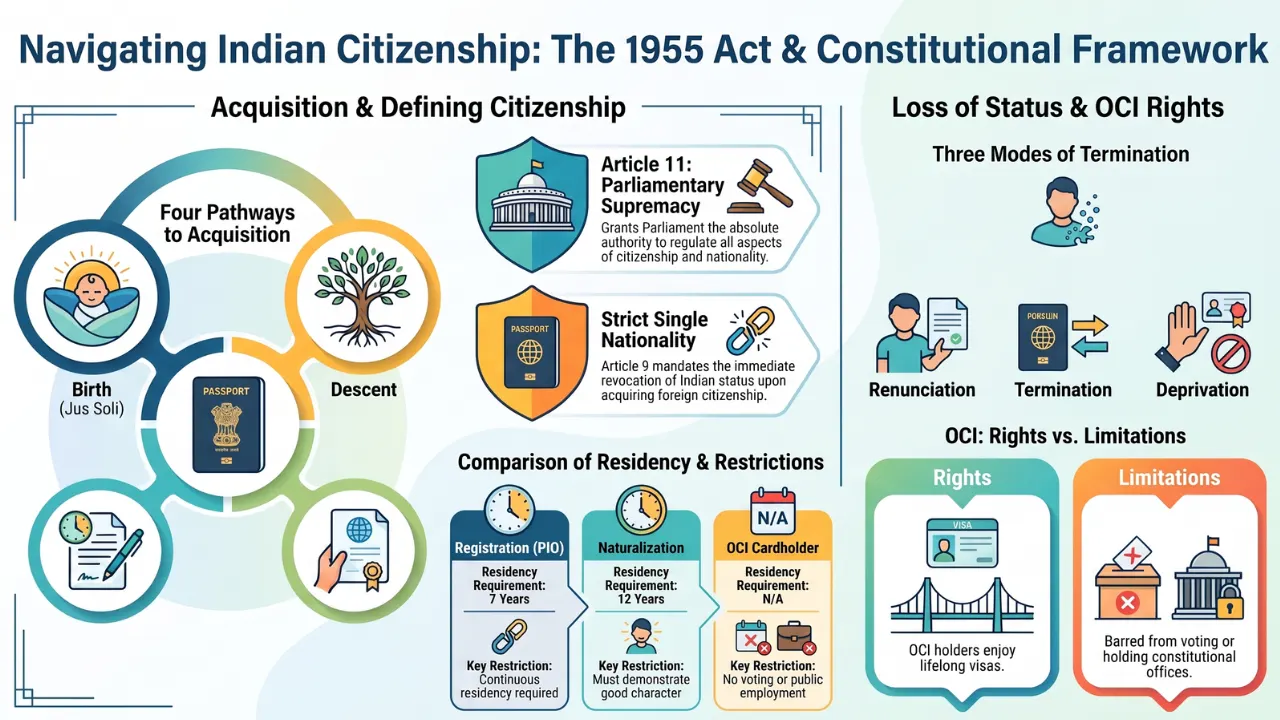
📌 Acquisition of Citizenship: Quick Summary & Study Notes
Explores the statutory mechanisms for acquiring Indian citizenship, including birth, descent, registration, and naturalization.
- Jus Soli (Birth): Citizenship granted to those born in India, with evolving restrictions based on parental status.
- Descent: Citizenship passed to children born abroad, updated in 1992 to ensure gender parity.
- Registration: Requires a strict seven-year continuous residency for Persons of Indian Origin (PIOs) and foreign spouses.
- Naturalization: A rigorous 12-year residency pathway for foreign nationals demonstrating good character.
Constitutional Foundations
Details the constitutional articles establishing initial citizenship and Parliament's plenary powers.
- Article 5: Established foundational citizenship based on permanent domicile and alternative conditions.
- Article 9: Enforces the strict rule of single nationality, revoking status upon acquiring foreign citizenship.
- Article 11: Grants Parliament supreme, unfettered authority to regulate all aspects of citizenship.
Termination and Deprivation
Outlines the legal mechanisms leading to the loss or punitive revocation of Indian citizenship.
- Renunciation: Voluntary surrender of citizenship by an adult, automatically impacting minor dependents.
- Automatic Termination: Instant loss of citizenship upon voluntary acquisition of a foreign passport.
- Deprivation: Government revocation of naturalized or registered citizenship due to fraud, prolonged absence, or serious crime.
Overseas Citizenship of India (OCI)
Defines the rights, limitations, and cancellation criteria for the OCI cardholder scheme.
- Eligibility: Open to foreign nationals with historical Indian ties and their foreign spouses.
- Statutory Rights: Grants a lifelong visa and economic parity with NRIs in specific sectors.
- Limitations: Explicitly denies voting rights, constitutional offices, and equality in public employment.
- Cancellation: Status can be revoked for fraud, disloyalty to the Constitution, or national security threats.
📖 Acquisition of Citizenship: Detailed Q&A
1. Acquisition of Citizenship
Q.1) Under Section 3 of the Citizenship Act, 1955, a person born in India between January 26, 1950, and July 1, 1987, acquires citizenship through which principle?
Answer: Between 1950 and 1987, India followed a strict jus soli principle, granting citizenship to anyone born in its territory regardless of their parents' nationality.
Hide Explanation Hide All Explanations
- The Foundational Principle of Jus Soli: Section 3 of the Citizenship Act governs the acquisition of citizenship by birth. In its original form, the law applied the principle of jus soli strictly. Any individual born within the territorial boundaries of India between January 26, 1950, and July 1, 1987, was automatically granted Indian citizenship, completely irrespective of the nationality or legal status of their parents. This broad, inclusive approach was designed to stabilize the population's legal status in the decades immediately following independence.
- Strategic Legislative Restrictions: Over time, the absolute birthright principle was viewed as a vulnerability that encouraged illegal immigration. To counter this, lawmakers amended the statute. For births occurring between July 1, 1987, and December 3, 2004, the law shifted toward jus sanguinis. It introduced a requirement that at least one parent must be a recognized citizen of India at the exact time of the child's birth for the child to acquire citizenship.
- Current Statutory Framework: For individuals born on or after December 3, 2004, the legal criteria became exceptionally stringent. A child now acquires Indian citizenship by birth only if both parents are Indian citizens, or if one parent is a citizen and the other is legally proven not to be an illegal migrant at the time of birth. This modern framework essentially eliminates the possibility of children of undocumented migrants claiming birthright citizenship.
Q.2) According to Section 4 of the Citizenship Act, 1955, a child born outside India on or after December 10, 1992, but before December 3, 2004, is considered an Indian citizen by descent if:
Answer: The 1992 amendment introduced gender parity, allowing citizenship to pass to a child born abroad if either the mother or father was an Indian citizen at the time of birth.
Hide Explanation Hide All Explanations
- Evolution Toward Gender Parity: Before 1992, Section 4 of the Citizenship Act contained a gender bias, allowing a child born outside India to acquire Indian citizenship by descent only if the father was an Indian citizen. The landmark 1992 amendment introduced necessary gender parity into the nationality laws. It permitted citizenship to be legally passed down if either the mother or the father was an Indian citizen at the time of the child's birth, reflecting broader constitutional commitments to equality.
- Introduction of the Registration Mandate: For children born outside India on or after December 3, 2004, citizenship by descent is no longer an automatic right. The updated law mandates that the birth must be formally registered at an Indian consulate within one year of its occurrence. This ensures that the Indian state can accurately track and document its citizens born in foreign jurisdictions.
- Prohibition of Dual Nationality: During the registration process for children born abroad after 2004, parents must adhere to strict documentary standards. They are required to submit a formal legal declaration stating that the minor child does not hold the passport of any other nation. This administrative requirement reinforces India's absolute constitutional prohibition against dual nationality from the moment of a child's birth.
Q.3) Under Section 5(1)(a) of the Citizenship Act, 1955, a Person of Indian Origin (PIO) must be an ordinary resident in India for what duration immediately before making an application for registration?
Answer: Persons of Indian Origin must meet a seven-year residency requirement before they are eligible to apply for Indian citizenship through registration.
Hide Explanation Hide All Explanations
- Statutory Residency Requirements: Section 5 of the Act provides the specific mechanism for individuals belonging to defined categories to acquire Indian citizenship through formal registration. For Persons of Indian Origin (PIOs), the law requires the applicant to be ordinarily resident in India for a total of seven years before formally applying. This ensures that the individual has developed substantial socio-economic ties to the country.
- Precise Calculation of the Residency Period: The seven-year residency period is strictly defined by immigration authorities and cannot be accumulated randomly. The applicant must have resided continuously in India for twelve months immediately preceding the date of application. Furthermore, they must have lived in India for an aggregate of six years during the eight years prior to that continuous twelve-month period.
- Legal Definition of Indian Origin: To qualify under this specific category, the applicant must meet the statutory definition of a Person of Indian Origin. The law deems an individual to be of Indian origin if they, or either of their parents, were born in undivided India as defined in the Government of India Act, 1935, or in any territory that became a part of India after August 15, 1947.
Q.4) An adult foreign national married to a citizen of India can acquire Indian citizenship through registration under Section 5(1)(c) provided they have been ordinarily resident in India for:
Answer: A foreign spouse of an Indian citizen must be ordinarily resident in India for seven years to be eligible for citizenship by registration.
Hide Explanation Hide All Explanations
- Integration of Foreign Spouses: Section 5(1)(c) facilitates the legal integration of foreign nationals who marry Indian citizens. This vital provision allows spouses to apply for citizenship by registration, which is generally a more streamlined process than the lengthier naturalization route, provided they meet all specific statutory and residency criteria.
- Rigorous Residency Prerequisite: Similar to the requirement for Persons of Indian Origin, a foreign spouse must ordinarily reside in India for seven years before applying for citizenship. This extensive waiting period acts as a safeguard against fraudulent marriages contracted solely for immigration benefits, ensuring the applicant has genuinely established their life within the Indian jurisdiction.
- Evidentiary and Documentary Standards: When submitting the application via the online citizenship module, the applicant is subject to strict evidentiary standards. They must produce a valid foreign passport, a valid residential permit, the official marriage certificate, and conclusive proof of their spouse's Indian nationality, such as a passport or a birth certificate.
Q.5) What is the primary residency requirement for a foreign national to acquire Indian citizenship by naturalization under Section 6 of the Citizenship Act, 1955?
Answer: Foreign nationals seeking citizenship via naturalization must fulfill a strict 12-year residency requirement in India.
Hide Explanation Hide All Explanations
- General Eligibility for Foreign Nationals: Section 6 of the Citizenship Act establishes the pathway for any foreign national who is not an illegal migrant to acquire Indian citizenship through the complex process of naturalization. This legal route is typically utilized by individuals who do not possess Indian ancestry and do not have a qualifying marriage to an Indian citizen.
- Breakdown of the Extended Residency Period: The applicant must fulfill a stringent 12-year residency requirement before their application can be considered. This timeline mandates continuous residence in India, or service in the Government of India, for the 12 months immediately preceding the application, coupled with an aggregate of 11 years residing in India over the 14 years prior to that 12-month period.
- Additional Qualifications for Integration: Beyond mere physical residency, the applicant must satisfy all qualitative qualifications outlined in the Third Schedule of the Act. This includes possessing a certified good moral character, demonstrating adequate knowledge of at least one language specified in the Eighth Schedule of the Constitution, and formally renouncing their previous foreign nationality.
2. Special Provisions & Assam Accord
Q.6) Which section of the Citizenship Act, 1955 grants the Central Government the power to specify the individuals who shall become citizens when a foreign territory becomes part of India?
Answer: Section 7 provides the Central Government exclusive authority to confer citizenship when India acquires new geographical territories.
Hide Explanation Hide All Explanations
- Sovereign Expansion and Legal Integration: Section 7 of the Citizenship Act dictates the legal process for conferring citizenship when the Republic of India acquires new geographical territories. This crucial provision ensures that the inhabitants of newly integrated regions are not left stateless, allowing them to be formally recognized as legal citizens of India.
- Exclusive Executive Authority: The statute grants the Central Government the exclusive and discretionary executive authority to issue official orders regarding the new territory. The government has the power to specify exactly which individuals connected to the newly incorporated territory will be granted Indian citizenship and the exact date from which this citizenship takes effect.
- Historical Precedents and Application: A prominent historical example of the application of Section 7 occurred when territories such as Puducherry, Goa, Daman, and Diu were successfully integrated into the Indian Union. Following the incorporation of these regions, the government enacted specific citizenship orders to smoothly formalize the nationality status of the local populations.
Q.7) According to Section 6A of the Citizenship Act, 1955 (related to the Assam Accord), immigrants of Indian origin who entered Assam from Bangladesh before which date are automatically recognized as Indian citizens?
Answer: Under Section 6A, individuals of Indian origin who migrated to Assam before January 1, 1966, are automatically deemed Indian citizens.
Hide Explanation Hide All Explanations
- Legislative Implementation of the Accord: Section 6A was strategically inserted into the Citizenship Act to provide a binding legislative framework for the Assam Accord of 1985. This section was specifically drafted to address the unique, sensitive, and complex socio-political issues arising from undocumented migration into the northeastern state of Assam from neighboring Bangladesh.
- Categorization Based on Entry Dates: The legal provision creates distinct categories based on the exact date of a migrant's entry into the country. Individuals of Indian origin who migrated to Assam before January 1, 1966, and have been ordinarily resident in the state since their arrival, are automatically deemed full citizens of India, regularizing their historical presence.
- Significance of the 1971 Cut-off Date: Immigrants who entered Assam between January 1, 1966, and March 25, 1971, face a different process. They must register with the government, and upon detection as foreigners, they enjoy all citizenship rights except voting rights for ten years, after which full citizenship is granted. The Supreme Court of India recently upheld the constitutional validity of this March 25, 1971 cut-off date.
3. Constitutional Foundations
Q.8) Under Article 5 of the Constitution of India, which of the following is NOT a valid condition for acquiring citizenship at the commencement of the Constitution?
Answer: Registration at an Indian consulate within one year was not a condition under Article 5; the core requirement was having an Indian domicile combined with birth or five years of residency.
Hide Explanation Hide All Explanations
- Foundational Domicile Requirement: Article 5 established the primary constitutional framework for determining citizenship when the Republic was born on January 26, 1950. The absolute foundational prerequisite for anyone seeking citizenship under this article was that the individual must have established a permanent domicile within the territory of India.
- Alternative Conditions for Inclusion: In addition to proving a permanent domicile, an individual had to fulfill one of three specific alternative conditions. They must have been born in India, either of their parents must have been born in India, or they must have been ordinarily residing in the country for a continuous period of at least five years immediately preceding the commencement of the Constitution.
- Purpose of the Constitutional Provision: This foundational constitutional provision was deliberately designed to provide a broad and inclusive legal safety net. It ensured that all permanent residents who viewed India as their true home following the turmoil of independence and partition were immediately granted legal status and civil rights.
Q.9) Which constitutional provision explicitly grants the Parliament of India the plenary power to regulate the acquisition and termination of citizenship by law?
Answer: Article 11 serves as a saving clause granting Parliament full legislative authority to regulate citizenship acquisition and termination.
Hide Explanation Hide All Explanations
- Delegation of Legislative Authority: Article 11 serves as a highly critical saving clause within Part II of the Indian Constitution. It explicitly clarifies that the preceding articles (Articles 5 through 10) do not in any way restrict the power of the Parliament to make future, comprehensive laws concerning nationality and legal status.
- Plenary Scope of Parliamentary Power: This constitutional mandate grants Parliament supreme, unfettered, and exclusive authority to draft detailed legislation regarding both the acquisition and the termination of citizenship. It also empowers Parliament to regulate any other complex matters connected to the legal status of individuals residing within the state.
- Foundation of the Citizenship Act: It was exclusively through the exercise of the sweeping powers granted by Article 11 that the Indian Parliament enacted the Citizenship Act, 1955. This monumental piece of legislation successfully transitioned India from a temporary, transitional constitutional framework to a permanent, detailed statutory code governing nationality.
Q.10) Which Article of the Indian Constitution enshrines the principle that a person who voluntarily acquires the citizenship of a foreign State shall not be a citizen of India?
Answer: Article 9 forms the bedrock of India's single citizenship policy, stripping citizenship from anyone who voluntarily acquires a foreign nationality.
Hide Explanation Hide All Explanations
- The Rule of Single Nationality: Article 9 of the Constitution lays the permanent bedrock for India's strict single-citizenship policy. It definitively declares that any person who voluntarily acquires the citizenship of a foreign state immediately and irrevocably loses the right to be recognized as an Indian citizen under Articles 5, 6, or 8.
- Triggers for Voluntary Acquisition: The termination of Indian citizenship under this constitutional provision is triggered specifically by the 'voluntary' acquisition of a foreign nationality. This standard ensures that the legal bond of loyalty to the Indian state remains absolutely undivided and prevents individuals from holding competing sovereign allegiances.
- Modern Statutory Enforcement: The rigid constitutional mandate of Article 9 is seamlessly operationalized in modern legal practice through Section 9 of the Citizenship Act, 1955. This statutory provision enforces the automatic termination of Indian status the exact moment a citizen formally acquires a foreign passport or nationality.
Q.11) In the context of the Indian legal framework, which of the following statements regarding citizenship and domicile is accurate?
Answer: The Indian Constitution establishes a strictly unitary system, recognizing only a single national citizenship and a single national domicile.
Hide Explanation Hide All Explanations
- Unitary Structure of Nationality: Unlike several federal systems around the world, such as the United States or Switzerland, where individuals possess both national and state-level citizenship, the Indian Constitution established a strictly unitary system. It mandates a single national citizenship for the entire country, rejecting any concept of provincial citizenship.
- The Legal Concept of Domicile: Judicial interpretation by the Supreme Court of India has consistently upheld that there is only one domicile in the country—the domicile of India. State boundaries exist purely for administrative and political convenience, and merely residing in a particular state does not create a separate, legally recognized provincial domicile.
- Ensuring Equality Before the Law: This unitary framework was deliberately chosen by the framers of the Constitution to foster a unified, cohesive national identity. It prevents regional fragmentation and guarantees that the fundamental rights of citizens are uniformly protected and applied regardless of their specific state of residence.
4. Termination and Deprivation
Q.12) Under Section 8 of the Citizenship Act, 1955, who is eligible to make a formal declaration to renounce their Indian citizenship?
Answer: Under Section 8, the legal mechanism for voluntary renunciation requires the applicant to be an Indian citizen of full age and capacity.
Hide Explanation Hide All Explanations
- Criteria for Legal Capacity: Section 8 of the Citizenship Act provides the legal mechanism for the voluntary renunciation of Indian citizenship. To execute this serious legal process, the individual making the declaration must be an Indian citizen of 'full age and capacity,' which legally refers to a sound-minded adult aged 18 or above.
- Formal Administrative Procedure: The renunciation process is highly formalized and tightly controlled. An applicant must submit an online declaration (Form XXII) through the Ministry of Home Affairs portal, physically surrender their Indian passport to an official consulate or embassy, and have the declaration officially verified and registered.
- Immediate Cessation of Legal Status: Upon the successful formal registration of the renunciation declaration by the Central Government, the legal transformation is instantaneous. The individual immediately ceases to be a citizen of India, permanently stripping them of all associated constitutional rights, privileges, and sovereign duties.
Q.13) According to Section 8(2) of the Citizenship Act, 1955, what is the immediate legal consequence for a minor child when a parent renounces their Indian citizenship?
Answer: When a parent formally renounces their citizenship, Section 8(2) triggers an automatic, derivative loss of Indian citizenship for all their minor children.
Hide Explanation Hide All Explanations
- Derivative Loss of Nationality: The Indian legal framework generally treats the nationality of minor children as derivative of their parents' status. Under Section 8(2), if a person ceases to be a citizen of India due to formal renunciation, every minor child of that person automatically loses their Indian citizenship simultaneously, by operation of law.
- Provisions Preventing Statelessness: While the law strips the minor of their Indian citizenship, it is typically applied in scenarios where the parent is actively acquiring or already possesses another nationality. This effectively extends the new foreign nationality to the child, thereby preventing the dangerous legal condition of international statelessness.
- Exceptions Based on Parental Custody: There are specific administrative interpretations protecting the minor's citizenship in complex family scenarios. If only one parent renounces Indian citizenship while the other remains an Indian citizen, the child does not automatically lose their Indian nationality, particularly if legal custody belongs to the Indian parent.
Q.14) A minor child who loses Indian citizenship due to a parent's renunciation under Section 8(2) can reclaim their citizenship by making a declaration:
Answer: A minor who loses citizenship due to parental renunciation has a strict one-year window after turning 18 to submit a declaration to reclaim it.
Hide Explanation Hide All Explanations
- Statutory Right of Resumption: The Citizenship Act acknowledges that a minor child does not possess the legal capacity to consent to the profound loss of their nationality. Therefore, the proviso to Section 8(2) grants the affected individual an absolute, statutory right to reclaim their Indian citizenship once they reach adulthood and gain legal capacity.
- The Strict One-Year Window: To exercise this powerful right of resumption, the individual must submit a formal declaration in the prescribed manner indicating their wish to resume Indian citizenship. Crucially, this declaration must strictly be made within one year after attaining full age, creating a narrow window between their 18th and 19th birthdays.
- Full Restoration of Constitutional Rights: Upon the successful registration of this declaration, the individual's status as a full Indian citizen is completely restored, granting them all constitutional rights. However, they must simultaneously surrender any foreign passports they possess to comply with the nation's strict single citizenship laws.
Q.15) Under Section 9 of the Citizenship Act, 1955, the automatic termination of Indian citizenship upon acquiring a foreign nationality does NOT apply in which of the following circumstances?
Answer: Automatic termination does not apply if foreign nationality is acquired during a war in which India is engaged, unless directed otherwise by the government.
Hide Explanation Hide All Explanations
- Mechanism of Automatic Termination: Section 9 of the Citizenship Act strictly enforces the constitutional prohibition on dual nationality. It dictates that if an Indian citizen voluntarily acquires the citizenship of another country through naturalization or registration, their Indian citizenship is automatically and instantly terminated without the need for formal renunciation.
- The Wartime Exception Clause: The statute thoughtfully includes a specific caveat related to national security. The automatic termination rule does not apply if a citizen acquires foreign nationality during a war in which India is actively engaged. In such volatile scenarios, termination is held in abeyance until the Central Government expressly directs otherwise.
- Mandatory Surrender of Documents: Even though termination under Section 9 is automatic by pure operation of law, the individual's legal obligations do not end there. Under the Passports Act, the individual is legally bound to formally surrender their Indian passport to the nearest Indian embassy or consulate and obtain an official 'Surrender Certificate'.
Q.16) Under Section 10 of the Citizenship Act, 1955, the Central Government has the power to deprive a person of Indian citizenship if their registration or naturalization was obtained by:
Answer: Section 10 empowers the government to deprive individuals of their naturalized or registered citizenship if it was procured through fraud or false representation.
Hide Explanation Hide All Explanations
- Targeted Scope of Deprivation: Section 10 of the Act outlines the highly punitive process of depriving an individual of their citizenship. It is crucial to note that this severe deprivation generally applies only to those who acquired citizenship through the mechanisms of registration or naturalization, not to natural-born citizens.
- Invalidation of Fraudulent Acquisition: The Central Government holds the executive authority to issue an official order revoking citizenship if it is fully satisfied that the certificate of naturalization or registration was procured through deceit. This includes false representation, the submission of forged documents, or the deliberate concealment of material facts during the application.
- Adherence to Principles of Natural Justice: Before issuing a deprivation order based on fraud, the government is statutorily required to adhere to principles of natural justice. It must serve a written notice to the individual, informing them of the specific grounds for the proposed action and granting them a reasonable opportunity to be heard or refer the case to a committee.
Q.17) According to Section 10 of the Citizenship Act, 1955, a naturalized citizen can be deprived of their citizenship if they are sentenced to imprisonment for a term of not less than two years within what period after naturalization?
Answer: A naturalized or registered citizen can be stripped of their citizenship if sentenced to a minimum two-year prison term within the first five years of acquiring it.
Hide Explanation Hide All Explanations
- The Standard of Good Character: The foundation of granting citizenship by naturalization includes a rigorous assessment of the applicant's good character and law-abiding nature. To ensure that this high standard is maintained post-acquisition, Section 10 provides explicit grounds for the revocation of citizenship based on subsequent criminal behavior.
- The Critical Five-Year Threshold: If an individual who acquired citizenship by registration or naturalization is sentenced in any country to a prison term of two years or more, within exactly five years of acquiring their Indian citizenship, the Central Government holds the immediate right to terminate their nationality.
- Protection of the Public Interest: This punitive provision acts as a vital safeguard for national security and public order. It ensures that individuals who quickly resort to serious criminal activities after being graciously welcomed into the Indian state are swiftly stripped of their privileges and reverted to alien status.
Q.18) Under Section 10 of the Citizenship Act, 1955, deprivation of citizenship can occur if a registered or naturalized citizen has been ordinarily resident out of India for a continuous period of:
Answer: Living outside India for a continuous period of seven years without specific exemptions or annual consulate registration can lead to deprivation of citizenship.
Hide Explanation Hide All Explanations
- Loss of Tangible Connection: Section 10 addresses cases where a naturalized or registered citizen effectively abandons their physical and social connection to India. The Central Government may unilaterally deprive an individual of citizenship if they choose to reside outside the country for a continuous, uninterrupted period of seven years.
- Statutory Exemptions for Service: The law provides specific, logical exemptions to prevent unfair deprivation of individuals serving the nation's interests. The seven-year rule does not apply if the individual was studying at an educational institution abroad, serving in a foreign government position on behalf of India, or working for an international organization of which India is a member.
- The Annual Registration Alternative: Citizens residing abroad for extended periods for personal reasons can also proactively protect their citizenship status from this clause. They are permitted to register annually in the prescribed manner at a local Indian consulate, indicating their explicit, documented intention to retain their Indian citizenship.
5. Overseas Citizenship of India
Q.19) As per Section 7A of the Citizenship Act, 1955, which of the following individuals is eligible for registration as an Overseas Citizen of India (OCI) Cardholder?
Answer: Foreign nationals who were citizens of India on or after January 26, 1950, are generally eligible to apply for OCI status under Section 7A.
Hide Explanation Hide All Explanations
- Mechanism for Diaspora Reintegration: Section 7A establishes the core eligibility criteria for the highly popular Overseas Citizen of India (OCI) scheme. The primary legislative objective is to grant long-term visa privileges and robust economic rights to the Indian diaspora who were forced to relinquish their Indian passports upon acquiring foreign nationality.
- Historical Citizenship Connection: A foreign national is broadly eligible to apply for an OCI card if they have a demonstrable historical connection to the state. Specifically, they qualify if they were a citizen of India at the time of, or at any time after, the commencement of the Constitution on January 26, 1950, or if they were eligible to become a citizen on that exact date.
- Strict Exclusion Policies for Specific Nations: The statutory framework explicitly prohibits certain geopolitical demographics from acquiring OCI status. Individuals who are or have ever been citizens of Pakistan or Bangladesh (or other specific countries designated by the Central Government) are permanently barred from OCI registration to mitigate ongoing national security risks.
Q.20) Under Section 7A, a spouse of foreign origin married to an Indian citizen or an OCI cardholder is eligible for OCI registration provided the marriage has been registered and subsisted for a continuous period of at least:
Answer: A foreign spouse becomes eligible for OCI registration only after their marriage to an Indian citizen or OCI cardholder has subsisted for at least two continuous years.
Hide Explanation Hide All Explanations
- Extension to Immediate Family Members: Section 7A(1)(d) intelligently broadens the scope of the OCI program to include individuals who lack direct Indian ancestry but have deeply integrated into Indian families. A spouse of foreign origin married to an Indian citizen, or married to an existing OCI cardholder, is fully eligible to register for OCI status.
- The Duration of Marriage Prerequisite: To prevent the proliferation of fraudulent marriages contracted solely for the purpose of gaining immigration benefits, the law establishes a firm timeline. It mandates that the marriage must be legally registered and must have subsisted for a continuous, uninterrupted period of at least two years immediately preceding the application.
- Mandatory Security Clearances: Prior to approving an OCI application based entirely on marriage, the Central Government exercises extreme caution. Authorities typically conduct stringent background checks and security clearances to ensure the foreign spouse poses no underlying threat to national security or the general public interest.
Q.21) Which Section of the Citizenship Act, 1955 explicitly deals with the conferment of rights upon an Overseas Citizen of India (OCI) Cardholder?
Answer: Section 7B outlines the specific statutory rights, such as lifelong visas and economic parity with NRIs, granted to OCI cardholders.
Hide Explanation Hide All Explanations
- Statutory Source of Privileges: Section 7B is the critical statutory provision that dictates the precise scope of rights enjoyed by an OCI cardholder. Unlike full citizens whose fundamental rights are immutably guaranteed by the Constitution, OCI rights are entirely statutory and are defined exclusively by notifications issued by the Central Government.
- Essential Travel and Residency Benefits: The most significant and widely utilized right conferred under Section 7B is the grant of a multi-purpose, multiple-entry, lifelong visa to visit India. This removes the substantial administrative burden of applying for standard tourist or business visas, facilitating seamless and frequent travel for the global diaspora.
- Economic and Educational Parity: Through executive orders issued under this specific section, OCI cardholders are granted vital parity with Non-Resident Indians (NRIs) in specific domestic sectors. This includes equal footing in economic, financial, and educational fields, allowing them to pursue specialized professions and invest heavily in non-agricultural real estate.
Q.22) According to Section 7B(2) of the Citizenship Act, 1955, an OCI cardholder is explicitly denied the right to:
Answer: Section 7B(2) restricts OCI cardholders from claiming equality in matters of public employment guaranteed to Indian citizens under Article 16.
Hide Explanation Hide All Explanations
- Exclusion from Sovereign Functions: While Section 7B gracefully grants extensive economic privileges, subsection (2) explicitly curtails political and constitutional rights. OCI cardholders are structurally and permanently barred from claiming equality of opportunity in public employment as guaranteed to sovereign Indian citizens under Article 16 of the Constitution.
- Electoral Disenfranchisement: To maintain the exclusivity and integrity of the democratic process, OCI cardholders cannot legally register as voters under the Representation of the People Act, 1950. Consequently, they are entirely ineligible to cast a ballot in any local, state, or national elections within the Republic.
- Complete Legislative Ineligibility: Furthermore, the statute aggressively bars OCI cardholders from standing for any form of public or legislative office. They cannot be elected as members of the House of the People (Lok Sabha), the Council of States (Rajya Sabha), or any State Legislative Assembly or Legislative Council.
Q.23) An OCI cardholder is NOT entitled to be appointed to which of the following constitutional positions under Section 7B(2) of the Citizenship Act, 1955?
Answer: OCI cardholders are statutorily barred from occupying high constitutional offices, including appointments as Judges of the Supreme Court or High Court.
Hide Explanation Hide All Explanations
- Protection of the Independent Judiciary: Section 7B(2) expressly forbids individuals holding an OCI card from occupying high constitutional offices. This ensures that individuals presiding over sensitive matters of national sovereignty hold absolute, undivided loyalty to the Indian state. This includes a strict prohibition against appointment as a Judge of the Supreme Court or a High Court.
- Ineligibility for the Highest Executive Offices: The constitutional restrictions logically extend to the highest executive offices in the land. An OCI cardholder is constitutionally and statutorily barred from standing for election as the President of India (Article 58) or the Vice-President of India (Article 66), reserving these roles exclusively for full citizens.
- Restrictions on General Public Services: Beyond the highest constitutional posts, OCI cardholders are generally ineligible for appointment to routine public services and posts in connection with the affairs of the Union or any State. Appointments are only permitted if the Central Government issues a specific, special order allowing it for highly specialized technical roles.
Q.24) What is the legal mechanism provided under Section 7C of the Citizenship Act, 1955 for an individual to voluntarily give up their OCI status?
Answer: Under Section 7C, an OCI cardholder can voluntarily relinquish their status by making a prescribed declaration of renunciation to the Central Government.
Hide Explanation Hide All Explanations
- Right to Voluntary Relinquishment: Section 7C establishes the formal legal procedure for an Overseas Citizen of India to voluntarily surrender their special status. Any OCI cardholder of full age and capacity has the absolute statutory right to initiate this process by making a prescribed legal declaration of renunciation.
- Requirement of Central Government Registration: The renunciation of this status is not legally effective upon the mere drafting or mailing of the declaration. The document must be submitted to and formally registered by the Central Government. The complete cessation of all OCI rights and privileges occurs precisely upon this administrative registration.
- Reversion to Standard Foreigner Status: Once the renunciation is finalized and registered, the individual immediately loses their highly coveted lifelong visa privileges and economic parity with NRIs. They revert fully to the status of a standard foreign national and must strictly abide by regular visa regulations to enter or remain in India.
Q.25) According to Section 7C(2) of the Citizenship Act, 1955, what happens to the spouse and minor children when a person renounces their Overseas Citizen of India (OCI) card?
Answer: Section 7C(2) specifies that when a primary cardholder renounces their OCI status, their spouse and minor children automatically lose their status as well.
Hide Explanation Hide All Explanations
- Automatic Cessation for Foreign Spouses: Section 7C(2) explicitly dictates the derivative consequences of renunciation. When an individual renounces their Overseas Citizen of India status, the spouse of foreign origin who initially obtained the OCI card solely based on that specific marital relationship will also automatically lose their registration.
- Derivative Impact on Minor Children: The legal framework extends this derivative loss of status directly to the primary cardholder's dependent offspring. Every minor child of the person who renounces their OCI card will simultaneously cease to be an Overseas Citizen of India, reflecting the wholly dependent nature of their initial registration.
- Administrative Finality of the Declaration: Once the primary cardholder submits the renunciation declaration and it is formally registered by the Central Government, the cessation of status for both the primary holder and their dependents is absolutely instantaneous. This leaves the entire family unit subject to regular foreign national immigration controls.
Q.26) Section 7D of the Citizenship Act, 1955 empowers the Central Government to cancel an OCI registration if it was obtained through:
Answer: The Central Government can unilaterally cancel an OCI registration if it discovers the status was procured through fraud, false representation, or forged documents.
Hide Explanation Hide All Explanations
- Sovereign Executive Authority: Section 7D intelligently equips the Central Government with broad discretionary power to unilaterally cancel an OCI registration if the cardholder violates fundamental statutory conditions. This vital provision ensures that the state maintains strict, unyielding sovereign oversight over the generous privileges granted to the diaspora.
- Invalidation of Deceit and Forgery: The primary and most heavily utilized ground for cancellation is fraud. If immigration authorities discover that the OCI status was procured through false representation, the use of forged documents, or the deliberate concealment of material facts (such as a hidden criminal record), the registration is swiftly revoked.
- Procedural Fairness and Natural Justice: While the government holds immense power to cancel cards, administrative law dictates procedural fairness. Before an OCI card is canceled on the grounds of fraud, the individual is generally provided a reasonable, documented opportunity to be heard, ensuring that arbitrary executive action is subject to legal checks.
Q.27) Under Section 7D, an OCI registration can be canceled if the cardholder has shown themselves by act or speech to be:
Answer: An OCI card can be revoked if the holder demonstrates explicit disloyalty or 'disaffection' towards the Constitution of India.
Hide Explanation Hide All Explanations
- The Constitutional Loyalty Standard: Clause (b) of Section 7D allows for the immediate cancellation of OCI status if the cardholder demonstrates hostility, disloyalty, or explicit disaffection toward the Constitution of India as established by law. This requires OCI holders to maintain a baseline of respect for the state's foundational document.
- Distinguishing Legitimate Criticism from Disaffection: Legal jurisprudence surrounding this sensitive provision clarifies that mere criticism of government policy, political dissent, or journalistic commentary does not ordinarily amount to 'disaffection.' The legal threshold requires deliberate acts or speeches that actively threaten the foundational democratic framework or sovereign integrity of the state.
- Maintaining Sovereign Regulatory Control: This strict provision highlights a critical legal reality: the OCI scheme is a heavily regulated privilege, not an absolute constitutional right. The Indian government demands that those granted lifelong, unrestricted access to the country do not actively work to undermine its sovereign institutions.
Q.28) An OCI cardholder faces cancellation of their registration under Section 7D if, within five years of registration, they are sentenced to imprisonment for a term of not less than:
Answer: Engaging in serious criminal behavior resulting in a two-year prison sentence within the first five years of registration triggers immediate OCI cancellation.
Hide Explanation Hide All Explanations
- The Heightened Five-Year Scrutiny Period: The Central Government maintains a period of heightened scrutiny over all OCI cardholders during the first five years of their registration. Clause (d) of Section 7D mandates that engaging in serious criminal behavior during this probationary window is grounds for immediate cancellation of the card.
- The Specific Threshold of Criminality: To actively trigger this punitive clause, the cardholder must be formally sentenced by a court of law to a term of imprisonment of two years or more. Minor infractions, such as standard traffic violations or petty misdemeanors that do not result in substantial jail time, do not qualify as grounds for cancellation.
- Global Applicability of Criminal Convictions: The statute is designed to apply universally; the conviction and sentencing can occur in a court within India or in any foreign jurisdiction around the globe. This emphasizes the government's intent to bar serious, proven criminals from utilizing the OCI scheme's lifelong visa privileges to evade justice.
Q.29) Section 7D allows for the cancellation of OCI registration if it is deemed necessary in the interest of:
Answer: The government retains broad discretionary power to cancel OCI status to protect India's sovereignty, security, diplomatic relations, and public interest.
Hide Explanation Hide All Explanations
- Broad Executive Discretion: Clause (e) of Section 7D grants the Central Government wide discretionary latitude to revoke OCI status on macro-level security grounds. Cancellation is legally permitted if it is deemed absolutely necessary in the interest of the sovereignty and integrity of India, the security of the state, or the general public interest.
- Preservation of Friendly Diplomatic Relations: The clause also allows for the cancellation of status if an OCI cardholder's actions threaten India's diplomatic relationships and friendly relations with any foreign state. This functions as a critical legal safeguard against individuals utilizing Indian territory for international espionage or terrorism.
- Necessary Exceptions to Natural Justice: While most standard cancellations require providing the cardholder an opportunity to be heard, cases involving national security, sovereignty, or acute public interest allow the government to bypass this procedural safeguard. The state can enforce cancellation with immediate executive discretion to rapidly neutralize perceived threats.
Q.30) If an individual obtained an OCI card based on their marriage to an Indian citizen, Section 7D mandates the cancellation of that OCI registration if:
Answer: An OCI card granted solely on the basis of marriage must be canceled if the marriage is legally dissolved by a competent court.
Hide Explanation Hide All Explanations
- Dissolution of the Qualifying Relationship: For individuals whose sole legal eligibility for an OCI card was their marriage to an Indian citizen or an existing OCI cardholder, the continuous maintenance of that marital bond is critical. Clause (f) of Section 7D explicitly requires the cancellation of the OCI registration if the marriage is legally dissolved by a competent court.
- Violation of Strict Eligibility Norms: Furthermore, the registration will be summarily canceled if it is discovered by authorities that the marriage was not solemnized in good faith. If the marriage was contracted specifically in violation of legal eligibility norms—functioning essentially as a 'sham marriage' for immigration purposes—the OCI status is rendered void.
- Consequences of Subsequent Marriages: The statute also firmly stipulates that if the foreign spouse, during the subsistence of the qualifying marriage, legally solemnizes another marriage with a different person, the original OCI registration is subject to immediate cancellation. In such cases, the foundational criteria of the status have been irreparably breached.