

Indian Polity Set 13: The Concept of Sovereignty
Master the Preamble of the Indian Constitution with this comprehensive quiz.
Explore core ideals including Sovereignty, Socialism, Secularism, and Republic structures.
Test your knowledge on the 42nd Amendment, direct democracy devices, and landmark Supreme Court judgments.
Perfect for UPSC and competitive exam preparation to strengthen foundational constitutional concepts.
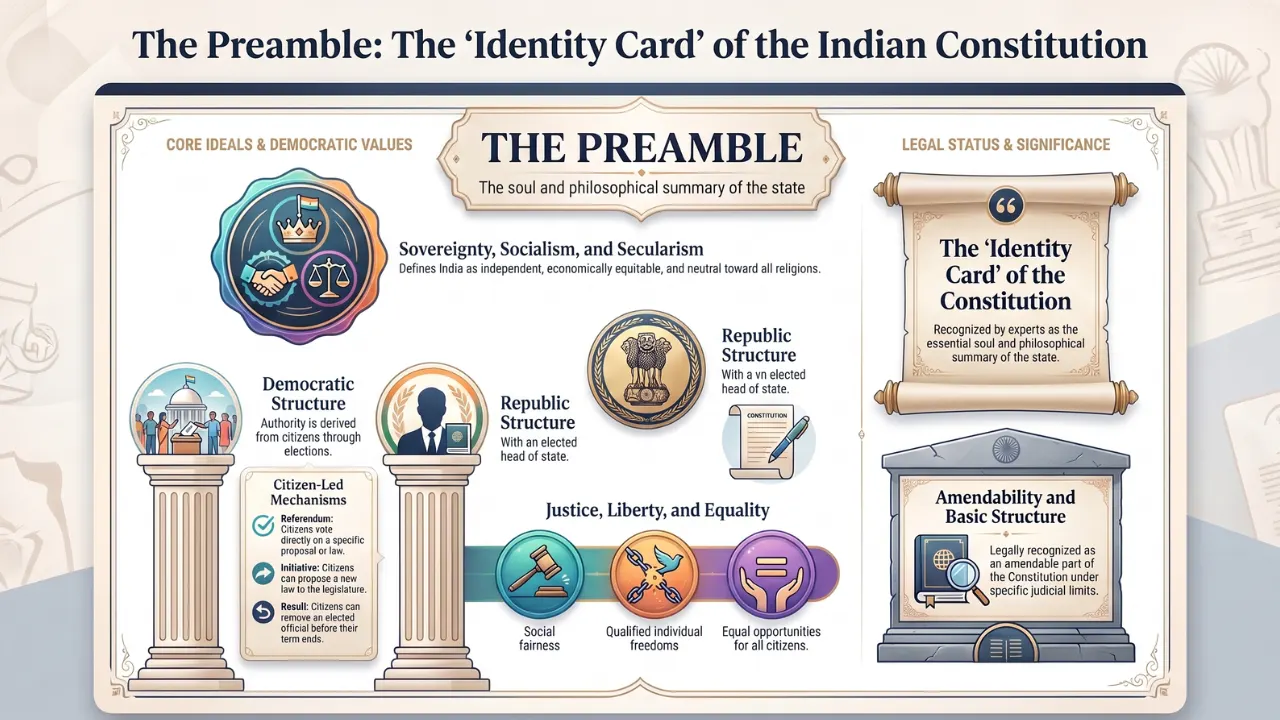
📌 Key Constitutional Ideals: Quick Summary & Study Notes
Core principles defining the Indian state such as sovereignty, socialism, and secularism.
- Sovereignty: Absolute internal and external independence from foreign powers.
- Socialism: Commitment to economic equality and welfare through a mixed economy.
- Secularism: Equal respect and state protection for all religions without a state religion.
Democratic & Republic Structure
The framework empowering citizens and establishing an elected government.
- Democracy: Government authority derived from citizens through representative elections.
- Republic: An elected head of state and complete absence of a privileged class.
- Direct Democracy: Citizen-led tools like referendum, initiative, recall, and plebiscite.
Justice, Liberty & Equality
The foundational rights and promises made to every Indian citizen.
- Justice: Ensuring social, economic, and political fairness across the nation.
- Liberty: Qualified freedom of thought, expression, belief, and worship.
- Equality: Guaranteeing equal status and opportunity for all without discrimination.
Significance & Legal Status
The philosophical importance and legal amendability of the Preamble.
- Identity Card: Described by experts as the guiding summary and soul of the Constitution.
- Legal Status: Officially recognized as an amendable part of the Constitution under basic structure limits.
📖 Key Constitutional Ideals: Detailed Q&A
Q.1) What does the term 'Sovereign' in the Preamble of the Indian Constitution primarily imply?
Answer: India possesses independent authority and is not subject to any external power.
Hide Explanation Hide All Explanations
- Independent National Authority: The term sovereign indicates that the nation is completely independent in its functioning and decision-making. It is not a dependency or a dominion of any other foreign nation, shedding its colonial past entirely. The government of the country has the supreme and ultimate power to formulate laws for its citizens without any outside interference or foreign pressure, which is a hallmark of a free nation.
- Internal and External Dimensions: Sovereignty is characterized by two distinct and critical dimensions: internal and external. Internal sovereignty dictates that the state holds supreme power over all individuals, groups, and organizations within its geographical borders, divided among the executive, legislature, and judiciary. External sovereignty means the nation is absolutely free from the control of any foreign state regarding its foreign policies and international relations.
- Authority Over Physical Territory: Because the nation is legally recognized as a sovereign state globally, it holds the recognized legal authority to interact with other nations on equal terms. It can legally acquire new foreign territory if necessary. Additionally, it can legally cede or transfer a portion of its own territory to a foreign state according to established constitutional procedures, showcasing ultimate state power.
Q.2) Which phrase in the Preamble demonstrates that the ultimate sovereignty in India rests with its citizens?
Answer: The phrase 'We, the people of India' shows that ultimate sovereignty rests with the citizens.
Hide Explanation Hide All Explanations
- Source of Constitutional Authority: The opening words 'We, the people of India' explicitly show that the Constitution draws its legal and moral authority directly from the citizens of the nation. It signifies that the ultimate power and sovereignty rest completely with the people of India, who have collectively designed and given this Constitution to themselves to govern their future.
- Concept of Popular Sovereignty: Popular sovereignty is a fundamental political system where the government is created by the people and exercises its authority entirely on their behalf. The political leaders and representatives remain in power only as long as they have the support, votes, and confidence of the general public. This ensures that the government is always a servant of the public will.
- Rejection of Monarchical Power: By officially stating that the people are the ultimate source of power, the document makes it undeniably clear that no external king, foreign power, or specific privileged group controls the country. The democratic foundation relies entirely on the collective will of the Indian citizens, permanently eliminating traditional monarchies and historical dictatorships from the Indian political landscape.
Q.3) During the Constituent Assembly debates, who proposed the amendment to describe India as a 'Secular, Federal, Socialist Union of States,' which was initially rejected?
Answer: K.T. Shah proposed the initial amendment to include 'Secular, Federal, Socialist' in the description of India.
Hide Explanation Hide All Explanations
- The Proposal by K.T. Shah: During the intense and highly detailed debates in the Constituent Assembly in November 1948, Professor K.T. Shah proposed an amendment to include the words 'Secular, Federal, Socialist' in the constitutional description of India. He strongly believed that including these specific words in the primary text would provide a clear idea of the governing ideals and social structure of the new nation.
- Dr. B.R. Ambedkar's Opposition: Dr. B.R. Ambedkar, the chief architect of the Constitution, strongly opposed this specific amendment during the initial drafting phase. He argued that the Constitution is merely a mechanism to regulate state organs, not to force a specific economic structure. He believed that the specific social or economic organization of the society should be decided by the people over time through elections, rather than being permanently locked into the Constitution's text.
- Eventual Rejection of the Amendment: Because of the powerful arguments presented by Dr. Ambedkar and other framers, the Constituent Assembly formally voted against K.T. Shah's proposal. The members decided to drop the words 'secular' and 'socialist' from the original Preamble adopted in 1949, preferring to let the Directive Principles of State Policy quietly guide the nation's social and economic goals instead of using explicit labels.
Q.4) Through which Constitutional Amendment Act was the word 'Socialist' added to the Preamble of the Indian Constitution?
Answer: The word 'Socialist' was added by the 42nd Amendment Act in 1976.
Hide Explanation Hide All Explanations
- The 42nd Amendment Act Context: The word 'Socialist' was absent from the original Preamble adopted by the Constituent Assembly in 1949. It was officially inserted into the Preamble by the 42nd Constitutional Amendment Act in the year 1976. This occurred during the period of National Emergency under Prime Minister Indira Gandhi, making it a highly significant but historically controversial addition.
- Explicit Mention of Implicit Ideals: Even before this specific word was formally added to the text, the Indian Constitution already contained deep socialist content and principles. These principles were woven heavily into the Directive Principles of State Policy, such as ensuring equitable distribution of resources. The 1976 amendment merely made explicit what was already implicitly present in the broader constitutional framework.
- Shift in Constitutional Description: With the successful passage of this massive amendment, the official description of the Indian nation changed significantly. The original elegant phrase 'Sovereign Democratic Republic' was legally expanded and transformed into a 'Sovereign Socialist Secular Democratic Republic.' This reflected a renewed political commitment to social welfare and a visible shift in the state's ideological stance.
Q.5) What type of socialism is primarily practiced and promoted by the Indian state?
Answer: The Indian state practices Democratic Socialism, functioning through a mixed economy model.
Hide Explanation Hide All Explanations
- Definition of Democratic Socialism: India strictly follows a model known as democratic socialism, which is very different from the communist or scientific socialism proposed by Karl Marx. Democratic socialism aims to achieve high social and economic equality through peaceful, evolutionary, and democratic methods rather than through violent revolution and the complete destruction of the capitalist class.
- The Mixed Economy Model: A defining feature of Indian democratic socialism is its heavy reliance on a 'mixed economy.' In this practical economic model, both the public sector (government-owned enterprises) and the private sector (privately owned businesses) safely coexist side by side. They work cooperatively to promote national development, generate wealth, and eradicate poverty.
- Rejection of Total State Control: Unlike communist countries like China or Cuba, where the government maintains strict and absolute control over all industries and centrally plans the entire economy, Indian socialism does not completely restrict private entrepreneurship. The Indian state acts primarily as a benevolent instrument of social welfare rather than an instrument of absolute economic control.
Q.6) In which landmark case did the Supreme Court declare that the basic framework of Indian socialism is to provide a 'decent standard of life to the working people'?
Answer: The Supreme Court interpreted Indian socialism as providing a decent standard of life to workers in the D.S. Nakara case.
Hide Explanation Hide All Explanations
- The Landmark Supreme Court Judgment: In the highly significant legal case of D.S. Nakara v. Union of India (1983), the Supreme Court of India provided a detailed and expansive legal interpretation of the newly added term 'Socialist'. The court clarified the specific economic, ethical, and social obligations that the Indian state must actively strive to fulfill for all its citizens.
- Focus on the Working Class: The Supreme Court distinctly observed that the basic framework of Indian socialism is purposefully designed to provide a decent and respectable standard of life to the working people. It aims to ensure that hard-working citizens are entirely free from economic exploitation and possess adequate means to support their families in dignity.
- Concept of Cradle to Grave Security: A major and widely celebrated highlight of this specific judicial interpretation was the introduction of providing social security to citizens from the 'cradle to the grave.' This legally implies that a socialist state is morally and constitutionally responsible for the health, welfare, and financial security of its people throughout their entire lifespan.
Q.7) Which of the following statements is true regarding the addition of the word 'Secular' to the Preamble?
Answer: The word 'Secular' was formally added to the Preamble by the 42nd Amendment Act in 1976.
Hide Explanation Hide All Explanations
- The 1976 Constitutional Amendment: Similar to the word 'Socialist', the term 'Secular' was notably missing from the original Preamble that was adopted by the framers in 1949. It was formally and explicitly inserted into the text by the 42nd Constitutional Amendment Act, which was enacted on December 18, 1976, during the National Emergency.
- Prior Existence in Fundamental Rights: Although the specific word 'Secular' was missing from the original Preamble text, the core concept of secularism was already deeply embedded in the Constitution. Articles 25 to 28 guarantee the fundamental right to freedom of religion, ensuring that the state remains neutral and protects all faiths long before the 1976 amendment.
- Placement in the Text: When the amendment was passed, the structural placement of the new words was carefully determined to ensure flow and significance. The words 'Socialist' and 'Secular' were inserted sequentially between the words 'Sovereign' and 'Democratic', fundamentally updating the primary identity of the Indian Republic to reflect contemporary political values.
Q.8) How is the Indian concept of Secularism distinctly defined compared to Western Secularism?
Answer: Indian secularism gives equal respect, protection, and support to all religions, unlike strict Western separation.
Hide Explanation Hide All Explanations
- Concept of Positive Secularism: The Indian concept of secularism is widely known as 'positive secularism' or Sarva Dharma Sambhava. Under this unique model, the state does not ignore religion but instead ensures that all religions present in India receive equal respect, protection, and active support from the government without bias.
- Contrast with Western Models: This framework is completely different from the negative secularism practiced in many Western countries (like France), where the state is strictly and rigidly divorced from all religious affairs. In India, the state maintains a principled distance but can constitutionally intervene in religious matters to promote vital social reforms and ensure civic equality.
- Absence of a State Religion: A crucial component of Indian secularism is that the country has absolutely no official state religion. Hinduism, Islam, Christianity, Sikhism, Buddhism, Jainism, and all other faiths share an equal legal status in the eyes of the law, and no preference or systemic discrimination is legally permitted by the state apparatus.
Q.9) In which landmark judgment did the Supreme Court declare that 'Secularism' is an integral part of the basic structure of the Constitution?
Answer: The Supreme Court declared secularism as part of the basic structure in the S.R. Bommai case.
Hide Explanation Hide All Explanations
- The S.R. Bommai Judgment: The case of S.R. Bommai v. Union of India (1994) is a highly celebrated and powerful landmark judgment in Indian legal history. Delivered by a massive nine-judge Constitution Bench, this verdict fundamentally reshaped the understanding of Centre-State relations, restricted the misuse of Article 356, and analyzed the core values of the Constitution.
- Declaration of Basic Structure: In this historic ruling, the Supreme Court unequivocally declared that secularism is a fundamental and absolutely non-negotiable part of the 'basic structure' of the Indian Constitution. This means that the secular character of the state cannot be altered, diluted, or destroyed, even by a constitutional amendment passed by Parliament.
- Neutrality of the State: The Court further clarified that Indian secularism requires strict religious neutrality from the state. It explicitly warned that religion cannot be used as a political instrument for mobilization. If a state government undermines secularism, it violates the Constitution, and such governments can be lawfully dismissed under Article 356.
Q.10) What is the fundamental implication of the term 'Democratic' as used in the Preamble?
Answer: The term implies that the government derives its supreme authority directly from the people's will through elections.
Hide Explanation Hide All Explanations
- Authority from the People: The term 'Democratic' implies that the Constitution of India has established a form of government that gets its supreme authority and absolute legitimacy directly from the will of the people. This collective will is expressed continuously through periodic, free, and fair elections at various levels of governance.
- Representative System: India practices a representative parliamentary democracy rather than a direct democracy. Because of its massive landmass and highly diverse population, it is impossible for all citizens to make laws directly. Instead, the people elect representatives to govern the country and make complex legislative decisions on their behalf.
- Universal Adult Franchise: Democracy in India is powerfully fueled by the principle of universal adult franchise, famously known as 'one person, one vote.' Every citizen of India who is 18 years of age or older, and is not otherwise legally debarred, has the fundamental democratic right to vote and choose their political leaders without discrimination.
Q.11) In a direct democracy, what is the device called where a proposed piece of legislation is referred directly to the electorate for settlement by their votes?
Answer: A referendum is a device where legislation is referred directly to the electorate for voting.
Hide Explanation Hide All Explanations
- Definition of Referendum: A referendum is a highly powerful primary device of direct democracy. It is a formal procedure where a proposed piece of legislation or a major policy decision is taken out of the hands of politicians and referred directly to the electorate. The citizens then vote directly to either accept or reject the proposal.
- Purpose and Political Application: This democratic tool allows the government to solve complex political or social issues by seeking the direct opinion of the voters. It completely bypasses the traditional legislative debate process in parliament, placing the final and ultimate decision-making power directly in the hands of the general public.
- Contrast with Indirect Democracy: In an indirect or representative democracy like India, elected officials vote on laws in Parliament. However, a referendum brings the legislative process back to the grassroots citizens. If a person is legally enrolled to vote in a country utilizing this system (like Switzerland), they can participate directly in lawmaking.
Q.12) Which device of direct democracy allows the people to actively propose a bill to the legislature for enactment?
Answer: An initiative allows citizens to independently propose new laws or policies directly to the legislature.
Hide Explanation Hide All Explanations
- Understanding the Initiative: An initiative is a unique, proactive, and citizen-led method used in direct democratic systems. By using this powerful tool, the common people can independently propose a brand new law, a bill, or even a sweeping constitutional amendment directly to the legislature for formal enactment.
- Mechanism of Action: Usually, this complex process requires a specific group of citizens to collect a predetermined number of valid signatures from registered voters. Once enough signatures are collected, the proposed policy is either put forward to a nationwide public vote or forcefully injected into the official legislative agenda for debate.
- Empowering the Citizenry: This device heavily empowers regular citizens because it allows them to bring critical, often ignored issues directly to the ballot. It prevents elected representatives from burying crucial social or legal changes that the general population deeply cares about and urgently wishes to implement.
Q.13) What is the method by which voters can remove an elected officer before the expiry of their term if they fail to discharge duties properly?
Answer: Recall is a tool used by voters to permanently remove an elected official before their term ends.
Hide Explanation Hide All Explanations
- Definition of Recall: Recall is a strict, severe accountability mechanism utilized in various direct democracy frameworks around the world. It is a formal procedure by which deeply dissatisfied voters can permanently remove an elected representative or a public official from their office before their official term has ended.
- Conditions for Use: This powerful tool is generally used when an elected official fails to discharge their administrative duties properly, engages in blatant corruption, or consistently acts against the best interests of the public. A specific and often high number of voter signatures is usually required to trigger a special recall election.
- Promoting Accountability: The primary objective of the recall device is to maintain constant pressure and exceptionally high accountability on public officials. It ensures that politicians do not abuse their power after winning an election, knowing full well that the public holds the ultimate, immediate power to unseat them.
Q.14) Which direct democracy device is generally used to obtain the opinion of the people on any issue of public importance, often to solve territorial disputes?
Answer: A plebiscite is a direct vote used to gauge public opinion on highly significant national or territorial issues.
Hide Explanation Hide All Explanations
- Understanding a Plebiscite: A plebiscite is a method of direct voting where the entire electorate of a specific region or country is invited to express their opinion on a highly significant proposal. It is often utilized by governments to consult the public directly on matters of supreme national or regional importance.
- Primary Uses: Historically and politically, a plebiscite is generally used to resolve complex territorial disputes, matters of national sovereignty, or to decide whether a conflicted region wants total independence or peaceful annexation by another power. It serves as an undeniable direct gauge of a population's core desires.
- Bypassing Political Parties: Plebiscites are viewed as a direct, uncorrupted communication channel between the ruling government and the citizens. By holding a plebiscite, the government successfully bypasses biased intermediaries such as political parties and the legislature, capturing the unfiltered voice and raw opinion of the general masses.
Q.15) What does the term 'Republic' signify in the context of the Indian Preamble?
Answer: A Republic signifies that the ultimate head of the state is elected for a fixed tenure.
Hide Explanation Hide All Explanations
- The Elected Head of State: A republic is a highly specific form of democratic polity where the ultimate head of the state is always elected by the people, either directly or indirectly, for a fixed tenure. In India, the President serves as this elected head of the state, confirming its proud republican status on the global stage.
- Rejection of Monarchy: This system stands in complete and deliberate contrast to a monarchy, such as in Britain, where the head of the state (a king or queen) holds a hereditary position based on bloodlines. By boldly declaring India a republic, the Constitution permanently rejected any form of hereditary rule or royalty governing the nation.
- Vesting of Political Sovereignty: A republic also strongly signifies that political sovereignty is vested firmly in the common people rather than in a single, powerful individual like a monarch. The supreme power of the nation flows endlessly from the public, and public offices are created strictly to serve their needs.
Q.16) Aside from an elected head of state, what is the second crucial element that defines a 'Republic' according to Indian constitutional interpretation?
Answer: A true republic is defined by the complete absence of any legally privileged class.
Hide Explanation Hide All Explanations
- Elimination of Special Privileges: A fundamental defining characteristic of a true republic, beyond just elections, is the complete absence of any privileged class in society. This means that no specific group of people is granted special legal rights, titles, or systemic advantages purely based on their birth, caste, or royal lineage.
- Equal Access to Public Offices: Because there is no recognized privileged class, all public offices, government positions, and civic responsibilities are open to every single citizen without any discrimination. Any eligible Indian citizen, regardless of their background, can aspire to hold the highest offices in the land, including the Presidency.
- Promotion of Civic Equality: This essential republican principle works hand-in-hand with the constitutional concept of equality. By abolishing titles of nobility and special privileges, the state ensures a perfectly level playing field, reinforcing the democratic idea that all citizens hold equal status within the political framework of the nation.
Q.17) The Preamble secures to all citizens Justice in which of the following three dimensions?
Answer: Justice is secured across three dimensions: social, economic, and political.
Hide Explanation Hide All Explanations
- The Concept of Justice: Justice is one of the most critical and foundational objectives stated in the Preamble, entirely necessary to maintain order and harmony in a highly diverse society. The Constitution rigorously promises to secure justice through various powerful provisions found primarily in the Fundamental Rights and the Directive Principles of State Policy.
- The Three Dimensions: The Preamble specifically promises three deeply interconnected dimensions of justice: social, economic, and political. This comprehensive threefold approach was heavily inspired by the historic ideals of the Russian Revolution, aiming to ruthlessly eliminate deep-rooted systemic inequalities in the newly independent nation.
- Priority of Justice: In the sequential text of the Preamble, Justice is intentionally mentioned before Liberty, Equality, and Fraternity. This specific order is not an accident of drafting; the framers firmly believed that justice is the ultimate foundational goal upon which true, lasting liberty and equality can safely rest and flourish.
Q.18) What does 'Social Justice' in the Preamble aim to achieve?
Answer: Social justice aims to create a deeply equitable society free of arbitrary discrimination.
Hide Explanation Hide All Explanations
- Elimination of Discrimination: Social justice means that the Constitution boldly aims to create a highly equitable society where no discrimination is practiced against any individual. It strictly forbids treating people differently or poorly based on arbitrary social grounds such as caste, creed, gender, religion, or place of birth.
- Eradication of Social Evils: This vital dimension of justice seeks to permanently free the Indian society from historical abuses and deeply entrenched social evils, such as untouchability and gender bias. It ensures that historically marginalized and suppressed communities are integrated respectfully and fairly into the mainstream social fabric.
- Promotion of Human Dignity: By promising social justice, the state legally commits to treating every single citizen with basic human dignity. It mandates that archaic social structures which previously oppressed specific sections of the population are dismantled, allowing for fair, unbiased, and unimpeded social progress for everyone.
Q.19) Which of the following best describes the constitutional goal of 'Economic Justice'?
Answer: Economic justice prevents discrimination based on wealth and provides opportunities to earn a living.
Hide Explanation Hide All Explanations
- Non-Discrimination Based on Wealth: Economic justice means that no individual should ever face discrimination or marginalization in society purely on the basis of their wealth, income, or overall economic status. It aims to actively bridge the massive and historical chasm between the incredibly wealthy and the destitute poor.
- Equal Pay and Opportunities: A key objective of economic justice is to ensure that every person is paid equally for an equal position, heavily discouraging unfair wage discrimination based on gender or caste. Furthermore, the state is constitutionally obligated to provide adequate and fair opportunities for all people to earn a decent and honest living.
- Synergy with Social Justice: When economic justice is perfectly combined with social justice, it forms the much broader concept of 'distributive justice.' This ensures that the material resources of the community are distributed equitably to serve the common good, rather than allowing a dangerous concentration of wealth in the hands of a few elites.
Q.20) What is ensured by the promise of 'Political Justice' in the Preamble?
Answer: Political justice guarantees an equal, free, and fair right for citizens to engage in political processes.
Hide Explanation Hide All Explanations
- Equal Political Participation: Political justice guarantees that all people have an equal, free, and completely fair right to participate in the democratic and political processes of the country. No citizen can be legally denied political participation due to arbitrary discrimination, their social background, or their lack of wealth.
- Universal Franchise and Office Access: This specific form of justice is practically realized through the robust system of universal adult franchise, which grants every adult citizen the right to vote. It also firmly ensures that all citizens have an equal opportunity to run for political office and directly shape the government's future policies.
- Voice in the Government: Ultimately, political justice aims to provide an equal and powerful voice in the government for everyone. It ensures that the government remains highly responsive to the needs of all sections of society, preventing the political dominance or capture of the state by any single elite or privileged group.
Q.21) The Preamble guarantees the liberty of thought, expression, belief, faith, and worship. Which historical event heavily influenced this ideal?
Answer: The ideals of Liberty, Equality, and Fraternity in the Preamble were deeply inspired by the French Revolution.
Hide Explanation Hide All Explanations
- Origin of the Ideal: The core, transformative ideals of Liberty, Equality, and Fraternity found prominently in the Indian Preamble were heavily inspired by the historic French Revolution. These timeless values were adopted to ensure that the newly independent society could finally breathe the oxygen of a free and civilized civilization.
- Dimensions of Freedom: The Preamble specifically promises magnificent liberty in five crucial areas: thought, expression, belief, faith, and worship. This provides citizens with the absolute freedom to choose their own way of life, form personal political views, and openly practice the religion of their choice without fear.
- Development of the Individual: Liberty is fundamentally seen as the necessary absence of aggressive restraints on the activities of individuals. However, it goes far beyond just being left alone; it is also about the state proactively providing the necessary opportunities for the full, unhindered development of individual personalities and talents.
Q.22) Is the 'Liberty' guaranteed by the Preamble absolute and unrestricted?
Answer: Liberty in the Constitution is qualified and must function within the limits of reasonable legal restrictions.
Hide Explanation Hide All Explanations
- Qualified Nature of Freedom: The liberty promised by the Preamble and detailed extensively in the Fundamental Rights is definitely not absolute. Liberty does not mean the freedom to do anything one pleases without consequence or regard for others. It is a highly qualified freedom that must be exercised responsibly.
- Reasonable Restrictions: A person is entirely free to act and express themselves, but only within the limits strictly set by the law. The Constitution itself imposes specific 'reasonable restrictions' on liberty to ensure that an individual's freedom does not quickly collapse into public chaos, dangerous license, or cause harm to others.
- Balance with Social Order: The framers brilliantly understood that absolute, unchecked liberty would destroy equality and social harmony. Therefore, boundaries are placed on liberty to protect the sovereignty of the nation, public order, decency, and morality, ensuring a well-balanced, safe, and thriving democratic society.
Q.23) The Preamble secures Equality of which two specific aspects?
Answer: The Constitution expressly secures equality of status and opportunity for all individuals.
Hide Explanation Hide All Explanations
- Definition of Equality: The powerful term 'Equality' in the Preamble signifies the complete and total absence of any special privileges to any specific section of society. It mandates that everyone is treated equally before the eyes of the law, permanently eliminating traditional hierarchies that severely divided the Indian population.
- Equality of Status: Equality of status means that the state absolutely does not recognize any artificial social distinctions such as caste, creed, or nobility. Every citizen, regardless of their birth, gender, or background, holds the exact same legal, moral, and civic status within the Republic of India.
- Equality of Opportunity: Equality of opportunity ensures the provision of adequate and fair chances for all individuals to develop themselves without any systemic discrimination. It forms the backbone of the Rule of Law and ensures that public employment and societal benefits are accessible to everyone strictly based on merit.
Q.24) Which Articles of the Indian Constitution primarily ensure the 'Civic Equality' promised in the Preamble?
Answer: Articles 14 through 18 are explicitly dedicated to guaranteeing and upholding civic equality.
Hide Explanation Hide All Explanations
- Fundamental Rights to Equality: Civic equality, which is a major, highly visible component of the equality promised in the Preamble, is deeply secured by the Fundamental Rights located in Part III of the Constitution. Specifically, Articles 14 through 18 are dedicated entirely to upholding this crucial democratic promise.
- Protections Against Discrimination: Article 14 firmly guarantees equality before the law. Article 15 strictly prohibits discrimination on the exact grounds of religion, race, caste, sex, or place of birth. Article 16 provides absolute equality of opportunity in matters of public employment, ensuring fairness in all government hiring.
- Abolition of Social Evils: To cement true civic equality of status, Article 17 formally and legally abolishes the oppressive, historical practice of untouchability, while Article 18 abolishes the conferment of special titles (except military and academic). Together, these articles vigorously tear down the historical walls of social inequality.
Q.25) What does 'Fraternity' in the Preamble seek to assure?
Answer: Fraternity aims to secure the individual's dignity as well as the unity and integrity of the Nation.
Hide Explanation Hide All Explanations
- The Sense of Brotherhood: The term 'Fraternity' translates to a deep, resonant feeling of brotherhood and a strong emotional attachment among all citizens of the country. It reflects the high aspiration to strengthen the social fabric and create a unified, caring family out of a highly diverse, multi-lingual population.
- Dignity of the Individual: Fraternity explicitly seeks to assure the unassailable dignity of every single individual. This means recognizing that the personality of every citizen is sacred and ensuring that social environments respect their fundamental human rights, preventing them from being treated merely as cogs in a state machine.
- Unity and Integrity of the Nation: Alongside individual dignity, fraternity aggressively promotes the unity of the nation. The 42nd Amendment in 1976 expanded this exact phrase to 'unity and integrity of the Nation' to counter dangerous separatist tendencies and foster a geographically and psychologically unified Indian republic.
Q.26) Which Article of the Constitution explicitly lists the promotion of harmony and the spirit of common brotherhood (Fraternity) as a Fundamental Duty?
Answer: Article 51A reinforces the promotion of harmony and common brotherhood as a Fundamental Duty.
Hide Explanation Hide All Explanations
- The Constitutional Duty: The spirit of Fraternity, which is prominently promised in the Preamble, is legally reinforced as a civic responsibility under Article 51A of the Constitution. This article explicitly outlines the Fundamental Duties expected of every Indian citizen to maintain national health and social harmony.
- Promoting Common Brotherhood: Specifically, Article 51A(e) states that it is the undeniable fundamental duty of every citizen to actively promote harmony and the spirit of common brotherhood amongst all the people of India. This duty transcends all religious, linguistic, regional, or sectional diversities that might otherwise divide the nation.
- Following Noble Ideals: Additionally, Article 51A(b) emphasizes the moral duty to cherish and follow the noble ideals that inspired the national struggle for freedom. These noble ideals fundamentally include the concepts of liberty, equality, non-violence, and the very fraternity that fueled India's successful independence and ongoing unity.
Q.27) Which prominent member of the Constituent Assembly described the Preamble as the 'horoscope of our sovereign democratic republic'?
Answer: K.M. Munshi famously described the Preamble as the 'horoscope of our sovereign democratic republic.'
Hide Explanation Hide All Explanations
- Statement by K.M. Munshi: Kanaiyalal Maneklal Munshi (K.M. Munshi), a distinguished lawyer, freedom fighter, and a highly prominent member of the Drafting Committee of the Constituent Assembly, famously described the Preamble as the 'horoscope of our sovereign democratic republic'.
- Meaning of the Metaphor: By comparing the Preamble to a horoscope, Munshi poetically implied that the text predicts the future and outlines the fundamental, unchangeable character of the Indian nation. Just as an astrological horoscope maps a life's overarching path, the Preamble maps the political and social destiny of the country.
- Importance in Constitutional Vision: This brilliant description highlights how the Preamble serves as an eternal guiding star for the newly independent nation. It ensures that the core values and the long-term destiny of India remain firmly aligned with the original visionary principles established by the founding fathers at the dawn of the republic.
Q.28) Who among the following eminent jurists referred to the Preamble as the 'identity card of the Constitution'?
Answer: Renowned jurist N.A. Palkhivala referred to the Preamble as the 'identity card of the Constitution.'
Hide Explanation Hide All Explanations
- Quote by N.A. Palkhivala: The celebrated Indian jurist and renowned constitutional expert, N.A. Palkhivala, eloquently referred to the Preamble as the 'identity card of the Constitution.' His brilliant description has become one of the most widely taught and accepted metaphors in Indian legal and political education.
- Significance of the Identity Card: The metaphor is highly powerful and incredibly accurate. Just as a physical identity card instantly reveals who a person is and their basic credentials, the Preamble immediately reveals the identity, the core philosophy, and the fundamental values of the entire, massive constitutional document.
- Summary of the Legal Text: Palkhivala's phrase highlights that the Preamble is a perfect miniature summary of the sprawling epic that is the Indian Constitution. It effectively displays the mindset of its framers, what the nation values, and the fundamental objectives the legal framework tirelessly strives to achieve.
Q.29) Which member of the Constituent Assembly referred to the Preamble as the 'soul of the Constitution' and a 'jewel set in the Constitution'?
Answer: Pandit Thakur Das Bhargava referred to the Preamble as both the soul and a jewel set in the Constitution.
Hide Explanation Hide All Explanations
- Remarks by Pandit Thakur Das Bhargava: During the rigorous and passionate debates of the Constituent Assembly, Pandit Thakur Das Bhargava expressed profound, unmatched reverence for the introductory text. He stated that the Preamble is the most precious part of the Constitution and famously called it the 'soul of the Constitution'.
- The Concept of the Jewel: In addition to calling it the soul, he further praised the text by beautifully describing it as a 'jewel set in the Constitution' and a 'superb prose poem.' These artistic descriptions underscore the immense emotional and philosophical value the framers attached to these opening words.
- Yardstick for Governance: Bhargava also astutely noted that the Preamble acts as a key to the Constitution and a reliable yardstick to measure the worth and success of the government. It provides the absolute moral and political baseline against which all future laws, amendments, and state actions must be rigorously judged.
Q.30) In which case did the Supreme Court overrule its earlier decision and declare that the Preamble IS a part of the Constitution and can be amended?
Answer: In the Kesavananda Bharati case, the Supreme Court declared the Preamble an amendable part of the Constitution.
Hide Explanation Hide All Explanations
- The Kesavananda Bharati Judgment: In the historic Kesavananda Bharati v. State of Kerala case (1973), a massive 13-judge bench of the Supreme Court made a monumental ruling regarding the legal status of the Preamble. The court definitively held that the Preamble is indeed a legally recognized and integral part of the Constitution.
- Overruling the Berubari Case: This landmark judgment directly rejected the Supreme Court's own earlier opinion given in the Berubari Union Case (1960), which had erroneously stated that the Preamble was not a part of the Constitution. The new 1973 ruling officially restored the Preamble's immense constitutional and legal significance.
- Power of Amendment and Basic Structure: Because the Preamble was recognized as a part of the Constitution, the court ruled that it can be amended under Article 368. However, it brilliantly introduced the 'Basic Structure Doctrine,' mandating that any amendment to the Preamble cannot destroy the fundamental features (like Secularism, Democracy, or Republic) contained intimately within it.