

Indian Polity Set 12: The Critique of a Borrowed Constitution
This comprehensive practice module specifically targets the major historical criticisms leveled against the drafting of the Indian Constitution, providing essential revision material for competitive examinations.
Dive deep into the early debates surrounding the "Borrowed Constitution" and understand why domestic and international critics labeled the document a mere carbon copy of the Government of India Act of 1935.
Each of the 30 questions features detailed, analytical explanations to help you grasp the nuanced arguments of Constituent Assembly members, ensuring a rock-solid foundation in Indian polity concepts.
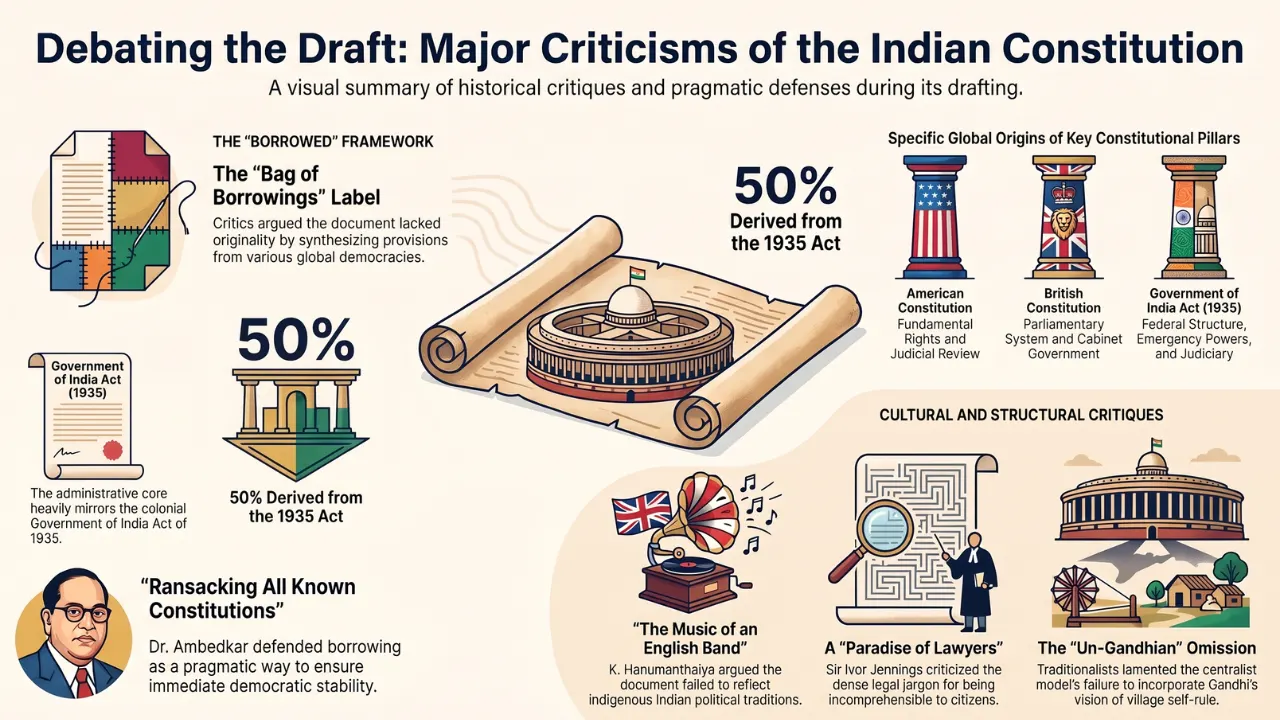
📌 Part 1: The Critique of a Borrowed Constitution: Quick Summary & Study Notes
Critics argued the Constitution lacked original political thought and merely aggregated features from global democracies.
- Global Inspiration: Dr. B.R. Ambedkar acknowledged surveying global constitutions to establish a robust foundation.
- Pragmatic Adaptation: The framers adapted universal principles to Indian realities rather than blindly copying foreign texts.
- Democratic Stability: Integrating tested mechanisms prioritized immediate operational stability during a volatile transition.
Part 2: A Carbon Copy of the 1935 Act
The Constitution was heavily criticized for structurally replicating the colonial Government of India Act of 1935.
- Jennings' Critique: Sir Ivor Jennings observed that the Constitution copied vast sections from the 1935 Act almost textually.
- Ambedkar's Defense: Ambedkar argued there is no shame in borrowing established administrative mechanisms for effective governance.
- Administrative Continuity: Detailed administrative provisions were retained to prevent bureaucratic collapse and authoritarian overreach.
Part 3: Un-Indian or Anti-Indian
Traditionalists felt the document was culturally alien and ignored indigenous ancient political traditions.
- Cultural Alienation: K. Hanumanthaiya lamented the document as the 'music of an English band' rather than an Indian Veena.
- Slavish Surrender: Lokanath Misra criticized the adoption of Western constitutional models as intellectual colonization.
- Neglect of Villages: Critics argued the centralized state model ignored the traditional role of village panchayats.
Part 4: An Un-Gandhian Constitution
The Constitution was criticized for failing to incorporate Mahatma Gandhi's vision of decentralized village democracies.
- Abandonment of Gram Swaraj: The Constitution centralized power instead of building upon village self-rule.
- Ambedkar's View: Ambedkar viewed traditional villages as sinks of localism and caste oppression, favoring individual rights.
- Directive Principles Compromise: Panchayati Raj was relegated to the non-justiciable Directive Principles as a compromise.
Part 5: Elephantine Size
The Indian Constitution became the lengthiest written constitution globally due to its exhaustive details and special provisions.
- Diversity & Geography: The vastness of India required numerous specific safeguards for minorities, tribes, and newly integrated regions.
- Administrative Bloat: A deep distrust of future politicians led to the strict codification of administrative details.
- Legal Precision: The lawyer-dominated Assembly aimed to eliminate all ambiguity, resulting in a massively detailed text.
Part 6: Paradise of the Lawyers
The dense legal jargon made the Constitution incomprehensible to the common man, benefiting only the legal elite.
- Sir Ivor Jennings: He coined the phrase 'Lawyer's Paradise' to describe the extreme legal complexity of the document.
- Endless Litigation: Critics warned that the intricate language would lead to a highly litigious society.
- Ponderous Law Manual: The Constitution was criticized for reading like a dry law manual rather than an inspiring socio-political charter.
📖 Part 1: The Critique of a Borrowed Constitution: Detailed Q&A
Part 1: The Critique of a Borrowed Constitution
Who proudly claimed that the Constitution of India was framed after 'ransacking all the known Constitutions of the World'?
Dr. B.R. Ambedkar openly stated that the drafting process involved surveying and borrowing the best practices of established democracies.
Hide Explanation Hide All Explanations
- The Acknowledgment of Global Inspiration: Dr. B.R. Ambedkar, the Chairman of the Drafting Committee, made this statement openly in the Constituent Assembly. Far from hiding the foreign influences, he proudly acknowledged that the drafting process involved a comprehensive global survey, ransacking the best practices of established democracies to ensure a robust foundation for India.
- The Rejection of Plagiarism Claims: Critics weaponized this methodology to label the Constitution a mere 'patchwork' or a 'hotch-potch' document. In a staunch defense, Dr. Ambedkar argued that nobody holds patent rights over the fundamental principles of a constitution, framing the borrowing process as a practical necessity rather than an act of intellectual theft.
- The Principle of Pragmatic Adaptation: The drafting committee did not blindly replicate foreign texts. Instead, they adapted these universal constitutional principles to fit the unique socio-economic and political realities of the subcontinent. This deliberate adaptation ensured that the historical faults of foreign models were avoided, aligning the borrowed features with Indian conditions.
- The Objective of Democratic Stability: By integrating tested institutional mechanisms from around the world, the framers prioritized immediate stability. They recognized that the newly independent nation needed a functioning, reliable government apparatus immediately, thereby minimizing the immense risks associated with experimenting with entirely novel and unproven political theories during a volatile transition.
Which foreign constitution primarily inspired the philosophical part of the Indian Constitution, specifically the Fundamental Rights?
The conceptualization of Fundamental Rights in the Indian Constitution drew its primary inspiration from the American Constitution's Bill of Rights.
Hide Explanation Hide All Explanations
- The Source of Civil Liberties: This inclusion was a deliberate strategy designed to protect individual liberties and guarantee equal protection against arbitrary state action in the new republic.
- A Synthesis of Global Philosophies: While the American model provided the blueprint for justiciable civil liberties, the Indian framers simultaneously looked to the Irish Constitution for the Directive Principles of State Policy. This created a highly innovative blend of enforceable fundamental rights and non-enforceable socio-economic guidelines intended to direct future state policy.
- Preventing Executive Authoritarianism: Borrowing the concept of written, guaranteed fundamental rights was deemed absolutely crucial for a nation emerging from centuries of colonial subjugation. It established a rigorous framework where the independent judiciary could exercise judicial review to strike down ordinary laws that infringed upon the core freedoms of citizens.
- Securing Democratic Foundations: The inclusion of these borrowed philosophical elements was instrumental in navigating the country's transition from a colonial subject state to a sovereign democratic republic. It ensured that the establishment of a political democracy was inherently paired with the constitutional aspiration to achieve widespread social and economic justice.
The structural framework of the Indian Constitution was largely derived from which historical document?
Over half of the structural provisions of the Indian Constitution were derived from the colonial Government of India Act of 1935.
Hide Explanation Hide All Explanations
- The Foundation of the Administrative Structure: The structural and administrative core of the Indian Constitution was heavily drawn from the colonial Government of India Act of 1935. In fact, over half of the provisions in the newly independent Constitution closely resembled or were virtually identical to the sections laid out in the 1935 Act.
- The Rationale for Structural Retention: The profound familiarity of Indian administrators, civil servants, and politicians with the 1935 framework made it an entirely logical choice for the new nation. Retaining this established structure provided crucial administrative continuity during the turbulent period following partition and the sudden withdrawal of British authority.
- The Core Features Retained: Several critical mechanisms of statecraft, such as the overarching federal scheme, the independent role of the judiciary, the office of the state Governor, expansive emergency powers, and the Public Service Commissions, were directly transplanted from the 1935 Act into the permanent constitutional document.
- Transforming the Imperial Intent: While the structural shell was undeniably colonial, the Indian framers radically transformed its ultimate intent. The 1935 Act was originally designed to maintain imperial control, but the framers infused this administrative machinery with the power of democratic accountability, universal adult franchise, and fundamental human rights.
Which part of the Indian Constitution was primarily drawn from the British Constitution?
The political structure, including the Cabinet Government and parliamentary system, was modeled after the British Constitution.
Hide Explanation Hide All Explanations
- The Adoption of the Westminster Model: The framers elected to adopt the British parliamentary system, which defined the essential 'political part' of the Constitution. This specifically included the principle of Cabinet Government and the symbiotic, interdependent relationship between the Executive and the Legislature.
- The Rejection of the Presidential System: Despite adopting fundamental rights heavily influenced by the United States, the framers firmly rejected the American presidential system of government. The parliamentary model was selected because Indian political leaders had gained decades of practical experience with it during the latter stages of British rule, rendering it a familiar and manageable mechanism.
- The Prioritization of Executive Accountability: The British parliamentary model was heavily favored because it prioritized the daily accountability of the executive branch to the elected legislature over the rigid, periodic separation of powers found in a presidential system. This continuous accountability was deemed essential for governing a highly diverse and rapidly developing nation.
- A Unique Synthesis of Sovereignty: While the parliamentary form was undeniably borrowed from Britain, the Indian Constitution did not adopt the British concept of absolute parliamentary sovereignty. Instead, it created a unique synthesis, blending the British parliamentary system with the American principle of judicial supremacy, thereby limiting the legislature's power through a supreme written constitution.
How did critics commonly refer to the Indian Constitution due to its integration of global provisions?
Critics pejoratively labeled the Constitution a 'bag of borrowings' due to its heavy reliance on foreign frameworks.
Hide Explanation Hide All Explanations
- The Nature of the Pejorative Labels: Because the final document synthesized complex elements from the USA, the UK, Ireland, Canada, Australia, Germany, and several other nations, domestic and international critics pejoratively labeled it a 'bag of borrowings,' a 'hotch-potch Constitution,' and a mere 'patchwork' of global documents.
- The Core Argument Asserting Lack of Originality: The primary thrust of this persistent criticism was that the document thoroughly lacked original Indian political thought. Detractors argued that simply compiling provisions from across the globe resulted in an unoriginal, soulless document that failed to reflect the unique historical genius of the Indian civilization.
- The Pragmatic Defense by the Framers: Defenders of the Constitution, led by Dr. Ambedkar, argued that demanding absolute originality was entirely illogical in the mid-20th century. By this era in human history, the fundamental principles of human rights, federalism, and democratic governance were well-established globally, making independent reinvention both unnecessary and highly inefficient.
- The Inherent Value of Constitutional Synthesis: The ambitious act of bringing together diverse constitutional elements was consistently framed by the drafting committee as a creative synthesis rather than mere mechanical copying. The framers successfully integrated these varied elements into a cohesive whole, demonstrating significant constitutional engineering required to balance conflicting socio-political demands in a modern state.
Part 2: A Carbon Copy of the 1935 Act
Which British Constitutionalist stated that 'the Constitution derives directly from the Government of India Act of 1935 from which many of its provisions are copied almost textually'?
Sir Ivor Jennings observed that the Constitution heavily relied on the colonial Government of India Act of 1935.
Hide Explanation Hide All Explanations
- The Academic Observation of Sir Ivor Jennings: Sir Ivor Jennings, a highly prominent British legal scholar and constitutionalist, critically analyzed the Indian Constitution shortly after its promulgation. He acutely noted its overwhelming reliance on the Government of India Act of 1935, pointing out that vast sections were copied almost textually from the colonial legislation.
- The Underlying Rationale for the Critique: Jennings firmly believed that adopting a heavy colonial administrative framework for a newly independent, aspirational democracy was inherently contradictory. He argued that the provisions borrowed were not always well-chosen for a free society and contributed directly to the document becoming unnecessarily long, rigid, and complicated.
- The Factual Extent of the Duplication: The critique leveled by Jennings was deeply grounded in empirical fact. Out of the original 395 articles in the Constitution, a substantial majority were either identical to or heavily influenced by the 321 sections of the 1935 Act, particularly regarding the nuances of provincial administration and the mechanisms of federalism.
- The Enduring Legacy of the Observation: Jennings' observations remain a cornerstone of academic constitutional critique in modern India. His commentary successfully highlighted the profound tension between the revolutionary socio-economic aspirations of the Indian independence movement and the highly pragmatic, conservative legal framework ultimately chosen to govern the new republic.
How did Dr. B.R. Ambedkar respond to the accusation that the Draft Constitution reproduced a good part of the 1935 Act?
Ambedkar unapologetically defended borrowing administrative details to ensure stability, noting no one holds patent rights on constitutional ideas.
Hide Explanation Hide All Explanations
- The Bold and Direct Defense: When confronted with the severe criticism that the Constitution was merely a carbon copy or an amended version of the 1935 Act, Dr. B.R. Ambedkar addressed the Constituent Assembly with remarkable candor. He stated unequivocally, 'I make no apologies. There is nothing to be ashamed of in borrowing'.
- The Argument Regarding Patent Rights: Ambedkar expanded on his formidable defense by arguing that 'nobody holds any patent rights in the fundamental ideas of a Constitution.' He viewed robust constitutional mechanisms as universal tools for effective governance rather than proprietary national inventions that could not be ethically shared or reused across borders.
- The Intentional Focus on Administration: Ambedkar clarified that the vast majority of the portions borrowed from the 1935 Act related strictly to the intricate details of administration. He argued that laying down detailed administrative procedures within the supreme law was necessary to prevent future elected governments from subverting the democratic process through administrative loopholes.
- The Triumph of Pragmatism Over Sentiment: This unyielding defense highlighted Ambedkar's highly pragmatic approach to modern state-building. He consciously prioritized the functional stability and immediate operational capability of the vulnerable Indian state over the emotional or sentimental desire for a completely novel, yet untried, constitutional framework.
Which critic observed that the Indian Constitution is 'both in language and substance a close copy of the Act of 1935'?
Academic commentator N. Srinivasan argued that the Constitution closely copied both the language and substantive power dynamics of the 1935 Act.
Hide Explanation Hide All Explanations
- The Scope of Srinivasan's Critique: N. Srinivasan, a notable academic commentator on the Indian polity, provided a stark and comprehensive assessment of the constitutional draft. He argued forcefully that the new Constitution failed to break away from its colonial predecessor, serving as a disappointingly close copy of the 1935 Act in both its legal language and its core substance.
- The Implications of Language Continuity: The specific criticism regarding language pointed directly to the adoption of dense, bureaucratic legal phrasing that was highly characteristic of British parliamentary drafting. This linguistic continuity ensured that colonial-era legal precedents and jurisprudence would largely remain applicable in independent India, favoring the established legal elite.
- The Preservation of Substantive Power Dynamics: Regarding substance, Srinivasan's critique highlighted that the fundamental power dynamics of the state—specifically the strong centralized authority and the rigid mechanisms of bureaucratic control over the constituent states—were preserved almost intact from the imperial era.
- The Broader Implications of the Critique: Srinivasan's acute observation reinforced the historical argument that the Indian independence movement achieved a peaceful transfer of power rather than a complete systemic or violent revolution. The structural machinery of the state remained fundamentally unchanged from the meticulous design engineered by the British administrators.
Which of the following major features was NOT primarily drawn from the Government of India Act of 1935?
Fundamental Rights were inspired by the US Constitution, not the 1935 Act which lacked any bill of rights.
Hide Explanation Hide All Explanations
- The Absence of Rights in the 1935 Act: While the Government of India Act of 1935 provided the vast structural and administrative blueprint for the new Indian state, it definitively did not contain a bill of rights. The transformative concept of Fundamental Rights was instead inspired by the American Constitution and embedded to protect citizens from the very administrative state created by the 1935 Act.
- The Adoption of the Federal and Administrative Blueprint: The 1935 Act was highly instrumental in shaping the Federal Scheme, explicitly dictating the complex division of powers between the powerful Union and the subordinate States. It also provided the exact foundational rules for the Judiciary, Emergency Powers, and day-to-day administrative details.
- The Carryover of Key Offices and Commissions: The institutional role of the Governor as the nominal head of a state, operating with discretionary powers, along with the establishment of autonomous Public Service Commissions for the recruitment of civil servants, were direct, unaltered carryovers from the framework established by colonial legislation.
- The Revolutionary Democratic Addition: The glaring absence of Fundamental Rights in the 1935 Act perfectly highlights its original colonial nature. The Indian framers' deliberate decision to graft American-style civil liberties onto a British-style colonial administrative structure represents the core innovative, yet highly contradictory, synthesis of the Indian Constitution.
According to defenders of the Constitution, why was it necessary to include detailed administrative provisions from the 1935 Act?
Detailed administrative scaffolding was deemed necessary to prevent chaos and safeguard democratic institutions against future authoritarianism.
Hide Explanation Hide All Explanations
- The Rationale for Excessive Administrative Bulk: Defenders of the Constitution, particularly Dr. B.R. Ambedkar, argued that in a nascent democracy with a populace entirely unaccustomed to constitutional morality, it was highly dangerous to leave administrative details to the whims of an ordinary legislature. The 1935 Act provided a ready-made, robust administrative manual to prevent chaos.
- The Imperative of Ensuring Systemic Continuity: Adopting the massive existing administrative framework ensured that the delicate transition from a British colony to an independent republic did not result in bureaucratic collapse or anarchy. The complex machinery of state could continue functioning without severe interruption, relying on known procedures and established institutional memory.
- Guarding Against Future Authoritarianism: By hardwiring exhaustive administrative details into the Constitution itself, the framers intentionally restricted the power of future elected governments to alter the basic functioning of the state bureaucracy. This rigidity provided a vital safeguard against potential authoritarian overreach or the dismantling of state institutions by populist leaders.
- The Need to Cultivate Constitutional Morality: Ambedkar famously noted that 'constitutional morality is not a natural sentiment' and had to be actively cultivated among the people and politicians alike. Providing a detailed, rigid administrative structure borrowed from the 1935 Act was seen as a necessary scaffold to support the country while these essential democratic traditions slowly took root.
Part 3: Un-Indian or Anti-Indian
Which Constituent Assembly member commented, 'We wanted the music of Veena or Sitar, but here we have the music of an English band'?
K. Hanumanthaiya used this metaphor to express disappointment at the heavy Western influence on the Constitution.
Hide Explanation Hide All Explanations
- The Evocative Metaphor of Music: K. Hanumanthaiya utilized the highly powerful cultural metaphor of musical instruments to express his profound disappointment with the cultural orientation of the final Constitution. The 'Veena or Sitar' elegantly represented indigenous Indian political frameworks and ancient cultural traditions.
- The Searing Critique of Westernization: By emphatically stating that the Assembly had produced the 'music of an English band,' Hanumanthaiya was criticizing the overwhelming, undeniable Western influence on the document. He felt the Constitution was a foreign orchestration that entirely ignored the native rhythms and realities of Indian society.
- The Articulation of Cultural Alienation: This specific criticism highlighted a deep cultural disconnect felt by traditionalists within the Assembly. They firmly believed that a living constitution must organically arise from the soil of the nation it governs, reflecting its unique historical trajectory rather than imposing alien, imported frameworks.
- The Enduring Resonance of the Critique: Hanumanthaiya's quote remains one of the most famous and enduring critiques of the Indian Constitution. It is frequently cited by modern scholars to perfectly illustrate the historical tension between the modern, Western-educated drafting elite and the traditional, indigenous aspirations of the wider Indian populace.
Why did critics broadly label the Indian Constitution as 'Un-Indian' or 'Anti-Indian'?
Critics felt the document was completely detached from India's ancient political traditions and relied on foreign frameworks.
Hide Explanation Hide All Explanations
- The Complete Absence of Indigenous Spirit: The primary reason a vocal faction of critics labeled the document 'Un-Indian' or 'Anti-Indian' was its apparent failure to incorporate ancient Indian political traditions. Specifically, the omission of decentralized governance models found in ancient village republics, which they felt constituted the true democratic spirit of India, was heavily criticized.
- The Foreign Nature of the Institutional Framework: Critics argued vehemently that the foundational principles of the Constitution—such as the Westminster parliamentary system, Anglo-Saxon adversarial jurisprudence, and a highly centralized federal structure—were entirely foreign concepts that had absolutely no historical roots in the Indian subcontinent.
- The Genuine Fear of Institutional Unsuitability: There was a genuine, pervasive apprehension among traditionalists that because the Constitution was foreign in its nature and conception, it would ultimately prove unsuited to the unique sociological, religious, and cultural conditions of India, eventually leading to systemic friction and governance failure.
- The Fundamental Conflict of National Ideals: The debate highlighted a fundamental conflict of ideals during the founding moment: whether independent India should revive its ancient civilizational governance structures to maintain continuity, or adopt modern, Western institutional forms to integrate seamlessly and powerfully into the contemporary global order.
Who criticized the Constitution as a 'slavish imitation of the west, much more – a slavish surrender to the west'?
Lokanath Misra argued that the adoption of Western models was a form of voluntary intellectual colonization.
Hide Explanation Hide All Explanations
- The Stinging Assertion of Intellectual Surrender: Lokanath Misra's stinging critique went far beyond mere observations of constitutional borrowing; he characterized the wholesale adoption of Western constitutional models as a 'slavish surrender.' He felt that by adopting foreign systems so eagerly, India was voluntarily submitting to intellectual and political colonization even after achieving physical independence from Britain.
- The Ardent Demand for Civilizational Confidence: Misra's intense criticism reflected a broader demand for civilizational confidence among nationalist leaders. Traditionalists believed that India, with its millennia of unbroken history and profound philosophy, possessed more than sufficient indigenous wisdom to craft a unique governance model without having to blindly imitate Western paradigms.
- The Implicit Rejection of Western Modernity: This critique was implicitly a fierce rejection of the specific brand of Western modernity championed by leading figures like Jawaharlal Nehru and Dr. Ambedkar. Misra and his ideological allies viewed this imported modernity as fundamentally incompatible with the deeply spiritual, agrarian, and communal ethos of traditional Indian society.
- The Framers' Universalist Counter-Perspective: In stark contrast to Misra, the principal framers believed that Western concepts of individual rights, civil liberty, and parliamentary democracy were not inherently 'Western' properties but universal human advancements. They viewed these tools as absolutely necessary to cure the historical social inequalities deeply entrenched in traditional Indian society.
Which member of the Constituent Assembly warned that the Constitution 'would not prove suitable and would break down soon after being brought into operation'?
Lakshminarayan Sahu feared that the Constitution's lack of organic connection to the masses would quickly lead to its failure.
Hide Explanation Hide All Explanations
- The Dire Prophecy of Institutional Failure: Lakshminarayan Sahu expressed severe pessimism regarding the longevity and viability of the new Constitution. He warned the Constituent Assembly in stark terms that the document was destined to break down shortly after its implementation because it entirely lacked an organic connection to the masses it sought to govern.
- The Disconnect from the Fundamental Spirit: Sahu argued passionately that the core ideals upon which the draft Constitution was framed had 'no manifest relation to the fundamental spirit of India.' He firmly believed that a legal framework completely divorced from the daily cultural and spiritual realities of the Indian peasantry could not sustain effective governance.
- The Rejection of an Alien Imposition: This critique underscored the deep-seated fear that the Constitution was an elitist imposition. Because the laws, fundamental rights, and administrative structures were derived from foreign sources, Sahu feared the average Indian would feel no cultural ownership or moral obligation towards them, leading directly to institutional collapse.
- The Historical Validation of the Concern: While Sahu's dire prediction of an immediate, catastrophic breakdown thankfully did not materialize, his underlying concern about the constant friction between the modern constitutional state and traditional Indian society continues to manifest today in ongoing socio-political debates regarding social justice, secularism, and local governance.
What was the core argument of the critics who claimed the Constitution was overly Westernized?
Critics argued the top-down Western nation-state model sidelined decentralized indigenous structures like village panchayats.
Hide Explanation Hide All Explanations
- The Marginalization of Indigenous Structures: The absolute core of the 'Westernized' critique was that the Constitution entirely ignored indigenous structures of governance that had existed in India for centuries. Traditionalists argued vehemently that local, decentralized self-government—specifically the village panchayats—should have been the foundational democratic block of the new republic.
- The Top-Down Adoption of the Nation-State Model: Instead of building the nation from the grassroots up, the framers adopted the heavily Western model of a highly centralized, powerful nation-state. This top-down approach was seen by critics as an alien concept designed strictly to consolidate political power at the center rather than empowering local, rural communities.
- The Fundamental Shift in Political Focus: Critics correctly argued that Western constitutions prioritize the individual citizen and the central state, whereas traditional Indian society prioritized the community, the caste, and the village. By focusing entirely on individual rights and centralized power, the Constitution fundamentally altered the traditional social equilibrium of the subcontinent.
- The Pragmatic Rebuttal by the Framers: The drafting committee countered these traditionalist claims by pointing out that traditional Indian structures, particularly the village, were rife with horrific caste-based oppression and ignorance. They argued that adopting modern, Western institutional concepts was a necessary revolution to liberate the individual and forge a progressive, egalitarian society.
Part 4: An Un-Gandhian Constitution
Why was the Constitution explicitly criticized as being 'Un-Gandhian'?
The Constitution was criticized for abandoning Gandhi's vision of decentralized village democracies.
Hide Explanation Hide All Explanations
- The Glaring Absence of Gandhian Philosophy: Critics lamented loudly that the Constitution was profoundly 'un-Gandhian' because it blatantly omitted the core philosophical and political ideals championed by Mahatma Gandhi throughout the long independence struggle. The final document reflected a blueprint for a modern industrial state rather than a spiritual, decentralized agrarian society.
- The Complete Neglect of Gram Swaraj: The most glaring omission, according to Gandhian loyalists, was the total abandonment of 'Gram Swaraj' (village self-rule). Gandhi had envisioned a decentralized polity built primarily upon self-sufficient village panchayats, which he considered the true, organic foundation of Indian democracy.
- The Centralization of State Power: Instead of oceanic circles of decentralized power flowing outward from the villages, the Constitution created a highly centralized federal structure. Ardent Gandhians viewed this monolithic state machinery as a 'soulless machine' that inherently corrupted political power and alienated the common citizen from the democratic process.
- The Ideological Triumph of Modernity: The un-Gandhian nature of the Constitution represented the definitive ideological victory of modernists like Jawaharlal Nehru and Dr. Ambedkar. They firmly believed that rapid industrialization and a strong centralized state were absolutely essential to eradicate crushing poverty and protect the fragile nation in a modern global context.
Which Constituent Assembly member attributed the un-Gandhian nature of the Constitution to Dr. Ambedkar's non-participation in the Gandhian movement?
T. Prakasam personally attacked Ambedkar, attributing the omission of Gandhian ideals to his opposition to the Gandhian movement.
Hide Explanation Hide All Explanations
- A Personal and Ideological Attack: T. Prakasam, a highly prominent leader and member of the Constituent Assembly, launched a direct and personal attack on Dr. B.R. Ambedkar. He publicly attributed the glaring omission of Gandhian ideals from the Constitution directly to Ambedkar's historical political opposition to Gandhi and his non-participation in the mainstream Gandhian nationalist movement.
- Highlighting the Deep Ideological Divide: This specific criticism highlighted the deep, often bitter ideological chasm between the orthodox Gandhian wing of the independence movement and marginalized leaders like Ambedkar. Prakasam genuinely believed that someone who did not share the experiential, spiritual journey of the Gandhian struggle could not accurately draft a document reflecting its ethos.
- Questioning the Authorship and Intent: By aggressively pointing out Ambedkar's political background, Prakasam and other Gandhians were questioning the fundamental intent behind the drafting process. They felt that the Drafting Committee had deliberately and maliciously sidelined the philosophy of the very movement that had secured the nation's political independence.
- The Assembly's Validation of Ambedkar's Role: Despite these sharp, personal criticisms, the paramount Constituent Assembly leadership, including Nehru and Sardar Patel, fully supported Ambedkar's vision of a modern, rights-based, centralized constitution over the traditionalist Gandhian model. This high-level support ensured that the final document reflected a progressive rather than a purely traditional agenda.
How did Dr. B.R. Ambedkar famously describe the traditional Indian village during the Constituent Assembly debates?
Ambedkar viewed traditional villages as sites of caste oppression and ignorance, favoring a framework centered on individual rights.
Hide Explanation Hide All Explanations
- Ambedkar's Searing Sociological Critique: When fiercely defending the decision to make the individual, rather than the village, the basic unit of the Constitution, Ambedkar launched a searing critique of the traditional Indian village. He famously and controversially called it 'a sink of localism, a den of ignorance, narrow-mindedness and communalism'.
- The Harsh Reality of Caste Oppression: Ambedkar's harsh assessment was deeply rooted in his own lived experience as a Dalit and his profound sociological understanding of rural India. He recognized that villages were not egalitarian utopias, as Gandhi romanticized, but rigidly hierarchical structures where untouchability and feudal exploitation were violently enforced by upper castes.
- The Categorical Rejection of Village Republics: Because of this oppressive, unchanging reality, Ambedkar strongly and successfully opposed the Gandhian idea of building the political structure upon village republics. He argued forcefully that empowering the village as an autonomous political unit would merely entrench existing local tyrannies and permanently disenfranchise marginalized communities.
- The Drive to Empower the Individual: By adopting the individual citizen as the fundamental unit of the Constitution, Ambedkar sought to legally bypass oppressive local power structures. A powerful, centralized state offering guaranteed fundamental rights was viewed by Ambedkar as the only viable mechanism capable of emancipating the individual from the strictures of traditional village society.
Which member of the Constituent Assembly moved the amendment that led to the inclusion of organizing village panchayats in the Directive Principles?
K. Santhanam moved a compromise amendment to include village panchayats in the non-justiciable Directive Principles.
Hide Explanation Hide All Explanations
- The Intense Pushback from Gandhians: Following Ambedkar's scathing attack on the village system and the initial, total omission of Panchayati Raj from the draft Constitution, a severe backlash erupted from outraged Gandhian members of the Assembly. They demanded unequivocally that local self-government be recognized in the constitutional framework.
- The Crucial Compromise Amendment: To resolve the rapidly escalating conflict that threatened to derail the consensus, K. Santhanam moved a crucial amendment directing the state to take deliberate steps to organize village panchayats and endow them with necessary powers. This amendment was born out of a desperate political need to find a middle ground between the modernists and the traditionalists.
- Strategic Placement in the Directive Principles: Ambedkar eventually accepted Santhanam's amendment to maintain peace, but it was strategically placed in Part IV of the Constitution—the Directive Principles of State Policy (Article 40). Because Directive Principles are legally non-justiciable, this inclusion functioned as a moral guideline rather than an enforceable legal mandate.
- A Severely Delayed Realization: While Santhanam's amendment saved the concept of the village panchayat from total constitutional erasure, the non-binding nature of Article 40 meant that effective local self-government was largely ignored by state governments for decades. It was only robustly institutionalized much later by the 73rd Constitutional Amendment Act in 1992.
Which of the following quotes expresses profound disappointment over the lack of Gandhian philosophy in the Constitution?
Mahavir Tyagi expressed deep disillusionment regarding the absence of Gandhian ideals in the constitutional framework.
Hide Explanation Hide All Explanations
- The Direct Expression of Disappointment: This direct and mournful critique was voiced loudly by Mahavir Tyagi during the Constituent Assembly debates. He explicitly stated, 'I must confess, I am very much disappointed. I see nothing Gandhian in this Constitution,' perfectly capturing the profound disillusionment of many independence veterans.
- The Perceived Betrayal of the Freedom Struggle: For dedicated figures like Tyagi, the decades-long independence movement was inherently and inextricably tied to Gandhi's specific socio-political vision. The failure of the final constitutional document to reflect this vision was perceived not just as a mere political disagreement, but as a deep betrayal of the very ideals that had mobilized the masses against British rule.
- The Stark Contrast in National Visions: The quote succinctly highlights the stark contrast between the revolutionary rhetoric of the freedom struggle, which promised a radical, spiritual restructuring of society based on indigenous morality, and the highly pragmatic, conservative legalism of the actual Constitution adopted by the elite drafting committee.
- The Enduring Legacy of the Critique: Tyagi's lamentation underscores the historical reality that the Indian Constitution was a product of intense, often painful compromise. While it successfully established a durable democratic state, it did so by intentionally sidelining the utopian, decentralized, and spiritual political framework advocated by the widely acknowledged 'Father of the Nation'.
Part 5: Elephantine Size
Which factor was primarily cited as contributing to the 'Elephantine Size' of the Indian Constitution?
The sheer vastness and diversity of India necessitated numerous detailed provisions to accommodate different regions and groups.
Hide Explanation Hide All Explanations
- The Unprecedented Challenge of Geography and Diversity: The sheer geographical vastness of India and its historically unprecedented socio-cultural diversity were the primary drivers behind the document's immense size. The framers had the Herculean task of accommodating a multitude of ethnicities, languages, religions, and distinct regions within a single, unified legal framework.
- The Necessity of Accommodating Special Provisions: To ensure fragile national unity in such a diverse nation, the Constitution had to include numerous, highly detailed special provisions. This included complex administrative blueprints for tribal areas (codified in the 5th and 6th Schedules), specific safeguards for religious and linguistic minorities, and intricate transitional mechanisms for various newly integrated regions.
- A Comprehensive Single Document for the Union and States: Unlike the United States, where the federal government and individual states have separate, distinct constitutions, the Indian Constitution provides a comprehensive framework for both the powerful Centre and the subordinate states. This dual coverage drastically increased the sheer length of the document.
- The Resulting Unmatched Bulk: Because the framers attempted to proactively codify solutions for nearly every conceivable conflict arising from this immense diversity, the document ballooned to 395 Articles and 8 Schedules at its inception. This made it immediately the lengthiest written constitution in the world, a status it maintains today.
Apart from fundamental principles of governance, what else does the Indian Constitution contain that contributes significantly to its extraordinary length?
The inclusion of extensive administrative details significantly bloated the Constitution's size.
Hide Explanation Hide All Explanations
- The Inclusion of Unprecedented Administrative Detail: While most modern constitutions limit themselves strictly to establishing the fundamental principles of statecraft, broad rights, and the general distribution of power, the Indian Constitution goes much further by incorporating highly detailed, specific administrative provisions into the supreme law.
- A Profound Distrust of the Legislature: This unusual inclusion was born out of a profound distrust of future political leadership by the drafting committee. The framers deeply feared that if administrative details were left to ordinary legislation, partisan politicians might manipulate the rules for short-term gain. By codifying administration, they sought to permanently insulate the bureaucracy from political interference.
- The Direct Borrowing from the 1935 Act: As extensively noted in the criticisms of its origins, the vast bulk of these administrative details were lifted directly from the Government of India Act of 1935. The meticulous, highly bureaucratic nature of British colonial drafting was thus permanently embedded into the very fabric of the republic's highest law.
- A Highly Unconventional Constitutional Approach: This approach was highly unconventional compared to other global democratic models. Matters that in countries like the UK or the USA are flexibly managed by ordinary laws, evolving political conventions, or executive orders are explicitly and rigidly spelled out in the Indian Constitution, significantly bloating its size.
Which historical document's influence is frequently cited as a major historical factor for the bulky size of the Indian Constitution?
The already bulky Government of India Act of 1935 provided the vast structural blueprint, contributing to the Constitution's size.
Hide Explanation Hide All Explanations
- The Excessively Bulky Predecessor: The Government of India Act of 1935 was itself an exceptionally lengthy and detailed piece of colonial legislation, containing 321 sections and 10 schedules. Because the Indian Constitution consciously adopted its structural framework, it inevitably inherited its immense bulk and complexity.
- The Enduring Legacy of Colonial Drafting: British colonial legislation in India was notoriously verbose, intentionally designed to cover every possible administrative contingency in a vast, unpredictable empire. By relying so heavily on the 1935 Act for the mechanics of federalism, the judiciary, and public services, the framers imported this verbose, overarching legal tradition.
- The Framers' Preference for Codification: The framers preferred explicit, written codification over relying on unwritten conventions, a tendency strongly encouraged by the detailed nature of the 1935 Act. This meant that the intricate relationships between the executive, legislature, and various state organs were spelled out in exhaustive, unyielding detail.
- The Compounding Effect of Democratic Additions: The inherent bulk of the 1935 Act was then massively compounded by the addition of modern democratic features—such as exhaustive Fundamental Rights, Directive Principles, and the mechanics of universal adult franchise—which were entirely absent from the colonial act, resulting in an even more massive final document.
Which Constituent Assembly member famously remarked, 'I am sure, the House does not agree that we should make the Constitution an elephantine one'?
H.V. Kamath used the term 'elephantine' to criticize the Constitution's massive volume and unwieldy nature.
Hide Explanation Hide All Explanations
- The Vocal Expression of Concern: During the intense, protracted debates regarding the continuously growing size of the constitutional draft, H.V. Kamath expressed his profound dismay at the document's expanding volume. He famously cautioned his colleagues, remarking, 'I am sure, the House does not agree that we should make the Constitution an elephantine one'.
- The Genuine Fear of Incomprehensible Complexity: Kamath's concern was not merely aesthetic or related to brevity; he deeply understood that a massive, unwieldy constitution would be incredibly difficult for the average, largely unlettered citizen to comprehend. He feared that the sheer volume of articles and schedules would alienate the populace from their own founding document.
- The Inevitability of Unstoppable Expansion: Despite Kamath's repeated warnings, the structural imperatives of the new state—managing unprecedented diversity, transitioning smoothly from colonial rule, and establishing a highly detailed federal framework—meant that the Drafting Committee felt compelled to continuously add clarifying clauses and exceptions, ensuring the document's 'elephantine' fate.
- The Coining of an Enduring Phrase: Kamath's specific use of the word 'elephantine' became one of the most enduring and widely cited descriptors of the Indian Constitution. It succinctly and memorably captures the ongoing critique of the document's unparalleled size, complexity, and heavy-footed legalism, a trait that has only increased with over 100 subsequent amendments.
Which demographic dominance in the Constituent Assembly is cited as a major reason for the Constitution's vast size and detailed nature?
The abundance of lawyers in the Assembly led to exhaustive codification, contributing to the document's immense length.
Hide Explanation Hide All Explanations
- The Overwhelming Dominance of the Legal Profession: The Constituent Assembly was overwhelmingly populated by individuals formally trained in the law. This undisputed dominance of 'legal luminaries' profoundly influenced the entire drafting process, naturally leading to a document characterized by meticulous detail and expansive, cautious legal phrasing.
- The Inherent Lawyer's Approach to Drafting: Lawyers naturally seek to eliminate all ambiguity, foresee every possible loophole, and rigidly codify procedures to prevent future disputes. Consequently, the framers attempted to draft a constitution that anticipated and provided a specific legal remedy for almost every conceivable constitutional crisis, vastly increasing the text's length.
- The Rejection of Brief Statements of Principle: Unlike the framers of the American Constitution, who laid down broad, flexible principles and left the interpretation to the courts and future generations, the Indian lawyer-politicians preferred rigid, exhaustive codification. They distrusted brevity, believing it would lead to chaotic judicial interpretations in a new democracy.
- The Ultimate Consequence of Legal Precision: While this approach aimed to provide absolute certainty and stability in a highly volatile post-independence environment, it resulted in a document so vast and dense that it validated the criticism of being an 'elephantine' creation. It became a text accessible primarily to the legal elite rather than the common citizen it was designed to protect.
Part 6: Paradise of the Lawyers
Who coined the phrase 'Paradise of the Lawyers' to describe the Indian Constitution?
Sir Ivor Jennings used this phrase to criticize the document's extreme, lawyer-centric legal complexity.
Hide Explanation Hide All Explanations
- The Origin of the Famous Phrase: The enduring phrase 'lawyer's paradise' was famously coined by Sir Ivor Jennings, the British constitutional expert who conducted a highly critical academic analysis of the Indian Constitution shortly after its adoption. The term perfectly highlights the extreme, almost prohibitive legal complexity of the document.
- The Basis of the Academic Critique: Jennings observed that the Constitution was drafted with such dense, complicated legal language and technical jargon that it deliberately evaded the understanding of the common man. It was, in essence, a document written by lawyers, for lawyers, requiring highly specialized legal knowledge to interpret and apply in daily governance.
- The Inevitability of Endless Litigation: Jennings argued persuasively that the sheer volume of detailed clauses, exceptions, and provisos inevitably created massive scope for differing interpretations and conflict. This complexity meant that any constitutional issue would quickly end up in court, requiring the expensive and continuous services of the legal profession.
- The Assembly's Composition as the Cause: Jennings directly attributed this characteristic to the composition of the Constituent Assembly, noting that it was dominated by 'lawyer-politicians.' He argued that they naturally favored intricate legal frameworks over simple, accessible declarations of civic rights and duties, ensuring their profession's centrality in the new republic.
Which Constituent Assembly member explicitly warned that the draft 'opens up vast avenues of litigation and will give our able and ingenious lawyers plenty of work to do'?
H.K. Maheswari accurately predicted that the intricate phrasing would spur endless litigation.
Hide Explanation Hide All Explanations
- The Explicit Warning Against Legal Battles: H.K. Maheswari, voicing deep concerns from within the Constituent Assembly, explicitly warned his colleagues about the highly litigious nature of the draft. He foresaw that the complex phrasing would open up 'vast avenues of litigation' and keep 'ingenious lawyers' perpetually busy, to the detriment of swift justice.
- The Grave Moral Consequence: Maheswari's critique went much deeper than just pointing out legal inefficiency; he argued that the draft tended to make people 'more litigious, more inclined to go to law courts, less truthful and less likely to follow the methods of truth and non-violence'.
- The Stark Disconnect from Gandhian Ideals: By suggesting that the Constitution actively promoted a culture of adversarial litigation over truth and non-violence, Maheswari was directly contrasting the highly legalistic document with the moral and ethical ideals of the Gandhian freedom struggle, which favored community arbitration and consensus over adversarial courts.
- The Astounding Reality of the Prediction: Maheswari’s dire predictions proved highly accurate. The intricate detailing of Fundamental Rights, coupled with extensive restrictions and exceptions, immediately made the Supreme Court of India the busiest constitutional court in the world, perfectly validating the fear of rampant, endless litigation.
According to critics, why is the Indian Constitution considered a 'lawyer's paradise'?
The heavy reliance on technical jargon makes it incomprehensible to common people without legal interpretation.
Hide Explanation Hide All Explanations
- The Impenetrable Barrier of Technical Jargon: The fundamental reason the Constitution is widely termed a 'lawyer's paradise' is its heavy, almost exclusive reliance on technical legal jargon and convoluted phraseology. The text is saturated with complex clauses, sub-clauses, and legal caveats that render it completely opaque to the layperson.
- The Absolute Necessity of Legal Interpretation: Because the language is so highly specialized, ordinary citizens cannot easily read or understand their fundamental rights or the mechanisms of their government. They are forced to rely entirely on legal professionals to interpret the Constitution, thereby placing immense power and profit directly in the hands of the legal community.
- Generating Ambiguity Through Over-Specification: Ironically, the framers' determined attempt to avoid ambiguity by over-specifying every detail created entirely new forms of ambiguity. The complex interplay between different restrictive clauses (such as those limiting fundamental rights for public order) required constant judicial arbitration, fueling endless, complex legal battles.
- The Tragic Alienation of the Citizenry: Critics argued that a constitution should be a simple, inspiring charter that every citizen can read and internalize. By making it a dense legal manual, the framers inadvertently alienated the general populace from the very document designed to secure their liberties and empower their civic lives.
Which Constituent Assembly member complained that the draft articles read like a 'ponderous law manual' instead of a lively socio-political charter?
P.R. Deshmukh lamented that the excessive verbosity and rigid bureaucratic phrasing stripped the Constitution of its inspirational quality.
Hide Explanation Hide All Explanations
- The Deep Aesthetic and Functional Critique: P.R. Deshmukh articulated a strong aesthetic and functional critique of the document's drafting style. He complained bitterly to the Assembly that the drafted articles read exactly like a 'ponderous law manual' rather than the inspiring, lively socio-political charter the newly independent nation expected and deserved.
- The Unnecessary Burden of Verbosity: Deshmukh lamented the extreme verbosity of the text, stating, 'we have been burdened with so much of words, words and words which could have been very easily eliminated.' He felt the vibrant essence of the republic was buried under unnecessary legal padding and bureaucratic phrasing.
- The Missing Quality of Inspiration: A constitution is often expected to serve as an inspirational text that embodies the spirit, history, and aspirations of a nation. Deshmukh felt that the rigid, highly bureaucratic phrasing stripped the document of its emotional resonance, reducing a historic revolution to dry, uninspiring statutory law.
- The Drafting Committee's Defense of Precision: In defense of their stylistic choices, the principal draftsmen maintained that poetic or lively language often leads to dangerous legal ambiguity. They consciously prioritized absolute legal precision and the safety of the state over the inspirational or literary quality of the constitutional text, accepting the aesthetic critique as a necessary cost.
What was identified as the primary reason for the complexity of the Indian Constitution, leading to its description as a lawyer's paradise?
The Assembly's dominance by lawyers led to a deeply codified document aimed at eliminating legal loopholes.
Hide Explanation Hide All Explanations
- The Professional Composition of the Assembly: The root cause of the Constitution's extreme complexity was the demographic composition of the Constituent Assembly itself. The body was overwhelmingly dominated by prominent, highly educated lawyers and legal luminaries, including towering figures like Dr. B.R. Ambedkar, Alladi Krishnaswami Ayyar, and K.M. Munshi.
- The Inescapable Professional Bias: These individuals naturally approached the monumental task of state-building through the specific lens of their profession. They drafted the Constitution exactly as if they were drafting a complex commercial contract or a penal code, aiming to eliminate every possible loophole through exhaustive, relentless detailing.
- The Preemptive Anticipation of Conflict: Highly trained in adversarial law, these lawyer-politicians anticipated severe future conflicts between the center and the states, and between the powerful state and the vulnerable individual. They sought to preemptively resolve these conflicts by embedding detailed restrictive clauses and exceptions directly into the constitutional text.
- The Ultimate Systemic Result: The ultimate result of this profound professional bias was a document that achieved a remarkably high degree of legal sophistication but entirely sacrificed accessibility. The dominance of legal minds ensured that the Constitution became the definitive 'lawyer's paradise,' guaranteeing that the judiciary and the legal profession would remain the indispensable, central arbiters of Indian democratic life.