

Indian Polity Set 9: Section 1: The Lengthiest Written Constitution
Core Concepts: Deep dive into Fundamental Rights, DPSP, and the Indian Judiciary.
Constitutional Features: Explore India's federal structure, parliamentary system, and constitution sources.
Exam-Ready: Features a smart mind map and interactive practice quizzes with a timer.
Quick Revision: Highly effective, detailed study material tailored for government exam aspirants.
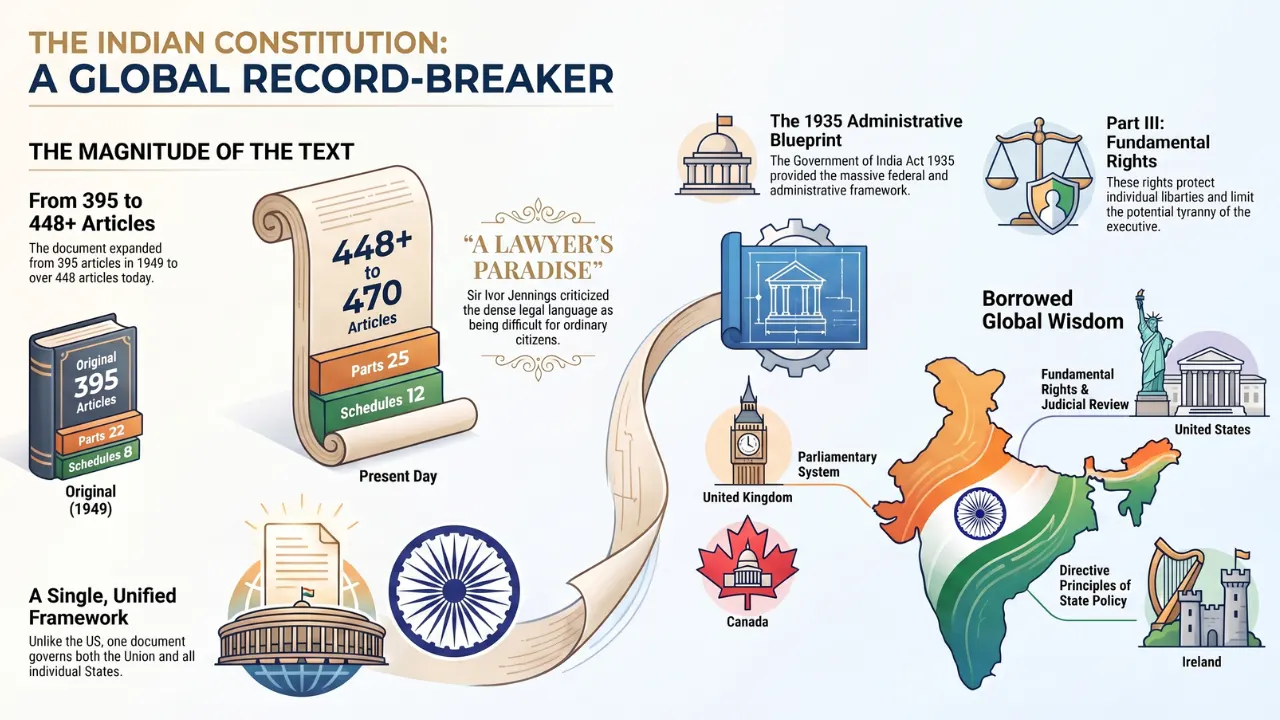
📌 The Lengthiest Written Constitution: Quick Summary & Study Notes
Explores the sheer scale, detailed provisions, and historical rationale behind the Indian Constitution's vast size.
- Original Scale: Started with 395 Articles, 22 Parts, and 8 Schedules to address immediate administrative needs.
- Legal Complexity: Drafted by legal experts resulting in precise, detailed phraseology often termed a 'Lawyer's Paradise'.
- Detailed Safeguards: Extensive provisions designed to prevent legal ambiguities and robustly protect Fundamental Rights.
- Schedules & Directives: Includes specialized lists (Schedules) and socio-economic goals (Directive Principles of State Policy).
Drawn From Various Sources
Details how the Indian Constitution adapted functional elements from global constitutions to suit unique national needs.
- Canadian Influence: Adopted a federal system with a strong centralizing tendency and residuary powers with the Union.
- US & British Models: Borrowed Fundamental Rights and Judicial Review from the US, and Parliamentary government from Britain.
- Government of India Act 1935: Served as the massive administrative blueprint providing the federal plan and emergency structures.
- Irish & Australian Input: Integrated Directive Principles from Ireland and the Concurrent List from Australia.
Blend of Rigidity and Flexibility
Examines the amendment mechanisms that allow the Constitution to remain both adaptable and foundational.
- Article 368: Provides the Parliament with the exclusive constituent power and formal procedure to amend the Constitution.
- Simple Majority: Allows flexible updates to routine administrative boundaries and names without a formal amendment.
- Special Majority & Ratification: Demands two-thirds majority in Parliament, plus state ratification for altering federal structures.
- Constitutional Supremacy: Ensures the written Constitution is the supreme law, preventing absolute parliamentary sovereignty.
Federal System with Unitary Bias
Analyzes India's unique quasi-federal structure that balances regional autonomy with indestructible national unity.
- Union of States: Article 1 defines India as an indestructible union, denying states the right to secede.
- Unitary Features: Incorporates single citizenship, centralized All-India Services, and central appointment of Governors.
- Emergency Transformation: The federal structure seamlessly converts into a unitary system during a declared National Emergency.
- Doctrine of Repugnancy: Ensures Central laws override State laws when conflicts arise on Concurrent List subjects.
Parliamentary Form of Government
Details the interconnected relationship between the executive and legislature designed for continuous democratic accountability.
- Executive-Legislative Coordination: Emphasizes intimate cooperation over the strict separation of powers found in Presidential systems.
- Collective Responsibility: The Council of Ministers remains continuously accountable to the Lok Sabha to maintain power.
- Dual Executive: The President acts as a nominal head bound by the real executive authority of the Prime Minister's cabinet.
- House Dissolution: Allows the premature dissolution of the lower house to mandate fresh elections during political deadlocks.
📖 The Lengthiest Written Constitution: Detailed Q&A
1. The Lengthiest Written Constitution
At the time of its commencement in 1949, how many Articles did the Constitution of India originally contain?
The Indian Constitution originally consisted of exactly 395 Articles upon its adoption in 1949.
Hide Explanation Hide All Explanations
- Original Constitutional Structure: When the Constitution of India was officially adopted by the Constituent Assembly in 1949, it was already globally recognized as the longest written constitution. It originally consisted of a comprehensive Preamble, exactly 395 Articles divided neatly into 22 Parts, and 8 appended Schedules. This immense scale was necessary to address the immediate administrative needs of a newly independent nation transitioning from colonial rule.
- The Evolution and Present Day Expansion: Over the ensuing decades, the foundational document has grown significantly due to numerous constitutional amendments required to address emerging governance challenges and societal shifts. Consequently, the contemporary Constitution contains approximately 448 to 470 Articles, categorized into 25 Parts and expanded to 12 Schedules. This growth reflects the living nature of the document.
- Strategic Avoidance of Ambiguity: The framers of the Constitution, many of whom were distinguished legal professionals and statesmen, intentionally incorporated extensive details into the text. Their primary strategic goal was to prevent future legal uncertainties, minimize ambiguities, and avoid constitutional controversies that could destabilize the young republic.
- Unmatched Global Scale: In the realm of political science, constitutions are generally classified as written documents (such as the American Constitution) or unwritten traditions (such as the British Constitution). The Indian Constitution confidently stands as the most comprehensive, elaborate, and detailed written national constitution in human history.
Which prominent British constitutional scholar criticized the Indian Constitution by calling it a 'Lawyer's Paradise'?
Sir Ivor Jennings criticized the Constitution's dense, highly technical legal language as a 'Lawyer's Paradise'.
Hide Explanation Hide All Explanations
- Complex Legal Phraseology: Sir Ivor Jennings, a highly renowned British constitutional expert, famously described the Indian Constitution as a 'Lawyer's Paradise'. He argued that the legal language and complex phraseology adopted by the constitution-makers made the document exceptionally dense and difficult for ordinary citizens to comprehend without professional legal assistance.
- Influence of Legal Luminaries: The Constituent Assembly was heavily dominated by eminent lawyers and legal scholars such as Dr. B.R. Ambedkar, Jawaharlal Nehru, Sardar Patel, and the legal advisor B.N. Rau. Their extensive legal backgrounds naturally led to a highly technical, precise, and detailed drafting style that prioritized legal exactness over simple public readability.
- Consequences of Constitutional Complexity: Jennings and other subsequent critics believed that this extreme level of detail and complex wording would inadvertently create a fertile ground for extensive litigation. They warned that it would lead to prolonged legal disputes and a heavy reliance on the judicial system to interpret everyday governance issues.
- A Deliberate and Necessary Safeguard: Despite the external criticism, many Indian constitutional scholars maintain that this complexity was a deliberate and necessary design choice. The highly detailed provisions serve as vital, explicitly stated safeguards to protect fundamental rights and prevent the arbitrary misuse of power in a socially diverse and unequal country.
Which of the following is NOT a primary reason for the vast size and comprehensive nature of the Indian Constitution?
India adopted a Parliamentary form of government, meaning a Presidential system did not contribute to its size.
Hide Explanation Hide All Explanations
- Geographical and Social Diversity: India's immense geographical size and deeply complex social diversity required the inclusion of highly detailed constitutional provisions. The framers felt compelled to include specific, tailored rules to protect various religious minorities, govern remote tribal areas, and uplift historically marginalized communities.
- Legacy of Colonial Legislation: A massive portion of the administrative framework within the Constitution was heavily influenced by the Government of India Act of 1935. This colonial legislation was itself a notoriously bulky and detailed document, and its structural adoption naturally inflated the size of the new Constitution.
- Unified Constitutional Framework: Unlike the federal system in the United States, where individual states maintain their own separate state constitutions, India operates under a single, unified Constitution. This singular document dictates the governance structures, powers, and limitations for both the Union government and all individual state governments, doubling its required length.
- The Chosen System of Government: India deliberately adopted a Parliamentary form of government, expressly rejecting a Presidential one. Therefore, the vastness of the Constitution is not due to a Presidential system, but rather the inclusion of detailed administrative provisions, rights, and directives deemed necessary for parliamentary accountability.
- Factors Influencing Size Summary: Geographical Scale necessitated specialized provisions; Historical Precedent brought in the bulky 1935 Act; a Single Document was created for both Centre and States; and Legal Dominance ensured exhaustive precision to prevent misinterpretation.
Which specific Part of the Indian Constitution guarantees Fundamental Rights to all citizens, operating as a limitation on the tyranny of the executive?
Part III of the Indian Constitution is entirely dedicated to protecting the Fundamental Rights of citizens.
Hide Explanation Hide All Explanations
- Core Constitutional Provisions: Part III of the Indian Constitution is entirely dedicated to Fundamental Rights, spanning from Article 12 to Article 35. This section is highly detailed and meticulously drafted to ensure that individual liberties are robustly protected against any form of state overreach or authoritarianism.
- Categories of Enshrined Rights: The Constitution currently guarantees six broad categories of fundamental rights to the populace. These essential liberties include the Right to Equality, the Right to Freedom, the Right against Exploitation, the Right to Freedom of Religion, Cultural and Educational Rights, and the critical Right to Constitutional Remedies.
- Limitations on State Power: These enshrined rights operate as direct, legal limitations on the potential tyranny of the executive branch and prevent the passage of arbitrary laws by the legislature. They are considered the absolute bedrock for promoting and sustaining the idea of political democracy within the nation.
- Mechanisms for Enforceability: A major reason for detailing these rights so extensively is to make them directly enforceable in the courts of law. Article 32 allows citizens to approach the Supreme Court directly if their fundamental rights are violated, making the constitutional text necessarily precise to guide judicial review.
How many Schedules did the original Indian Constitution contain upon its adoption, and how many does it possess presently?
The Constitution contained 8 Schedules at adoption and has expanded to 12 Schedules presently.
Hide Explanation Hide All Explanations
- The Original Framework: At the exact time of its adoption by the Constituent Assembly in 1949, the Indian Constitution contained exactly 8 Schedules that sat alongside its 395 Articles. These schedules served as essential organizational tools for the massive document.
- Purpose and Utility of Schedules: Schedules are essentially detailed lists, tables, or categorizations appended to the end of the Constitution. They help organize bureaucratic activities, territorial extents, and governmental policy details, thereby keeping the main body of the Articles slightly more streamlined and readable.
- Subsequent Constitutional Additions: Through various constitutional amendments over the years, four new schedules were added to address entirely new governance requirements. For instance, the 9th Schedule was added early on to protect certain land reform laws from judicial scrutiny, and the 10th Schedule was added much later to introduce strict anti-defection provisions for legislators.
- Expansion into Local Governance: The 11th and 12th Schedules were added during the 1990s to specifically outline the powers, authority, and responsibilities of rural Panchayats and urban Municipalities. This pivotal move toward decentralized local governance brought the current total to 12 Schedules.
Which Part of the Indian Constitution contains the 'novel feature' known as the Directive Principles of State Policy?
The Directive Principles of State Policy are located in Part IV of the Indian Constitution.
Hide Explanation Hide All Explanations
- Location and Scope in the Constitution: The Directive Principles of State Policy (DPSP) are extensively and carefully outlined in Part IV of the Indian Constitution, covering Articles 36 through 51. The inclusion of these detailed socio-economic goals adds a significant amount of text to the overall document.
- A Novel Constitutional Feature: Dr. B.R. Ambedkar famously described the Directive Principles as a truly 'novel feature' of the Indian Constitution. They serve as comprehensive, philosophical guidelines meant to instruct both the central and state governments on how to actively establish a robust social and economic democracy.
- Non-Justiciable but Fundamental: Unlike the Fundamental Rights found in Part III, the Directive Principles are non-justiciable. This means citizens cannot actively sue the government in a court of law to force their implementation. However, the Constitution explicitly declares that these principles remain absolutely fundamental in the governance of the country.
- Ideological Categories of Directives: To provide exhaustive governance guidance, these principles encompass a tremendously wide range of topics. Scholars generally classify them into three broad ideological categories: Socialistic principles focusing on welfare, Gandhian principles focusing on village autonomy and morality, and Liberal-intellectual principles focusing on modern administration.
2. Drawn From Various Sources
The concept of a federal system featuring a remarkably strong central government was primarily borrowed from the Constitution of which country?
The model of a federation with a strong centralizing tendency was borrowed directly from Canada.
Hide Explanation Hide All Explanations
- The Canadian Federal Influence: The framers of the Indian Constitution deliberately borrowed the concept of a 'Federation with a strong centralizing tendency' directly from the Constitution of Canada. This specific model ensures that while regional states have independent power, the Union Centre remains overwhelmingly dominant in critical areas.
- Vesting of Residuary Powers: Mirroring the Canadian constitutional model perfectly, the Indian Constitution vests all residuary powers in the Union Government. This means that any legislative subject not explicitly mentioned in the Union, State, or Concurrent lists automatically falls under the exclusive jurisdiction of the Central Parliament.
- Appointment of State Governors: The Canadian influence is also highly visible in the specific method chosen for appointing state Governors. In India, Governors are appointed directly by the Central government rather than being elected by the state's citizens, ensuring a continuous mechanism of central oversight over state administration.
- Supreme Court Advisory Jurisdiction: Furthermore, the constitutional provision that allows the President of India to proactively seek the advisory opinion of the Supreme Court on complex matters of law or public importance is another structural feature borrowed directly from the Canadian legal system.
From which global source did the Indian Constitution explicitly borrow the concepts of Fundamental Rights, Judicial Review, and the independence of the judiciary?
The concepts of Fundamental Rights and Judicial Review were adopted from the United States Constitution.
Hide Explanation Hide All Explanations
- Protection of Individual Liberties: The foundational concept of Fundamental Rights, which rigorously protects individual civilian liberties against arbitrary state action, was heavily inspired by the historic Bill of Rights found within the Constitution of the United States of America.
- The Power of Judicial Review: The essential democratic principle of Judicial Review—which empowers the Supreme Court to examine and invalidate legislative laws and executive orders that violate the Constitution—is a direct and profound adaptation from American constitutional jurisprudence.
- Guaranteeing Judicial Independence: The US Constitution also heavily influenced the structural framework utilized to ensure the absolute independence of the judiciary. This includes the difficult removal process for judges, protecting them from undue political interference or retaliation from the executive branch.
- Executive Branch Structures: Other highly significant institutional features borrowed from the United States include the concept of utilizing an Electoral College for the election of the President, the formal impeachment process for the President, and the creation of the specific post of the Vice-President.
The Parliamentary form of government, the concept of 'Rule of Law,' and the institution of the Speaker were heavily adopted from which nation's legal traditions?
The British Constitution served as the source for the Parliamentary form of government and Rule of Law.
Hide Explanation Hide All Explanations
- Familiarity with the Colonial System: Due to the long, deeply entrenched history of British colonial rule, Indian political leaders and administrators were intimately familiar with the British Parliamentary system. Consequently, they adopted this functional model over the American Presidential system for the newly independent nation to ensure immediate administrative stability.
- The Supremacy of Rule of Law: The foundational democratic concept of the 'Rule of Law'—which strictly mandates that the country is governed by established laws and not by the arbitrary decisions or whims of individuals—was borrowed directly from deep-seated British legal traditions.
- Legislative Procedures and Institutions: The British Constitution profoundly influenced India's daily legislative framework. This includes the intricate process of law-making, the powerful institution of the Speaker of the lower house, the cabinet system of ministers, and the practice of bicameralism at the national level.
- The Principle of Single Citizenship: Unlike the dual citizenship model prevalent in the United States, India adopted the British concept of a single, unified national citizenship. This strategic choice was made to actively foster a strong sense of national unity and fraternity among a highly diverse and geographically massive population.
- Borrowed Features Summary: Parliamentary Government came from Britain; Fundamental Rights from the US; a Strong Central Federation from Canada; Directive Principles from Ireland; and the Concurrent List from Australia.
Which historic, bulky document provided the detailed administrative framework, the Federal plan, and the emergency provisions for the Indian Constitution?
The Government of India Act of 1935 acted as the primary administrative blueprint for the Constitution.
Hide Explanation Hide All Explanations
- The Primary Constitutional Blueprint: The Government of India Act of 1935 served as the primary, foundational structural blueprint for the new Indian Constitution. Records indicate that nearly 250 distinct provisions were adapted directly from this highly detailed piece of British colonial legislation.
- Extensive Administrative Framework: The 1935 Act provided the incredibly extensive administrative details that were deemed necessary to successfully run a massive, complex country. This heavy reliance on a prior administrative manual explains precisely why the resulting Indian Constitution is so unusually long and procedurally complex.
- Key Structural Borrowings: Vital structural features that form the backbone of the Indian state were sourced from this Act. These include the basic Federal working plan, the establishment of the Public Service Commissions, the intricate design of the Judiciary, and the powerful Office of the Governor.
- Foundation of Emergency Powers: The foundational framework for Emergency provisions—which legally allow the Central government to assume extraordinary, almost dictatorial powers during a severe national crisis—was also initially derived from the structures laid out in the Government of India Act, 1935.
The concept of the 'Concurrent List' and the provision for a 'Joint sitting of both Houses of Parliament' were distinctly borrowed from the Constitution of:
The Australian Constitution provided the framework for the Concurrent List and joint parliamentary sittings.
Hide Explanation Hide All Explanations
- The Concurrent Legislative List: The Indian Constitution meticulously divides legislative powers into three distinct lists to prevent jurisdictional clashes. The concept of the 'Concurrent List'—where both the central Parliament and the State Legislatures hold the power to make laws on the exact same subjects—was borrowed directly from the Australian Constitution.
- Mechanism for Resolving Deadlocks: To effectively resolve legislative deadlocks that occur between the two houses of Parliament over a bill, the Constitution allows the President to summon a joint sitting of the Lok Sabha and Rajya Sabha. This highly practical legislative mechanism was also inspired by Australian parliamentary practices.
- Guaranteeing Freedom of Trade: The crucial constitutional provisions guaranteeing the absolute freedom of trade, commerce, and intercourse within the national territory, and preventing states from setting up economic barriers against one another, were heavily influenced by the Australian economic model.
- Implementation of International Treaties: Australia also inspired the unique provision that grants the national legislature the exclusive, overriding power to enact laws to implement international treaties and agreements, even if the specific subject matter otherwise falls outside normal federal legislative jurisdiction.
Although the Indian Constitution is often called a 'bag of borrowings,' it is more accurately described as a tailored adaptation. From which constitution did India borrow the Directive Principles of State Policy (DPSP)?
The Directive Principles of State Policy were explicitly adapted from the Irish Constitution.
Hide Explanation Hide All Explanations
- The Directive Principles: The most prominent and widely discussed feature borrowed from the Constitution of Ireland is the Directive Principles of State Policy. These embedded principles serve to guide the elected government in creating a comprehensive welfare state focused intently on social and economic justice for all citizens.
- The Presidential Electoral Process: The specific, highly complex method utilized for the election of the President of India—which involves an electoral college utilizing a system of proportional representation by means of a single transferable vote—was directly adapted from the Irish constitutional framework.
- Nominations to the Upper House: The Irish Constitution also deeply inspired the practice wherein the President of India nominates highly distinguished individuals (specifically from fields like art, science, literature, and social service) directly to the Rajya Sabha (Upper House), bypassing traditional electoral politics.
- A Tailored Synthesis: Because the framers openly and shamelessly borrowed the best functional practices from various global documents to suit unique Indian needs, the Indian Constitution is sometimes affectionately referred to as a 'bag of borrowings.' However, as experts note, it was not a blind copy, but a highly tailored synthesis of global democratic thought.
3. Blend of Rigidity and Flexibility
Which specific Article of the Indian Constitution outlines the power and procedure of the Parliament to amend the Constitution?
Article 368 explicitly grants Parliament the constituent power and process to amend the Constitution.
Hide Explanation Hide All Explanations
- The Locus of Amending Power: Article 368, strategically located in Part XX of the Constitution, explicitly grants the Parliament of India the exclusive constituent power to amend the Constitution. It carefully lays down the formal, step-by-step procedure required for doing so.
- The Purpose of the Amendment Article: The inclusion of this specific Article ensures that the Constitution remains a dynamic, living document that can safely adapt to rapidly changing societal needs and technological advancements. Simultaneously, it prevents a temporary ruling party from altering fundamental, foundational laws arbitrarily.
- Dual Methods of Formal Amendment: Article 368 internally provides for two specific types of formal amendments: those requiring a special majority of Parliament, and those requiring a special majority plus the formal ratification by at least half of the state legislatures, depending on the severity of the change.
- Exclusion of Simple Majority Changes: It is highly important to note that structural changes made by a simple legislative majority (such as altering state boundaries or changing state names) are explicitly not considered formal Constitutional Amendments under the rigorous legal scope of Article 368.
How does the Indian Constitution effectively demonstrate a 'flexible' nature regarding certain administrative provisions?
The Constitution shows flexibility by allowing routine administrative changes via a simple legislative majority.
Hide Explanation Hide All Explanations
- A Synthesis of Constitutional Models: Global constitutions are typically categorized as either rigid (like the notoriously difficult-to-amend US Constitution) or flexible (like the UK's unwritten constitution). The Indian Constitution represents a masterful, unique synthesis of both models, allowing for easy, pragmatic updates to specific, less critical administrative provisions.
- The Simple Majority Mechanism: The Constitution proves its flexibility because numerous operational provisions can be amended by a mere simple majority of the members present and voting in Parliament. This process is functionally exactly like passing any ordinary piece of daily legislation.
- Practical Examples of Flexibility: Routine state actions such as creating entirely new states, altering existing state boundaries, changing the names of states, or modifying the salaries and allowances of high constitutional officials can be executed rapidly through this highly flexible simple majority process.
- Classification Outside Article 368: Legally speaking, any constitutional text change brought about through this simple majority mechanism is explicitly not counted as a formal Constitutional Amendment under the rigorous, demanding framework of Article 368.
Under the strict rules of Article 368, what is mathematically required to achieve an amendment by a 'Special Majority' of Parliament?
A Special Majority requires a majority of total membership and two-thirds of members present and voting.
Hide Explanation Hide All Explanations
- Defining the Special Majority: For significant constitutional changes that affect fundamental rights or directive principles, Article 368 demands a 'special majority.' Firstly, this means the amendment bill must be passed by an absolute majority of the total membership of each House of Parliament, regardless of vacancies or absentees.
- The Present and Voting Clause: Secondly, and more restrictively, the bill must also be actively supported by a majority of not less than two-thirds of the members of each House who are physically present and voting on that specific day. Both conditions must be met simultaneously.
- Balancing Stability and Essential Change: This highly rigorous mathematical requirement introduces a necessary element of rigidity to the Constitution. It guarantees that foundational laws cannot be whimsically changed by a government possessing only a slim, temporary, or fragmented legislative majority.
- Prohibition of Joint Sittings: Unlike ordinary legislative bills where deadlocks can be resolved, there is absolutely no provision for a joint sitting of both Houses of Parliament to resolve a deadlock over a constitutional amendment bill. It must successfully pass both houses independently, preserving the power of the Upper House.
When does an amendment to the Constitution require both a special majority in Parliament AND the subsequent ratification by at least half of the State Legislatures?
Amendments altering the federal structure require a special majority and ratification by 50% of the states.
Hide Explanation Hide All Explanations
- Protecting the Federal Bargain: The absolute most rigid aspect of the Indian Constitution is specifically reserved for provisions that directly affect the federal structure of the country. This extreme rigidity ensures that the Central government cannot unilaterally strip constitutional powers away from the regional states.
- The Complex Ratification Process: If an amendment seeks to alter federal provisions, it must first successfully pass through both houses of Parliament with a special majority. Following this, it must be formally ratified by the legislatures of not less than 50% of the recognized states before it can be presented to the President.
- Mechanics of State Level Approval: The state legislatures ratify such crucial amendments by passing a resolution with a simple majority. Interestingly, there is no specific constitutional time limit imposed on the states to complete this ratification process, which can sometimes delay major reforms.
- Scenarios Demanding Ratification: Examples of constitutional provisions requiring this highly rigid, multi-tiered procedure include any changes to the election of the President, the extent of the executive power of the Union and states, and the vital distribution of legislative powers located in the Seventh Schedule.
- Amendment Type Breakdown: A Simple Majority handles state boundaries; a Special Majority modifies Fundamental Rights; and a Special Majority plus State Ratification protects changes to the distribution of legislative powers.
Which leader famously stated in the Constituent Assembly that a completely rigid and unalterable constitution would 'stop a nation's growth' and wrongly bind succeeding generations?
Dr. B.R. Ambedkar argued against a rigid Constitution to prevent stunting the nation's organic growth.
Hide Explanation Hide All Explanations
- The Assembly's Great Debate: During the intense drafting sessions of the Constitution, there was a fierce, philosophical debate regarding exactly how difficult it should be to amend the document. Some conservative members feared that excessive rigidity would inevitably lead to political stagnation and eventual violent revolution.
- Dr. Ambedkar's Visionary Stance: Dr. B.R. Ambedkar, serving as the principal architect of the Constitution, strongly and eloquently advocated for a pragmatic balance. He argued forcefully that making a constitution entirely rigid and permanent would inevitably 'stop a nation's growth, the growth of a living, vital, organic people'.
- The Principle of Generational Freedom: He emphasized the profound moral principle that the earth fundamentally belongs to the living generation in usufruct. He believed it was fundamentally wrong to permanently disable succeeding generations from modifying the legal framework to suit completely unforeseen future economic or social circumstances.
- Establishing the Golden Mean: Consequently, Ambedkar skillfully guided the Drafting Committee to strike what he called a 'golden mean' between the extreme, suffocating rigidity of the US Constitution and the dangerously extreme flexibility of the British system. This philosophy directly resulted in the nuanced mechanisms of Article 368.
In sharp contrast to the British system which operates on 'Parliamentary Sovereignty,' the Indian democratic system is characterized primarily by:
India adopted Constitutional Supremacy, making the written Constitution the ultimate law over Parliament.
Hide Explanation Hide All Explanations
- The British Model of Sovereignty: In the United Kingdom, the Parliament is considered totally and legally sovereign. The British Parliament possesses the unlimited, unchecked power to make, amend, or unmake any law whatsoever, and British courts fundamentally cannot strike down primary parliamentary legislation.
- The Indian Approach to Supremacy: India, however, decisively rejected the concept of absolute Parliamentary Sovereignty. Instead, the nation adheres strictly to the doctrine of 'Constitutional Supremacy,' meaning the written Constitution itself is the ultimate, supreme law of the land, and the Parliament is merely a creation of it.
- The Mechanism of Checks and Balances: Because the Indian Parliament's law-making powers are strictly defined, enumerated, and limited by the written Constitution, any law it passes can be subjected to rigorous judicial review. The Supreme Court can strike down any legislation found to be unconstitutional or ultra vires.
- The Basic Structure Doctrine: This constitutional supremacy was further, permanently cemented by the Supreme Court in the landmark Kesavananda Bharati case. The Court decisively ruled that Parliament cannot use its amending powers to destroy or alter the 'basic structure' of the Constitution, heavily limiting legislative sovereignty.
4. Federal System with Unitary Bias
How does Article 1 of the Indian Constitution officially describe the territorial and political nature of India?
Article 1 deliberately describes India as a 'Union of States' to establish its indestructible nature.
Hide Explanation Hide All Explanations
- Intentional and Deliberate Phrasing: The term 'federation' is highly intentional in its absence; it is never used anywhere in the text of the Indian Constitution. Instead, Article 1 explicitly and boldly describes India as a 'Union of States,' a phrase carrying immense legal and political weight.
- Rejection of the Agreement Theory: Dr. B.R. Ambedkar explained to the Constituent Assembly that this specific phrasing implies two vital concepts. Firstly, unlike the United States of America, the Indian federation is absolutely not the result of a voluntary agreement or treaty among formerly independent sovereign states.
- The Concept of Indestructible Unity: Secondly, the phrase signifies that no individual state has the legal or constitutional right to secede from the federation under any circumstances. The Union is completely indestructible, heavily emphasizing national unity and territorial integrity over regional sovereignty.
- Defining the Quasi-Federal Nature: This specific terminology perfectly encapsulates India's highly unique governance structure. It is federal in form, possessing independent state governments and divided legislative powers, but it operates with a deeply unitary spirit to maintain ultimate national integrity.
Which of the following is considered a prominent 'Unitary' or non-federal feature deeply embedded within the Indian Constitution?
Single Citizenship is a deliberate unitary feature implemented to maintain a unified national identity.
Hide Explanation Hide All Explanations
- Establishing the Federal Baseline: A true, classical federal system usually exhibits definitive features such as two distinct levels of government, a rigid division of powers, a supreme written constitution, and an independent judiciary. India possesses all of these, establishing its basic federal operating structure.
- The Pervasive Unitary Tilt: However, the Indian Constitution also contains a massive number of unitary features that heavily favor the Central government, leading experts to call it quasi-federal. The concept of Single Citizenship is a prime, highly visible example of this deliberate unitary bias.
- Fostering National Unity: In strictly federal countries like the USA, citizens hold dual citizenship (national citizenship and state citizenship). In India, regardless of which state a person is born or resides in, they hold only Indian citizenship. This was engineered to prevent virulent regionalism and keep the country united.
- Other Significant Unitary Aspects: Other highly prominent unitary features woven into the Constitution include a strong Centre endowed with all residuary powers, a single integrated judiciary, the direct appointment of state Governors by the Centre, and the existence of powerful All-India Services.
- Federal vs. Unitary Features Summary: Federal traits include dual government and divided powers. Unitary traits counter this with single citizenship, centralized Governors, and emergency central dominance.
In which landmark 1994 case did the Supreme Court definitively declare that 'Federalism' is an indestructible part of the Basic Structure of the Indian Constitution?
The Supreme Court ruled that Federalism is a part of the Basic Structure in the S.R. Bommai case.
Hide Explanation Hide All Explanations
- The Historical Context of the Dispute: The S.R. Bommai case (1994) arose directly from the frequent and highly arbitrary dismissal of democratically elected state governments by the Central government. The Centre had been routinely misusing the emergency powers granted under Article 356 (President's Rule) for political gain.
- Curbing Unchecked Central Overreach: In a massive, landmark judgment, a nine-judge constitutional bench of the Supreme Court laid down strict, binding guidelines to prevent the blatant misuse of Article 356. This monumental decision served to fiercely protect state autonomy against unwarranted Central overreach.
- Federalism Elevated to Basic Structure: The Court powerfully and unanimously reiterated that despite the Constitution's obvious unitary bias and centralizing tendencies, 'Federalism' remains an integral, essential, and indestructible part of the 'basic structure' of the Constitution, which cannot be destroyed by the Centre.
- Establishing the Floor Test Principle: The judgment also firmly established the democratic principle that the only valid place to test whether a state government has a majority is on the floor of the Legislative Assembly. It cannot be decided through the subjective, often partisan opinion of the state Governor.
Which Article exclusively empowers the Parliament to create All-India Services, acting as a highly effective mechanism of central control over state administration?
Article 312 allows the Parliament to establish All-India Services for centralized administrative control.
Hide Explanation Hide All Explanations
- The Drive for Administrative Unity: Article 312 of the Indian Constitution empowers the Parliament to create one or more All-India Services (AIS). This currently includes elite cadres such as the Indian Administrative Service (IAS), the Indian Police Service (IPS), and the Indian Forest Service (IFoS).
- Dual Service with Central Control: Officers belonging to these services are recruited and trained exclusively by the Central government, but they are allocated to serve in various state cadres. This highly unique system creates a shared pool of top-tier administrators serving both levels of government simultaneously.
- A Pronounced Unitary Bias in Administration: While these officers work under the immediate operational control of the state governments, their ultimate disciplinary control and ability to be dismissed rests solely with the Union government. This acts as a significant, undeniable unitary feature within India's federal setup.
- The Protective Role of the Rajya Sabha: To protect state interests from unilateral central domination, Parliament can only create a newly proposed All-India Service if the Rajya Sabha (Council of States) first passes a resolution by a two-thirds majority officially declaring it necessary in the national interest.
During a declared National Emergency (Article 352), what legally happens to the federal structure of the Indian Constitution?
During a National Emergency, the federal framework seamlessly transforms into a powerful unitary state.
Hide Explanation Hide All Explanations
- The Design of Emergency Provisions: The Indian Constitution contains highly elaborate and powerful emergency provisions (found in Articles 352, 356, and 360). These were meticulously designed to help the nation effectively and swiftly handle extraordinary crises such as war, armed rebellion, or total financial collapse.
- Automatic Structural Transformation: A highly unique, globally unparalleled feature of the Indian Constitution is that during a proclaimed National Emergency, the normal federal framework seamlessly and automatically transforms into a virtually unitary system of governance without warning.
- Absolute Central Dominance: During this emergency period, the Central government becomes legally all-powerful. It gains the overriding authority to direct state governments on any executive matter whatsoever, and Parliament gains the power to legislate on any subjects normally reserved exclusively for the State List.
- Bypassing Formal Amendment: This drastic, fundamental shift from a cooperative federal state to a top-down unitary state happens automatically upon the President's declaration of the emergency. It entirely bypasses the need for any formal constitutional amendment under Article 368, highlighting the Constitution's extreme flexibility during crises.
Under the 'Doctrine of Repugnancy' detailed in Article 254, what legally occurs if a State law conflicts directly with a Central law on a subject listed in the Concurrent List?
The Central law firmly overrides the conflicting State law on Concurrent subjects under Article 254.
Hide Explanation Hide All Explanations
- The Nature of the Concurrent List: The Seventh Schedule of the Constitution contains the highly contested Concurrent List. This list includes specific subjects (like criminal law, marriage, and bankruptcy) upon which both the Union Parliament and the State Legislatures possess the legal power to make laws.
- Resolving Legislative Conflicts: Article 254 establishes the crucial 'Doctrine of Repugnancy' to legally resolve scenarios where a state government and the central government pass conflicting, irreconcilable (repugnant) laws on the exact same subject found within the Concurrent List.
- Affirming Central Supremacy: In the event of such a direct conflict, the law made by the Parliament absolutely prevails. The conflicting state law is immediately rendered void, but only to the exact extent that it is inconsistent with the central law. This mechanism heavily reinforces the unitary bias of the Constitution.
- The Singular Constitutional Exception: There is one specific constitutional exception to this rule of central dominance: if the state law was explicitly reserved for the consideration of the President of India and successfully received his formal assent, that specific state law will prevail within that specific state, despite the conflict.
5. Parliamentary Form of Government
Which of the following is a core, defining principle of the Parliamentary form of government adopted by India?
The Indian parliamentary system relies on intimate cooperation between the legislature and the executive.
Hide Explanation Hide All Explanations
- Choosing the Governance System: After intense debate, the Constituent Assembly deliberately opted for the British Parliamentary system rather than the American Presidential system to govern the massive, newly independent nation, seeking continuous accountability.
- The Core Principle of Co-ordination: The fundamental, philosophical basis of the Parliamentary system is the intimate, daily co-operation and co-ordination between the legislative and executive branches of government. They are intertwined to ensure smooth, responsive administration.
- Contrast with the Presidential System: This is in stark contrast to the Presidential system utilized in the USA, which is built on a rigid, formalized doctrine of the separation of powers. In that system, the executive and legislature are strictly compartmentalized, independent, and often in opposition.
- The Executive Drawn from the Legislature: In India's parliamentary system, the executive branch (the Council of Ministers) is drawn directly from within the legislature (Parliament). Ministers must be elected members of Parliament, organically and legally linking the two organs of state.
- Systems Comparison Overview: Unlike the US Presidential system's rigid separation and fixed intervals, the Indian Parliamentary system fuses executive and legislative functions to ensure constant, daily accountability.
In the Indian Parliamentary system, who is legally and practically considered the 'real' executive authority?
The real, working executive authority is vested entirely in the Prime Minister and the Council of Ministers.
Hide Explanation Hide All Explanations
- The Concept of a Dual Executive: A highly defining feature of the parliamentary system implemented in India is the presence of a dual executive structure at both the central and state levels: consisting of a nominal head and a real working head.
- The Nominal, Constitutional Head: The President of India serves as the nominal, titular, or constitutional head of state (the de jure executive). According to the text, all executive actions of the national government are formally taken and signed in the name of the President.
- The Real, Working Head: However, the actual, practical executive authority (the de facto executive) who makes the daily decisions of governance is completely vested in the Prime Minister and their appointed Council of Ministers.
- The Binding Nature of Aid and Advice: The Constitution strictly mandates that the President must exercise their functions based entirely on the 'aid and advice' provided by the Council of Ministers headed by the Prime Minister. This effectively renders the President a ceremonial figurehead who must follow the cabinet's decisions.
What does the vital principle of 'Collective Responsibility' entail within the framework of the Indian Constitution?
The entire Council of Ministers is structurally and legally responsible collectively to the Lok Sabha.
Hide Explanation Hide All Explanations
- The Bedrock of Parliamentary Democracy: Collective responsibility is undeniably the most fundamental, defining principle of the parliamentary form of government. It ensures continuous, daily democratic accountability of the powerful executive branch to the representatives of the people.
- Strict Accountability to the Lower House: The Constitution explicitly states in Article 75 that the Council of Ministers is collectively responsible solely to the lower house of Parliament, the Lok Sabha (House of the People), and not to the indirectly elected Rajya Sabha.
- Swimming and Sinking Together: This principle effectively means that the government must maintain the confidence of the majority of Lok Sabha members to stay in power. If a vote of no-confidence is successfully passed against the government, the entire Council of Ministers must resign immediately, regardless of individual performance.
- Continuous Democratic Assessment: Unlike a Presidential system where the executive is judged only at the end of a fixed four-year term during an election, the Indian parliamentary executive is judged continuously. It can be removed on any afternoon it loses legislative support, prioritizing responsiveness.
In the landmark 1974 case Shamsher Singh v. State of Punjab, what did the Supreme Court definitively establish regarding the true extent of the President and Governor's powers?
The Court verified that constitutional heads must act exclusively on the binding advice of their Ministers.
Hide Explanation Hide All Explanations
- The Core Legal Dispute: The pivotal Shamsher Singh case arose to clarify a massive constitutional ambiguity: whether the constitutional 'satisfaction' required by the President or Governor to take executive action meant their own personal satisfaction or the collective satisfaction of the elected government.
- Overruling Past Jurisprudential Errors: In this watershed ruling, the Supreme Court explicitly overruled previous, flawed judgments (such as the Sardari Lal case) that had erroneously suggested constitutional heads could act on their own personal discretion in certain executive matters involving civil servants.
- Affirming Parliamentary Democracy: The Court definitively ruled that India operates strictly on a British-style parliamentary model. Therefore, the President and Governors are strictly formal, constitutional heads who wield almost no independent executive power outside of a few very narrowly defined discretionary exceptions.
- The Binding Nature of Advice: The judgment firmly established that whenever the Constitution requires the 'satisfaction' of the President or Governor, it legally means the satisfaction of the Council of Ministers. They are constitutionally bound to act on ministerial advice, cementing the bedrock principle of responsible democratic government.
According to the Constituent Assembly debates led by Dr. B.R. Ambedkar, why did the framers prefer the Parliamentary system over the Presidential system?
Dr. Ambedkar stated that the parliamentary system offers more responsibility, albeit at the cost of stability.
Hide Explanation Hide All Explanations
- The Structural Governance Trade-off: During the exhaustive Constituent Assembly debates, Dr. B.R. Ambedkar clearly framed the choice between governance systems as a stark trade-off between two crucial, competing properties that a democratic executive should possess: 'stability' and 'responsibility'.
- Assessing the American System: He accurately noted that the American Presidential system guarantees incredibly high stability because a President cannot easily be removed for four years, regardless of public opinion. However, this comes at the cost of lower daily legislative responsibility and potential gridlock.
- Assessing the British System: Conversely, the British Parliamentary system offers extremely high daily responsibility, as the government can be dismissed on any day it loses a majority in the house. However, this system naturally suffers from lower structural stability and the threat of frequent governmental collapse.
- The Final Philosophical Choice: Ambedkar stated, 'The Draft Constitution in recommending the parliamentary system of Executive has preferred more responsibility to more stability.' The framers deeply believed that an infant, highly unequal democracy needed an executive that was constantly, daily accountable to the people's representatives to prevent authoritarianism.
Which feature of the Indian Parliamentary system enables fresh elections and ensures ultimate democratic accountability when a government irreparably loses its majority?
Dissolving the Lower House allows political deadlocks to be broken via immediate, fresh general elections.
Hide Explanation Hide All Explanations
- The Ultimate Mechanism of Accountability: A key, defining feature of the parliamentary form of government in India is the structural provision allowing for the premature dissolution of the lower house of the legislature when political deadlocks cannot be resolved.
- The Status of the Legislative Houses: At the central level, this dissolvable body is the Lok Sabha, and at the state level, it is the State Legislative Assembly (Vidhan Sabha). In stark contrast, the Upper Houses (Rajya Sabha and State Legislative Councils) are permanent continuing bodies and cannot be dissolved under any circumstances.
- Triggering the Dissolution Process: The President (or state Governor) can dissolve the lower house upon the formal advice of the Prime Minister (or Chief Minister). This drastic step frequently happens if the ruling government completely loses its majority and no alternative, stable government can be formed from the existing members.
- The Guarantee of Democratic Renewal: Dissolution effectively cuts short the standard five-year term of the house, enabling immediate, fresh general elections. This ensures that when severe political gridlock occurs, the ultimate power to choose a new government and break the deadlock is returned directly to the electorate, ensuring absolute democratic accountability.