

Indian Polity Set 6: Section 1: The Major Committees and Their…
Committees & Leadership: Covers the major Constituent Assembly committees led by Nehru, Patel, and Prasad.
Drafting Process: Details Dr. B.R. Ambedkar's Drafting Committee and constitutional debates.
Key Milestones: Highlights timelines from the Objectives Resolution to final enactment.
Interactive Practice: Includes a timed quiz to test your preparation.
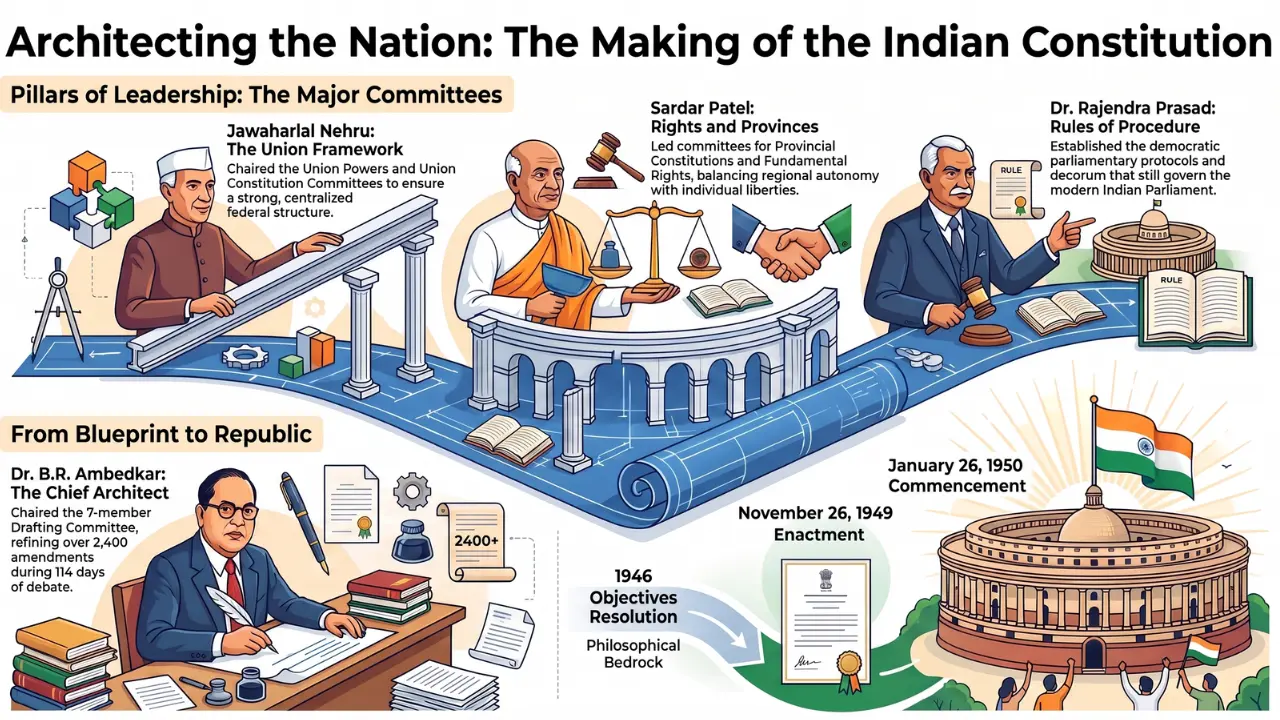
📌 Major Committees and Leadership: Quick Summary & Study Notes
The principal committees that established the foundational policies and administrative frameworks of the Constitution.
- Union and States: Jawaharlal Nehru led the Union Powers, Union Constitution, and States Committees to build a strong federal center.
- Provinces and Rights: Sardar Patel designed provincial structures and ensured protections for fundamental rights and minorities.
- Procedures and Finance: Dr. Rajendra Prasad managed the rules, overarching agenda, and internal finances of the Assembly.
The Drafting Process
The translation of broad policies into a rigorous, legally sound constitutional document.
- Drafting Committee: Chaired by Dr. B.R. Ambedkar, this 7-member group synthesized all reports into the final statutory text.
- Constitutional Adviser: Sir B.N. Rau conducted global research and prepared the initial 300-page working draft.
- Democratic Debate: The Assembly rigorously debated and disposed of 2473 specific amendments over 114 working days.
Timeline and Milestones
The crucial chronological markers from the Assembly inception to the birth of the Republic.
- Objectives Resolution: Introduced in 1946 by Nehru, laying the philosophical bedrock of justice, equality, and sovereignty.
- Enactment: The Constitution was officially adopted on November 26, 1949, with some provisions taking immediate effect.
- Commencement: The bulk of the Constitution came into force on January 26, 1950, honoring the 1930 Purna Swaraj declaration.
📖 Major Committees and Leadership: Detailed Q&A
1. The Major Committees and Their Leaders
Who among the following was the Chairman of the Union Powers Committee of the Constituent Assembly?
Jawaharlal Nehru was the Chairman of the Union Powers Committee, which defined the specific powers of the central government.
Hide Explanation Hide All Explanations
- Strategic Centralization and Leadership: The Union Powers Committee was one of the most critical major committees of the Constituent Assembly, and it was chaired by Jawaharlal Nehru. His appointment to this role was highly strategic, as Nehru was a strong proponent of a robust central government capable of holding the vast, newly independent nation together. The trauma of partition had convinced the national leadership that a weak center could lead to the Balkanization of India, making the vision of Nehru vital for the survival of the nation.
- Defining the Jurisdictional Scope: The primary mandate of this committee was to meticulously define the specific powers, subjects, and jurisdictions that would fall under the exclusive domain of the central government. This involved categorizing subjects of national importance, such as defense, foreign affairs, atomic energy, and communications, ensuring that the Union had the necessary authority to protect national sovereignty.
- Influence on the Federal Structure: The rigorous deliberations of the Union Powers Committee directly shaped the constitutional architecture of Indian federalism. The recommendations generated by the committee laid the foundational groundwork for the Union List found in the Seventh Schedule of the Indian Constitution. Furthermore, the work of the committee established the principle that residuary powers - those not explicitly categorized - would vest with the Union rather than the provincial states, cementing the centralized federal structure.
Which prominent leader chaired the Provincial Constitution Committee?
Sardar Vallabhbhai Patel chaired the Provincial Constitution Committee, designing the administrative structure for the states.
Hide Explanation Hide All Explanations
- Pragmatic Regional Leadership: Sardar Vallabhbhai Patel, universally recognized for his monumental role in integrating the princely states, was appointed as the Chairman of the Provincial Constitution Committee. His deep understanding of regional political dynamics, grassroots governance, and his pragmatic approach to administration made him the ideal leader to design the constitutional framework for the constituent states of the Indian Union.
- Structuring Regional Governance: The core objective of this major committee was to formulate the administrative and constitutional structure of the provinces, which would later be known as states. The committee deliberated extensively on the executive architecture at the state level, deciding on the role, powers, and appointment mechanisms of the State Governors, as well as the functioning of the state legislative assemblies and councils.
- Balancing Autonomy with Unity: The committee faced the delicate task of granting sufficient political and administrative autonomy to the provinces to accommodate regional aspirations, while simultaneously ensuring that this autonomy did not threaten the overarching unity established by the Union Powers Committee. The resulting framework ensured that while states had control over local subjects like public order and health, they remained inextricably bound to the central constitutional machinery.
Who was appointed as the Chairman of the Union Constitution Committee?
Jawaharlal Nehru was the Chairman of the Union Constitution Committee, framing the internal structure of the Central Government.
Hide Explanation Hide All Explanations
- Dual Directorship of the Union Framework: In addition to heading the Union Powers Committee, Jawaharlal Nehru was also entrusted with the chairmanship of the Union Constitution Committee. This dual leadership role allowed Nehru to seamlessly align the vast powers granted to the central government with the actual institutional and structural framework required to exercise those powers effectively.
- Architecting the Executive and Legislature: The specific function of the Union Constitution Committee was to frame the internal structure and operating principles of the Central Government. The committee engaged in profound debates regarding the nature of the executive branch, ultimately favoring a parliamentary system of democracy modeled on the British Westminster system, complete with a bicameral legislature and a nominal head of state (the President) acting on the aid and advice of a Prime Minister.
- Input for the Final Draft: The comprehensive reports, structural blueprints, and memorandums generated by this committee served as the primary source material for the Constitutional Adviser, Sir B.N. Rau, and the Drafting Committee. The decisions made here directly translated into Part V of the Indian Constitution, which comprehensively details the roles of the President, the Parliament, and the Union Judiciary.
Who chaired the Advisory Committee on Fundamental Rights, Minorities and Tribal and Excluded Areas?
Sardar Vallabhbhai Patel chaired this Advisory Committee to ensure legal protections for individual liberties and minorities.
Hide Explanation Hide All Explanations
- A Massive and Sensitive Mandate: The Advisory Committee on Fundamental Rights, Minorities, and Tribal and Excluded Areas was arguably the largest and most complex of the major committees, operating under the chairmanship of Sardar Vallabhbhai Patel. The committee was tasked with the highly sensitive responsibility of ensuring that the diverse, pluralistic fabric of India was legally protected against potential tyranny by the state or the majority.
- Delegation through Sub-Committees: Due to its immense scope, Patel strategically divided the workload among specialized sub-committees. J.B. Kripalani chaired the Fundamental Rights Sub-Committee, while H.C. Mukherjee led the Minorities Sub-Committee, and figures like Gopinath Bordoloi and A.V. Thakkar handled tribal and excluded areas. Patel synthesized their findings into cohesive policies that balanced individual liberties with the security needs of the nascent state.
- Enshrining Justice and Safeguards: The rigorous work of the committee culminated in the drafting of Part III (Fundamental Rights) of the Constitution, guaranteeing civic liberties, equality, and protections against discrimination. Furthermore, the committee established vital political and social safeguards for religious minorities, depressed classes, and tribal populations, fulfilling the promises of social justice laid out in the foundational Objectives Resolution.
Who was the Chairman of the States Committee (Committee for Negotiating with States)?
Jawaharlal Nehru chaired the States Committee to manage diplomatic and constitutional negotiations with the princely states.
Hide Explanation Hide All Explanations
- Diplomatic Integration: The States Committee, formally known as the Committee for Negotiating with States, was an essential major committee chaired by Jawaharlal Nehru. While Sardar Patel is renowned for the administrative and physical integration of the princely states, the committee of Nehru was responsible for the diplomatic and constitutional negotiations required to bring their representatives into the democratic fold of the Assembly.
- Addressing the Princely Boycott: Upon the formation of the Constituent Assembly, the 93 seats allocated to the princely states remained entirely vacant, as these rulers initially boycotted the constitution-making process. The committee engaged in continuous, delicate negotiations with the rulers and their representatives to convince them that their future security and prosperity lay within the Indian Union.
- Achieving Sovereign Unity: The success of this committee was paramount to preventing the Balkanization of the Indian subcontinent. Through sustained dialogue, the committee slowly secured the participation of delegates from various princely states, ensuring that the final Constitution was not just a document for British India, but a unified legal framework representing the entirety of the sovereign Indian territory.
2. Assembly Procedures and Operations
The Rules of Procedure Committee was chaired by which of the following leaders?
Dr. Rajendra Prasad chaired the Rules of Procedure Committee, managing parliamentary decorum and debate rules.
Hide Explanation Hide All Explanations
- Authority and Decorum: Dr. Rajendra Prasad, who held the prestigious position of the permanent President of the Constituent Assembly, also took on the chairmanship of the Rules of Procedure Committee. His role was critical in maintaining decorum, discipline, and systematic progression in an assembly comprising nearly 300 highly vocal and intellectually diverse political leaders.
- Establishing the Democratic Framework: The primary responsibility of this committee was to formulate the exhaustive rules that would govern the daily debates, voting mechanisms, and legislative proceedings. Establishing these rules was an immediate necessity, as the Assembly could not effectively debate the future of the nation without first agreeing on the parliamentary procedures that would govern the interactions of the members.
- Legacy of Parliamentary Tradition: The procedural guidelines drafted under the leadership of Dr. Prasad did more than just manage the Constituent Assembly; they laid the foundational parliamentary traditions of independent India. The protocols regarding the introduction of motions, the reading of drafts, and the rights of members to propose amendments evolved directly into the rules of procedure currently utilized by the modern Indian Parliament.
The Steering Committee of the Constituent Assembly was headed by:
Dr. Rajendra Prasad chaired the Steering Committee, managing the overarching administrative agenda of the Assembly sessions.
Hide Explanation Hide All Explanations
- Administrative Control and Prioritization: Dr. Rajendra Prasad chaired the Steering Committee, a crucial major committee responsible for the overarching administrative control of the constitutional process. The core function of this committee was to manage the day-to-day order of business, prioritize discussions, and establish the overarching agenda for the plenary sessions.
- Streamlining the Legislative Traffic: With numerous major and minor committees simultaneously researching, debating, and submitting complex reports, the Constituent Assembly faced the risk of severe procedural bottlenecks. The Steering Committee acted as the central traffic controller, ensuring that related topics were grouped logically and that the finite time of the Assembly was utilized efficiently.
- Facilitating the Final Output: The effective management provided by the Steering Committee was a primary reason the Assembly successfully processed over 7000 proposed amendments. By maintaining strict schedules and focusing the debates, the committee enabled the framers to finalize the most comprehensive written constitution in global history within a highly productive three-year span.
3. Minor Committees and Specialized Tasks
Who headed the Ad-hoc Committee on the National Flag?
Dr. Rajendra Prasad chaired the Ad-hoc Committee on the National Flag, adopting the Tricolor prior to independence.
Hide Explanation Hide All Explanations
- A Symbol of Sovereignty: Dr. Rajendra Prasad chaired the Ad-hoc Committee on the National Flag, a highly significant minor committee tasked with formalizing the visual identity of the nascent republic. This committee was formed with the urgent necessity of providing the nation with a universally accepted emblem prior to the formal transfer of power from the British Crown.
- Adoption Prior to Independence: Through rapid but careful deliberations, the committee finalized the design of the Tricolor featuring the Ashoka Chakra. Consequently, the Constituent Assembly officially adopted the National Flag of India on July 22, 1947, just weeks before the nation achieved independence on August 15.
- Unifying a Diverse Populace: The selection of the flag required immense political sensitivity. The committee had to ensure that the chosen colors and symbols represented the secular, democratic, and unified aspirations of a highly diverse population, meticulously avoiding any specific communal or religious overtones that could trigger conflict during the volatile period of partition.
Who among the following was the Chairman of the Order of Business Committee, which was a Minor Committee?
Dr. K.M. Munshi chaired the Order of Business Committee, which organized the exact sequence of legislative debates.
Hide Explanation Hide All Explanations
- Legal Expertise in Administration: Dr. K.M. Munshi, an eminent lawyer, seasoned politician, and a core member of the Drafting Committee, served as the chairman of the Order of Business Committee. The Constituent Assembly utilized around 13 to 15 such minor committees to tackle administrative, technical, and highly specific procedural issues, ensuring the main body remained focused on constitutional law.
- Micro-Scheduling the Debates: While the Steering Committee set the broad agenda, the Order of Business Committee was responsible for the micro-scheduling. It organized the exact sequence in which specific draft articles, constitutional clauses, and contentious amendments would be taken up for voting and discussion on the assembly floor.
- Preventing Filibustering and Delays: By meticulously planning the daily legislative calendar, the committee actively prevented procedural chaos and filibustering. This strict ordering of business ensured that the 114 working days of the Assembly dedicated to the draft were optimized, allowing every clause of the massive document to receive adequate democratic scrutiny without stalling the overall timeline.
Which leader was appointed as the Chairman of the House Committee?
B. Pattabhi Sitaramayya chaired the House Committee to manage logistics, housing, and accommodations for Assembly members.
Hide Explanation Hide All Explanations
- Logistical Leadership: The House Committee, categorized as a minor but administratively vital committee within the Constituent Assembly, was chaired by B. Pattabhi Sitaramayya. While the major committees debated high legal philosophy, this committee was grounded in the absolute practicalities of running a multi-year parliamentary body.
- Housing the Delegates: The primary duty of the House Committee was non-legislative. It managed the complex logistical arrangements, housing, rationing, and general accommodations for the nearly 300 delegates who traveled from distant provinces and princely states across the subcontinent to attend the prolonged sessions in New Delhi.
- Sustaining the Democratic Exercise: Given the lengthy duration of the constitution-making process - spanning almost three years - providing secure, comfortable living conditions and adequate facilities was crucial for maintaining the health, attendance, and productivity of the members. The success of the House Committee in these logistical efforts was a quiet but essential pillar supporting the historic output of the Assembly.
Who was the Chairman of the Committee on the Functions of the Constituent Assembly?
G.V. Mavalankar chaired the Committee on the Functions of the Constituent Assembly to manage its dual legislative roles.
Hide Explanation Hide All Explanations
- Defining the Dual Mandate: G.V. Mavalankar chaired the Committee on the Functions of the Constituent Assembly, playing a crucial role in the early legislative history of India. Under the Indian Independence Act of 1947, the Constituent Assembly was granted full sovereign status, holding a dual mandate: acting as a constituent body to frame the Constitution, and functioning as a legislative body to enact ordinary, day-to-day laws for the country.
- Separation of Powers and Personnel: The committee helped delineate exactly how these dual functions would operate without causing institutional confusion. It was established that the roles would be performed on separate days. When the body met to draft the Constitution, Dr. Rajendra Prasad presided; conversely, when it convened as a legislature, G.V. Mavalankar took the chair.
- Precursor to the Lok Sabha: This dual arrangement continued effectively until the Constitution was formally adopted in November 1949. His adept handling of the legislative affairs during this transitional period established robust parliamentary precedents. His leadership laid the groundwork for his subsequent historical role as the very first Speaker of the Lok Sabha in independent India.
Who among the following headed the Credentials Committee?
Alladi Krishnaswamy Ayyar chaired the Credentials Committee to verify the legal standing and election of all Assembly delegates.
Hide Explanation Hide All Explanations
- Juridical Oversight of Membership: Alladi Krishnaswamy Ayyar, a highly respected jurist who also served on the core Drafting Committee, was the Chairman of the Credentials Committee. As a minor committee, its function was strictly procedural but carried immense weight in validating the democratic legitimacy of the entire constitution-making process.
- Validating Democratic Representation: The members of the Constituent Assembly were not directly elected by the public; they were indirectly elected by the provincial legislative assemblies using a complex system of proportional representation with a single transferable vote. The Credentials Committee was responsible for thoroughly verifying the election certificates and legal standing of every arriving delegate to ensure no fraudulent representation occurred.
- Navigating Post-Partition Flux: The role of the committee became exceptionally critical following the partition of India in 1947. The partition drastically altered the demographic and territorial boundaries, reducing the membership of the Assembly from 389 to 299. The committee meticulously managed these transitions, verifying the credentials of new members representing re-drawn constituencies and integrating delegates from newly acceding princely states.
Which leader chaired the Finance and Staff Committee?
Dr. Rajendra Prasad chaired the Finance and Staff Committee, ensuring the financial and administrative independence of the Assembly.
Hide Explanation Hide All Explanations
- Fiscal Responsibility at the Top: Dr. Rajendra Prasad added to his extensive portfolio by chairing the Finance and Staff Committee, underscoring the critical importance of this minor committee. Managing the finances of a sovereign body over three years required unassailable integrity, making the Assembly President the ideal candidate for the role.
- Managing the Exchequer: The logistical exercise of researching, debating, and drafting the Constitution was highly resource-intensive. This committee meticulously managed the budget of the Assembly, overseeing all expenditures which culminated in a total cost of approximately Rs. 64 lakh. This included funding for research, global travel for advisers, printing of massive drafts, and member allowances.
- Ensuring Institutional Independence: Beyond finances, the committee was responsible for recruiting and administering the vast secretariat of the Assembly, including researchers, translators, typists, and clerks. By maintaining strict internal control over its own funding and human resources, the Constituent Assembly successfully insulated itself from external administrative pressures, reinforcing its status as an entirely sovereign entity.
4. The Drafting Committee
On August 29, 1947, the Drafting Committee was set up. Who was appointed as its Chairman?
Dr. B.R. Ambedkar was unanimously elected as the Chairman of the Drafting Committee.
Hide Explanation Hide All Explanations
- The Chief Architect of the Republic: Dr. B.R. Ambedkar was unanimously elected as the Chairman of the Drafting Committee. His unparalleled expertise in constitutional law, economics, and social philosophy made him the indispensable choice for this role. Due to his relentless dedication and intellectual leadership, he is universally recognized today as the chief architect of the Indian Constitution.
- Synthesizing the Constitutional Framework: The Drafting Committee operated as the central hub of the entire Constituent Assembly. Under the leadership of Ambedkar, the committee was responsible for taking the myriad of reports, memorandums, and proposals generated by the various Major and Minor committees and meticulously weaving them into a single, legally sound, and coherent statutory text.
- A Monumental Personal Undertaking: The burden of drafting fell heavily on Ambedkar. Historical accounts note that he often worked grueling 18-hour days despite suffering from poor health, dedicating himself fully to the creation of the foundational document of the republic. He introduced the final draft, guided it through multiple readings, and expertly defended its complex provisions against intense scrutiny on the assembly floor.
When was the Drafting Committee officially appointed by the Constituent Assembly?
The Drafting Committee was officially established on August 29, 1947, just two weeks after Independence.
Hide Explanation Hide All Explanations
- A Shift in Sovereign Priorities: The Drafting Committee was officially established on August 29, 1947, occurring precisely two weeks after India achieved its independence from British colonial rule. This timing was highly significant; with political independence finally secured, the Assembly could shift its total focus away from colonial negotiations and toward the technical mechanics of state-building.
- A Compact Team of Experts: The Assembly deliberately kept the Drafting Committee compact, comprising only seven members. Unlike the heavily political major committees, this group was populated by some of the finest legal minds and seasoned administrators of the era, chosen specifically for their technical expertise and constitutional acumen.
- Rapid Execution of the First Draft: Despite the overwhelming complexity of merging diverse regional, linguistic, and social interests into a single legal document, the committee worked with remarkable speed. Utilizing the initial research provided by the Constitutional Adviser, the seven-member team produced and published the first formal draft of the Constitution in February 1948, taking less than six months to complete this Herculean task.
Who replaced B.L. Mitter on the Drafting Committee after he resigned due to ill health?
N. Madhava Rau was appointed to the Drafting Committee to replace B.L. Mitter following his resignation due to ill health.
Hide Explanation Hide All Explanations
- Maintaining Committee Stability: The Drafting Committee originally consisted of seven highly qualified members appointed in August 1947. However, the grueling pace of the work and personal circumstances necessitated alterations to the composition of the committee over the drafting period.
- The Resignation of B.L. Mitter: B.L. Mitter, a distinguished legal mind, was one of the original seven members appointed to the committee. Unfortunately, the intense demands of the constitution-making process took a toll on him, and he was forced to resign from his position shortly after his appointment due to declining health.
- Infusion of Administrative Experience: To fill this critical vacancy and ensure the drafting process did not lose momentum, N. Madhava Rau was appointed to the committee. Madhava Rau brought with him a wealth of administrative and legal experience, proving instrumental in the day-to-day legal drafting and helping the committee navigate complex administrative structures within the draft.
Which member was appointed to the Drafting Committee to replace D.P. Khaitan following his death?
T.T. Krishnamachari replaced D.P. Khaitan after Khaitan passed away in 1948.
Hide Explanation Hide All Explanations
- An Unforeseen Tragedy: D.P. Khaitan, a highly respected lawyer from Kolkata and an original appointee to the Drafting Committee, passed away in 1948 right in the midst of the intensive constitution-making process. His untimely death left a significant void in the legal team tasked with finalizing the draft.
- T.T. Krishnamachari Steps In: To ensure the committee remained at full strength during its most critical deliberative phases, T.T. Krishnamachari was appointed to replace Khaitan. Krishnamachari was a dynamic figure who brought profound insights into economic policy, trade, and financial administration, enriching the economic provisions of the Constitution.
- Vocal Advocacy and Acknowledgment: Krishnamachari became a highly visible and vocal member on the Assembly floor, actively debating structural and economic clauses. He famously took to the floor to publicly acknowledge the immense, disproportionate burden carried by Chairman Ambedkar, noting that the committee sat for 141 days, devising new legal formulas to accommodate vastly different political viewpoints.
Which of the following prominent leaders was NOT a member of the seven-member Drafting Committee?
Sardar Vallabhbhai Patel was not a member of the technical 7-member Drafting Committee, although he led major policy committees.
Hide Explanation Hide All Explanations
- The Exclusive Seven: The Drafting Committee was an exclusive body strictly consisting of seven members: Dr. B.R. Ambedkar, N. Gopalaswamy Ayyangar, Alladi Krishnaswamy Ayyar, Dr. K.M. Munshi, Syed Mohammad Saadullah, N. Madhava Rau, and T.T. Krishnamachari.
- The Separation of Policy and Drafting: Sardar Vallabhbhai Patel, despite being one of the most powerful figures in the Constituent Assembly, was not a member of the Drafting Committee. The Assembly deliberately separated the formulation of broad political policy from the highly technical task of statutory drafting. Mass political leaders like Patel and Nehru dictated the ideological and structural policies through the Major Committees, while the legal experts on the Drafting Committee translated those policies into precise constitutional law.
- A Non-Partisan Approach to Law: The composition of the Drafting Committee showcased a commendable effort to remain non-partisan and technically rigorous. The inclusion of individuals like Syed Mohammad Saadullah, who focused extensively on regional interests and minority rights, alongside independent legal experts, ensured that the final draft was legally sound and socially inclusive.
Who was appointed as the Constitutional Adviser to the Constituent Assembly to prepare an initial rough draft?
Jurist Sir B.N. Rau served as the Constitutional Adviser, compiling global research and drafting the first 300-page blueprint.
Hide Explanation Hide All Explanations
- The Foundational Legal Mind: Jurist Sir B.N. Rau was appointed as the Constitutional Adviser to the Constituent Assembly. While Dr. Ambedkar is rightly celebrated as the chief architect, the behind-the-scenes legal research and preliminary drafting of Sir B.N. Rau provided the essential raw material that made the Constitution possible.
- Global Comparative Research: To ensure India benefited from global democratic experiences, Rau traveled extensively to the USA, UK, Canada, and Ireland to conduct comparative studies of working constitutions. He engaged in deep consultations with international legal luminaries, including U.S. Supreme Court Justice Felix Frankfurter, gathering critical insights on fundamental rights and judicial review that profoundly influenced the Indian framework.
- Drafting the First Blueprint: Before the Drafting Committee even began its detailed clause-by-clause work, Sir B.N. Rau compiled the resolutions of the various committees alongside his own international research to produce a comprehensive, 300-page first working draft in October 1947. Dr. Ambedkar explicitly acknowledged this contribution on the Assembly floor, stating that a significant part of the credit for the Constitution rightfully belonged to Sir B.N. Rau.
5. Key Constitutional Milestones
Who moved the historic Objectives Resolution in the Constituent Assembly on December 13, 1946?
Jawaharlal Nehru introduced the Objectives Resolution, which laid down the philosophical bedrock for the Constitution.
Hide Explanation Hide All Explanations
- Laying the Philosophical Bedrock: On December 13, 1946, during the very first session of the Constituent Assembly, before a single legal article was drafted, Jawaharlal Nehru moved the historic Objectives Resolution. This document was designed to serve as the philosophical bedrock for the entire constitution-making process.
- Defining the Destiny of the Republic: The resolution explicitly laid down the underlying philosophy, fundamental commitments, and guiding principles of the future Constitution. It boldly declared the solemn resolve to proclaim India as an Independent Sovereign Republic, cutting all ideological ties with the concept of a British Dominion.
- A Promise of Justice and Equality: The text guaranteed social, economic, and political justice; equality of status and opportunity; and freedom of thought, expression, and belief to all the people of India. It also mandated adequate, constitutionally entrenched safeguards for minorities, tribal areas, and depressed classes. The profound ideals encapsulated in this resolution were eventually adapted and immortalized as the Preamble of the Indian Constitution.
On which date was the Objectives Resolution unanimously adopted by the Constituent Assembly?
The Objectives Resolution was formally and unanimously adopted on January 22, 1947, after weeks of deliberation.
Hide Explanation Hide All Explanations
- A Calculated Period of Deliberation: After being introduced by Nehru on December 13, 1946, the Constituent Assembly did not rush to pass the Objectives Resolution. The Assembly deliberated on the resolution for several weeks, deliberately delaying the vote to provide ample opportunity for the boycotting Muslim League and the hesitant princely states to join the proceedings and share in the foundational vision.
- Unanimous Sovereign Approval: When it became clear that further delays would stall the creation of the state, the Objectives Resolution was formally and unanimously adopted by the Constituent Assembly on January 22, 1947. This unanimous vote represented a unified vision among the diverse delegates regarding the moral and political trajectory of the nation.
- The Ultimate Constitutional Mandate: Once adopted, this resolution served as a strict, non-negotiable mandate for all future work. Every subsequent major and minor committee, as well as the Drafting Committee, was bound to frame their specific constitutional provisions in direct alignment with the egalitarian and democratic goals set forth in the resolution. Its adoption marked the definitive moment the Assembly asserted its sovereign right to chart the future of India.
Out of the 7635 amendments tabled during the drafting of the Constitution, approximately how many were actually discussed and disposed of in the Assembly?
The Assembly meticulously debated and disposed of exactly 2473 amendments on the floor during the reading of the draft.
Hide Explanation Hide All Explanations
- The Crucible of Democratic Debate: The draft Constitution was subjected to an astonishing level of scrutiny; it was not simply rubber-stamped by the Congress majority. When the draft was opened for discussion during the second reading, members of the Assembly proposed a staggering total of 7635 amendments.
- Clause-by-Clause Consideration: Out of these thousands of proposals, the Assembly meticulously debated, discussed, and disposed of 2473 specific amendments on the floor of the house. This exhaustive, clause-by-clause consideration formed the bulk of the 114 working days dedicated solely to the draft.
- A Testament to Intellectual Rigor: This rigorous deliberative process highlights the deeply democratic, intellectually demanding, and transparent nature of constitution-making in India. As Chairman, Dr. B.R. Ambedkar stood at the center of this storm, systematically replying to criticisms, accepting valid amendments, and fiercely defending the core legal structure of the draft against competing political ideologies.
Who moved the final motion stating that the Constitution as settled by the Assembly be passed?
Dr. B.R. Ambedkar moved the historic final motion to pass the Constitution at the culmination of the third reading.
Hide Explanation Hide All Explanations
- Culmination of a Historic Journey: Following years of relentless drafting, committee reports, and the exhaustive debate of thousands of amendments, the third and final reading of the draft Constitution commenced in November 1949. At the culmination of this reading, Dr. B.R. Ambedkar moved the historic final motion stating that the Constitution as settled by the Assembly be passed.
- The Declaration of Consensus: This motion represented the final political and legal consensus reached by the diverse body of representatives. Despite severe ideological differences regarding federalism, language, and economic rights, the Assembly rallied behind this motion, declaring the Draft Constitution as passed on November 26, 1949.
- The Act of Signing: Following the passage of the motion, the document was authenticated. Out of the 299 members of the Assembly, 284 were present on that day to physically append their signatures to the historic document, alongside the President, Dr. Rajendra Prasad, thereby cementing the legal foundation of the modern Indian state.
6. Timeline and Enactment
On which date was the Constitution of India formally enacted and adopted by the Constituent Assembly?
The Constitution of India was officially adopted and enacted on November 26, 1949, now celebrated as Constitution Day.
Hide Explanation Hide All Explanations
- The Birth of a Law: The Constitution of India was officially adopted and enacted by the Constituent Assembly on November 26, 1949. In recognition of this monumental achievement, this date is celebrated annually across India as Constitution Day.
- Structure of the Enacted Document: The Constitution, exactly as it was adopted on this date, was an incredibly comprehensive document containing a Preamble, 395 Articles, and 8 Schedules. It immediately earned the distinction of being the longest and most detailed written constitution of any sovereign country in the world.
- Immortalized in the Preamble: The significance of this specific date is permanently immortalized in the text of the Preamble itself. The closing lines of the Preamble declare the adoption and enactment of the document on the twenty-sixth day of November 1949. It is vital to distinguish this date of enactment from the later date of full enforcement on January 26, 1950.
How much time did the Constituent Assembly take to complete the framing of the Indian Constitution?
The Constituent Assembly took exactly 2 years, 11 months, and 18 days from its first meeting to final enactment.
Hide Explanation Hide All Explanations
- A Multi-Year Democratic Exercise: The Constituent Assembly took exactly 2 years, 11 months, and 18 days to complete its historic task, calculating from its first meeting on December 9, 1946, to the final enactment on November 26, 1949.
- Logistics of the Sessions: During this nearly three-year period, the Assembly convened for 11 distinct sessions, with the members sitting for a total of 165 or 166 days. Of this total sitting time, 114 days were spent exclusively on the rigorous, clause-by-clause consideration of the Draft Constitution produced by the committee of Ambedkar.
- Addressing Criticisms of Delay: Contemporary critics frequently labeled the Assembly as time consuming, comparing it unfavorably to the American Constitution, which was framed in a mere four months. However, this criticism fails to account for the unique challenges faced by India. The drafters had to synthesize elements from over 60 global constitutions, manage the legal integration of hundreds of princely states, and design intricate safeguards for a population characterized by unparalleled religious, linguistic, and caste diversity, fully justifying the prolonged timeline.
Which animal was adopted as the official symbol or seal of the Constituent Assembly?
The elephant was adopted as the official symbol and seal of the Constituent Assembly, representing endurance and strength.
Hide Explanation Hide All Explanations
- The Official Emblem: The elephant was officially adopted as the symbol and seal of the Constituent Assembly of India. This emblem became the visual representation of the sovereign authority of the body during the drafting years.
- Stamping Authority: The figurine of an elephant was intricately carved onto the official seal of the Assembly. This seal was routinely stamped on official documents, memorandums, committee reports, and correspondences produced during the vast bureaucratic process of constitution-making.
- Symbolism and Reality: While historical records do not provide a singular mandate for this choice, the elephant is deeply symbolic in Indian culture, representing immense strength, wisdom, stability, and endurance - highly fitting traits for a body tasked with uniting a fractured subcontinent. Coincidentally, political scientists often refer to the final Indian Constitution as having an elephantine size due to its unprecedented bulk, 395 articles, and exhaustive administrative details.
Following the French practice, who was elected as the temporary President of the Constituent Assembly during its first meeting?
Following French practice, Dr. Sachchidananda Sinha was elected temporary President on December 9, 1946.
Hide Explanation Hide All Explanations
- The Historic Inaugural Session: The Constituent Assembly convened for its historic first meeting on December 9, 1946, in New Delhi. This session was marked by the conspicuous absence of the Muslim League, which boycotted the assembly to demand a separate state of Pakistan, resulting in an attendance of only 211 members.
- Adopting Global Parliamentary Precedent: To initiate proceedings, establish order, and conduct the necessary elections for permanent leadership, the Assembly required an immediate presiding officer. Drawing on established global democratic traditions, the Assembly adopted the French parliamentary practice of appointing the oldest member to preside over the initial session.
- The Provisional Chairman: Consequently, Dr. Sachchidananda Sinha, being the oldest serving member, was unanimously elected as the temporary or provisional Chairman of the Assembly. The brief but crucial tenure of Dr. Sinha successfully set the Assembly in motion, culminating two days later, on December 11, 1946, with the formal election of Dr. Rajendra Prasad as the permanent President.
7. Enactment and Commencement
On which date did specific provisions of the Constitution, such as those related to citizenship and elections, came into force?
Crucial provisions relating to citizenship and elections came into force immediately on November 26, 1949.
Hide Explanation Hide All Explanations
- The Necessity of Immediate Action: While the vast majority of the Constitution was slated to commence in 1950, certain administrative, electoral, and legal provisions were required immediately upon enactment on November 26, 1949, to manage the rapidly transitioning state machinery.
- Specific Articles Enforced Early: To address these urgent needs, provisions pertaining to citizenship, the establishment of the Election Commission, the provisional parliament, and various temporary and transitional provisions came into force immediately on November 26, 1949. Article 394 explicitly provided the legal mechanism for this split enforcement.
- Managing the Post-Partition Reality: The immediate enforcement of the citizenship articles was not merely a legal technicality; it was a practical necessity. The massive, traumatic cross-border migration occurring between India and the newly formed Pakistan required urgent legal clarity regarding who was officially an Indian citizen, allowing the state to provide rights and rehabilitation to refugees.
Why was January 26, 1950, specifically chosen as the date of commencement for the major part of the Constitution?
January 26, 1950, was chosen to legally commence the Constitution to honor the historic 1930 Purna Swaraj resolution.
Hide Explanation Hide All Explanations
- The Dawn of the Republic: The remaining provisions - constituting the major bulk of the Constitution - came into full legal force on January 26, 1950. In the text of the Constitution, this specific day is legally designated as the date of commencement.
- A Date Steeped in History: January 26 was not selected arbitrarily; it was chosen to honor a deeply significant milestone in the anti-colonial freedom struggle in India. During the historic Lahore Session of the Indian National Congress in December 1929, the leadership passed a resolution demanding Purna Swaraj or Complete Independence. Following this, January 26, 1930, was celebrated across the subcontinent as the first Independence Day.
- Bridging the Past and Future: By deliberately delaying the commencement of the Constitution to align with this date, the framers poetically linked the historical, decades-long demand for complete self-rule with the actual, legal realization of a sovereign, democratic republic. Today, this monumental transition is celebrated annually as Republic Day.
According to Article 395 of the Indian Constitution, which pre-existing British act was NOT repealed upon the commencement of the Constitution?
Article 395 allowed the Abolition of Privy Council Jurisdiction Act of 1949 to remain, ensuring total authority for the Supreme Court.
Hide Explanation Hide All Explanations
- Severing the Colonial Cord: To establish the supreme, unadulterated legal sovereignty of the new Indian Republic, it was constitutionally imperative to officially sever ties with the colonial legislative framework that had previously governed the territory. Article 395 was drafted and enacted for this precise, transformative purpose.
- Sweeping Repeals: Article 395 explicitly and categorically repealed the Indian Independence Act of 1947 and the Government of India Act of 1935, along with all subsequent enactments that had amended or supplemented them. This act of repeal ensured full constitutional autochthony - meaning the Constitution derived its authority from the people of India, not from a grant by the British Crown.
- The Strategic Exception: However, Article 395 contained one highly specific, strategic exception. The Abolition of Privy Council Jurisdiction Act of 1949 was explicitly not repealed and was allowed to continue in force. This specific act was retained because it had legally abolished the appellate jurisdiction of the British Privy Council over Indian courts. By keeping this act active, the framers ensured that the newly established Supreme Court of India remained the absolute, uncontested highest court of appeal, preventing any lingering legal ambiguities regarding British judicial oversight.