

Indian Polity Set 4: Section 1: The Government of India Act of 1919
Core Topic: Covers the Constitutional Development of India from 1919 to 1947.
Key Acts Explained: Details the Government of India Acts of 1919 and 1935, plus the 1947 Independence Act.
Major Concepts: Highlights Dyarchy, Provincial Autonomy, and Partition.
Interactive Features: Includes a quick mind map and an interactive practice quiz for exam revision.
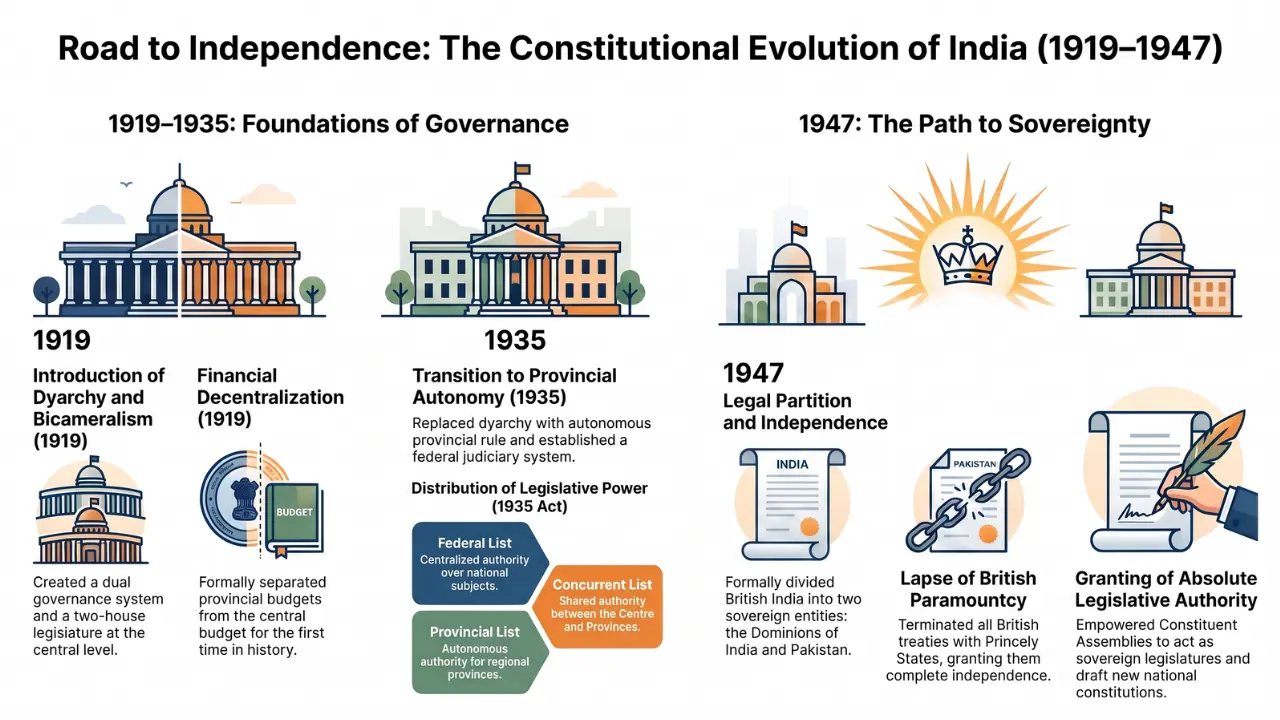
📌 Government of India Act 1919: Quick Summary & Study Notes
Introduced dyarchy and a bicameral legislature to increase Indian participation while retaining British control.
- Dyarchy: Dual governance system dividing provincial subjects into reserved and transferred categories.
- Bicameralism: Restructured the Central Legislature into two houses, the Legislative Assembly and the Council of State.
- Decentralization: Formally separated provincial budgets from the central budget for the first time.
Government of India Act 1935
Abolished dyarchy in favor of Provincial Autonomy and laid out the framework for an All-India Federation.
- Provincial Autonomy: Granted provinces a defined sphere of autonomous administrative action, effectively ending dyarchy.
- Power Distribution: Divided legislative powers systematically into Federal, Provincial, and Concurrent lists.
- Federal Court: Established a federal judiciary to resolve jurisdictional disputes between the Centre and the provinces.
Indian Independence Act 1947
Formalized the partition of British India and legally transferred sovereign power to the Dominions of India and Pakistan.
- Partition: Legally divided the subcontinent into two entirely separate, independent, and sovereign entities.
- Lapse of Paramountcy: Terminated British suzerainty over Princely States, freeing them from all treaties with the Crown.
- Sovereign Assemblies: Granted Constituent Assemblies absolute authority to act as central legislatures and draft their own constitutions.
📖 Government of India Act 1919: Detailed Q&A
1. The Government of India Act of 1919
What was the most notable administrative feature introduced by the Government of India Act of 1919 at the provincial level?
The Government of India Act of 1919 introduced a dual form of governance known as 'dyarchy' for the major provinces.
Hide Explanation Hide All Explanations
- Implementation of Dual Governance: The Government of India Act of 1919, formulated on the recommendations of the Montagu-Chelmsford report, introduced a dual form of governance known as 'dyarchy' for the major provinces. This system was designed to test partial self-governance by dividing the provincial executive into two distinct administrative halves, thereby allowing Indian participation without threatening absolute British sovereignty.
- Division of Administrative Subjects: Under this framework, provincial subjects were bifurcated into 'reserved' and 'transferred' categories. The reserved subjects were administered directly by the British Governor and his appointed executive council, operating without any accountability to the elected legislature. Conversely, the transferred subjects were managed by the Governor acting on the advice of Indian ministers who were drawn from, and responsible to, the provincial legislative council.
- Democratic Accountability and Colonial Control: This structural division introduced the first elements of democratic accountability to the Indian executive branch, marking a significant milestone in constitutional history. However, the mechanism inherently favored colonial control, as the Governor retained overriding veto powers and controlled the finances, often rendering the Indian ministers ineffective in executing their duties.
- Long-term Implications for Indian Polity: Despite its functional failures, the dyarchy experiment served as a critical training ground for Indian political leaders. It exposed the limitations of divided executive power, leading to subsequent nationalist demands for complete provincial autonomy, which would ultimately materialize in the succeeding 1935 legislative framework.
How did the Government of India Act of 1919 restructure the Central Legislature?
The Act replaced the pre-existing unicameral Imperial Legislative Council with a modern bicameral legislature at the national level.
Hide Explanation Hide All Explanations
- Establishment of a Bicameral Framework: This fundamental restructuring aimed to expand Indian representation while maintaining an upper house to act as a conservative check on the directly elected lower house, a structural design that deeply influenced India's post-independence parliamentary system.
- Composition of the Legislative Houses: The newly formed lower house, the Legislative Assembly, consisted of 145 members who served three-year terms, with a majority being elected through a restricted franchise. The upper house, designated as the Council of State, comprised 60 members serving five-year terms. This architecture served as the direct institutional predecessor to the contemporary Lok Sabha and Rajya Sabha.
- Limitations on Legislative Authority: While the establishment of a bicameral system broadened political participation, the actual legislative and financial authority of the chambers remained strictly curtailed. The Governor-General retained autocratic powers, including the ability to certify bills rejected by the legislature and the authority to issue emergency ordinances, ensuring that ultimate control remained with the British executive.
What significant financial reform was introduced by the Government of India Act of 1919 regarding government budgets?
For the first time in the history of British India, the Government of India Act of 1919 formally separated the provincial budgets from the central budget.
Hide Explanation Hide All Explanations
- Financial Decentralization: This financial decentralization was a logical and necessary prerequisite for the implementation of the dyarchy system, as provincial ministers required distinct financial allocations to administer their transferred departments.
- Empowerment of Provincial Legislatures: By bifurcating the financial architecture, the Act authorized the provincial legislatures to debate and enact their own budgets based on assigned revenue sources. The legislation established a clear classification of central and provincial subjects of revenue, keeping dominant sources like income tax central, while assigning specific shares to key provinces to mitigate regional discontent.
- Continued Executive Dominance: Despite the separation of budgets, the fiscal autonomy of the legislatures was highly restricted. At the central level, the budget was partitioned into votable and non-votable categories, with the legislature only permitted to vote on a mere one-third of the total expenditure. The Governor-General retained the statutory power to unilaterally restore any grant that the legislature refused or reduced.
The Government of India Act of 1919 provided for the establishment of which important administrative institution?
The Act explicitly provided for the establishment of a Public Service Commission in India, marking the first statutory commitment to a merit-based civil service.
Hide Explanation Hide All Explanations
- Foundation for Merit-Based Administration: The Act explicitly provided for the establishment of a Public Service Commission in India, marking the first statutory commitment to creating a formalized, merit-based civil service recruitment system independent of political patronage. This provision aimed to ensure the efficiency of the colonial administration while responding to Indian demands for greater inclusion in the superior civil services.
- The Role of the Lee Commission: Although the 1919 Act contained the foundational provision, the commission was not immediately established. Growing political pressure led the British government to appoint the Lee Commission in 1923 to evaluate the racial composition of the administrative services. The Lee Commission strongly emphasized the necessity of implementing the 1919 provision, calling it a cardinal feature for future governance.
- Establishment and Legacy: Following the recommendations of the Lee Commission, the first Central Public Service Commission was formally established on October 1, 1926. This body was entrusted with conducting examinations and overseeing recruitment, laying the administrative and institutional groundwork for the modern Union Public Service Commission (UPSC) that operates under the current Indian Constitution.
How did the Government of India Act of 1919 alter the voting franchise in British India?
The 1919 Act marginally expanded political participation by broadening the electoral franchise based on stringent property, income, and taxation qualifications.
Hide Explanation Hide All Explanations
- Expansion of Restricted Franchise: The 1919 Act marginally expanded political participation by broadening the electoral franchise, yet it fell drastically short of universal adult suffrage. Voting rights were not granted as a fundamental right but were strictly contingent upon meeting stringent property, income, and taxation qualifications.
- Specific Eligibility Criteria: To qualify as a voter, an individual was required to satisfy specific criteria, such as paying a minimum land revenue of Rs. 3,000, possessing property with a designated rental value, holding a university senate membership, or having prior experience in a legislative council. These high thresholds ensured that the electorate remained largely confined to the wealthy and educated elite.
- Demographic Exclusion and Inclusion: Due to these highly restrictive qualifications, only about 5 million individuals out of a total population exceeding 300 million were enfranchised, leaving the vast majority of Indians entirely excluded from the political process. However, the Act did represent a progressive milestone by granting a limited number of women the right to vote in certain provinces for the first time in Indian history.
Under the Government of India Act of 1919, how many Indian members were required to be in the Viceroy's Executive Council?
The legislation stipulated that out of the eight members comprising the Viceroy's Executive Council, a minimum of three were required to be Indians.
Hide Explanation Hide All Explanations
- Increased Executive Participation: Recognizing the necessity to appease nationalist sentiments and demonstrate a commitment to gradual reform, the 1919 Act mandated a structural increase in Indian representation at the highest echelon of the colonial executive branch. This was an effort to associate Indians more closely with the day-to-day administration of the empire.
- Statutory Quota for Indians: The legislation stipulated that out of the eight members comprising the Viceroy's Executive Council, a minimum of three were required to be Indians. Some historical records note this as three out of six ordinary members, deliberately excluding the unique positions of the Viceroy and the Commander-in-Chief from the calculation.
- Strategic Limitations on Portfolio Allocation: While this numerical increase was symbolically significant, it did not translate into substantive executive power. The Indian members were systematically assigned less critical portfolios, such as health, education, and labor, while the strategic levers of colonial power—defense, home affairs, and finance—remained firmly under the control of British officials. Furthermore, the Viceroy retained absolute veto power over all council decisions.
What provision did the Government of India Act of 1919 make for the future review of its constitutional reforms?
The Act explicitly mandated that a statutory commission be established exactly ten years after the legislation's enactment to review its reforms.
Hide Explanation Hide All Explanations
- Mechanism for Statutory Review: The architects of the 1919 Act acknowledged that their reforms were an unprecedented and transitional experiment in colonial governance. To monitor the efficacy of these reforms, the Act explicitly mandated that a statutory commission be established exactly ten years after the legislation's enactment.
- Scope of the Commission's Inquiry: The primary statutory objective of this future commission was to rigorously inquire into the working of the dyarchy system, evaluate the growth of education, and determine whether India was prepared for further development of responsible governing institutions. This provision institutionalized the British strategy of gradual, phased constitutional concessions.
- The Simon Commission Controversy: Due to mounting political pressure and fears of losing control in an upcoming domestic election, the British government preemptively appointed this body in 1927, two years ahead of the stipulated deadline. Known as the Simon Commission, its entirely British composition deeply offended Indian leaders, sparking nationwide boycotts and protests because it excluded Indians from deciding their own constitutional destiny.
How did the Government of India Act of 1919 treat the concept of communal representation?
The 1919 Act entrenched and expanded communal representation by extending separate electorates to Sikhs, Indian Christians, Anglo-Indians, and Europeans.
Hide Explanation Hide All Explanations
- Institutionalization of Religious Divides: The Government of India Act of 1919 did not reverse the controversial policy of communal representation introduced in 1909; instead, it entrenched and expanded the system. This policy reflected the colonial administration's strategy of fragmenting the emerging Indian nationalist movement by institutionalizing religious and social cleavages within the constitutional framework.
- Expansion to New Communities: Building upon the precedent of granting separate electorates to Muslims, the 1919 Act extended this divisive mechanism to other minority groups. It formally granted separate electorates to Sikhs, Indian Christians, Anglo-Indians, and Europeans.
- Impact on the Nationalist Movement: Under this system, electoral constituencies were strictly segregated by community, meaning voters could only cast ballots for candidates belonging to their own specific religious or social group. This structural separation severely hindered efforts to forge a unified national identity, deepened inter-communal mistrust, and created a complex legacy that ultimately contributed to the partition of the subcontinent.
Under the dyarchy system introduced in 1919, who had the power to overrule the Indian ministers on transferred subjects?
The Provincial Governor retained autocratic powers to overrule Indian ministers on transferred subjects.
Hide Explanation Hide All Explanations
- The Overriding Authority of the Governor: The fundamental flaw of the dyarchy system lay in the retention of autocratic power by the Provincial Governor. Despite the theoretical transfer of subjects like health and education to Indian ministers, the Governor remained the ultimate executive authority in the province, capable of overriding any democratic decision.
- Mechanism of Executive Interference: The Governor was granted broad statutory powers to interfere in the administration of transferred subjects. He could legally overrule the Indian ministers on any grounds that he deemed 'special' or necessary for the proper discharge of his overarching responsibilities. This meant that ministerial policies could be blocked at the sole discretion of the colonial executive.
- Financial and Legislative Constraints: The autonomy of the ministers was further crippled by their lack of independent financial authority, as the Governor retained complete control over provincial finances and budgetary allocations. Additionally, the Governor held the power to veto bills passed by the provincial legislature, issue emergency ordinances, and dissolve the assembly, ensuring that the colonial administration maintained an unbreakable grip on provincial affairs.
Which of the following subjects was categorized as a 'Reserved Subject' under the 1919 Act?
Law and order (police), finance, and land revenue were categorized as reserved subjects administered directly by the Governor.
Hide Explanation Hide All Explanations
- The Strategic Bifurcation of Administration: The division of provincial administration under the 1919 Act was meticulously engineered to ensure that the British maintained absolute control over the levers of hard power and economic extraction. This bifurcation resulted in two highly unequal lists of subjects: reserved and transferred.
- The Scope of Reserved Subjects: The 'Reserved Subjects' encompassed all departments critical to the preservation of colonial authority. This list included vital areas such as law and order (police), finance, land revenue administration, irrigation, administration of justice, and control over the press. These subjects were administered directly by the Governor and his unelected executive council.
- Contrast with Transferred Subjects: In sharp contrast, the 'Transferred Subjects' were areas of public welfare that required significant expenditure but offered little in terms of strategic control. Subjects like education, public health, local self-government, agriculture, and public works were handed over to the Indian ministers. This arrangement deliberately burdened Indian politicians with immense public expectations while systematically denying them the financial resources and executive authority required to succeed.
2. The Government of India Act of 1935
What major structural change did the Government of India Act of 1935 bring to the provincial level?
The 1935 Act dismantled dyarchy at the provincial level and introduced the principle of 'Provincial Autonomy'.
Hide Explanation Hide All Explanations
- The Abolition of Dyarchy: The most fundamental structural transformation initiated by the Government of India Act of 1935 at the provincial tier was the total abolition of the highly criticized and functionally flawed dyarchy system introduced in 1919. The artificial division of governance into reserved and transferred subjects was completely dismantled.
- Implementation of Provincial Autonomy: In place of dyarchy, the Act established the principle of 'Provincial Autonomy.' This framework granted the provinces a defined sphere of autonomous administrative action, elevating them from mere administrative appendages of the central government to distinct legal entities with authority derived directly from the British Crown.
- Establishment of Responsible Government: Under Provincial Autonomy, almost all provincial departments were placed under the control of Indian ministers. These ministers were appointed from the elected members of the provincial legislature and were collectively responsible to it, marking the first genuine implementation of responsible parliamentary government at the provincial level. However, this autonomy remained somewhat curtailed by the extraordinary discretionary powers retained by the British-appointed Governors.
How were legislative powers distributed between the Centre and the Provinces under the Government of India Act of 1935?
Legislative powers were divided into three exhaustive lists: Federal, Provincial, and Concurrent.
Hide Explanation Hide All Explanations
- The Federal Legislative Framework: To operationalize the proposed All-India Federation, the 1935 Act introduced a highly sophisticated and detailed constitutional mechanism for distributing legislative authority. It moved away from a unitary system by dividing powers strictly between the central government and the constituent provincial units.
- The Three-Fold Distribution System: The Act categorized all potential legislative subjects into three exhaustive lists. The Federal List contained 59 items of national significance, such as defense, external affairs, and currency, over which the central legislature had exclusive jurisdiction. The Provincial List comprised 54 items of local interest, including public order and public health, placing them under the sole jurisdiction of provincial legislatures.
- The Concurrent Innovation: The Act also introduced a Concurrent List containing 36 subjects (such as criminal law and marriage) where both the federal and provincial legislatures possessed concurrent jurisdiction to enact laws. In cases of conflict, federal law generally superseded provincial law. This tripartite division of powers proved so effective that it was directly adopted into the Seventh Schedule of the independent Constitution of India.
Under the Government of India Act of 1935, who was vested with the 'Resid residuary Powers' of legislation?
All residuary legislative authority was vested exclusively in the Governor-General, acting in his absolute discretion.
Hide Explanation Hide All Explanations
- The Concept of Residuary Powers: In any constitutional framework dividing legislative authority, residuary powers refer to the exclusive authority to enact laws on novel or unforeseen subjects that are not explicitly enumerated in any of the predefined constitutional lists. Proper allocation of these powers is essential for maintaining the balance of a federal system.
- Departure from Federal Norms: Unlike standard federal constitutions—such as those of the United States or Australia, which typically assign residuary powers to the constituent states or the central legislature—the 1935 Act adopted a highly autocratic approach. It deliberately denied these powers to both the Federal and Provincial legislatures.
- Vesting in the Executive: Instead, the Act vested all residuary legislative authority exclusively in the Governor-General, acting in his absolute discretion. If a new legislative requirement arose, the Governor-General alone possessed the authority to allocate the right to legislate on that subject to either the Centre or the provinces. This mechanism ensured that the British executive retained an ultimate trump card over the evolving legal landscape of India.
What judicial institution was established by the Government of India Act of 1935 to resolve disputes between the Centre and the provinces?
The Act mandated the creation of the Federal Court of India, established in Delhi in 1937, to resolve federal disputes.
Hide Explanation Hide All Explanations
- The Necessity of a Federal Judiciary: The transition from a unitary state to a complex federal structure inherently generates jurisdictional conflicts regarding the distribution of legislative and executive powers. To maintain constitutional order and interpret the intricate provisions of the 1935 Act, the establishment of an independent, apex judicial institution in India became an absolute necessity.
- Establishment and Jurisdiction: The Act mandated the creation of the Federal Court of India, which was formally established in Delhi in 1937, with Sir Maurice Gwyer serving as its inaugural Chief Justice. The Court was granted exclusive original jurisdiction to adjudicate disputes arising between the federal center and its constituent units (the provinces or acceding states).
- The Precursor to the Supreme Court: The Federal Court also possessed appellate jurisdiction to hear appeals from provincial High Courts on matters requiring the interpretation of the Constitution Act. While it served as the direct institutional predecessor to the modern Supreme Court of India, its authority was not strictly final; judgments of the Federal Court could still be appealed to the Judicial Committee of the Privy Council in London, preserving ultimate British judicial supremacy until independence.
Which of the following was a proposed feature of the 1935 Act that never actually came into existence?
The proposed All-India Federation never came into existence because the Princely States refused to accede.
Hide Explanation Hide All Explanations
- The Grand Federal Vision: The central architectural ambition of the Government of India Act of 1935 was the establishment of an 'All-India Federation.' This proposed structure aimed to politically unify the subcontinent by bringing both the British Indian Provinces and the vast array of semi-autonomous Princely States under a single, overarching federal umbrella.
- Conditions for Establishment: The implementation of this federation was strictly conditional. The Act stipulated that the federation could only be formally established if a sufficient number of Princely States voluntarily agreed to join. Specifically, states representing at least half of the total princely state population, and entitled to at least half of the states' seats in the upper house, had to sign an 'Instrument of Accession'.
- The Failure of the Federation: The rulers of the Princely States ultimately rejected the proposal. Fearing that joining a democratic federation would precipitate the loss of their internal sovereignty, autocratic privileges, and fiscal independence, they refused to accede. Consequently, the mandatory threshold was never met, and the federal provisions of the 1935 Act remained a dead letter, leaving the central government to operate under the archaic provisions of the 1919 Act until 1947.
Under Section 93 of the Government of India Act of 1935, what extraordinary power was granted to the Provincial Governors?
Section 93 granted Provincial Governors sweeping emergency powers to suspend elected governments and assume direct rule.
Hide Explanation Hide All Explanations
- The Emergency Provision: Section 93 of the Government of India Act of 1935 represented a profound safeguard for British colonial interests, designed to counteract the newly granted Provincial Autonomy. It provided Provincial Governors with sweeping, dictatorial emergency powers to intervene directly in the governance of their respective provinces.
- The Mechanism of Intervention: According to the statute, if a Governor was subjectively satisfied that a situation had arisen wherein the government of the province could no longer be conducted in accordance with the Act, he possessed the authority to issue a formal proclamation. This proclamation allowed him to instantly suspend the elected council of ministers, bypass the provincial legislature, and assume all executive and legislative powers unto himself.
- Historical Application and Legacy: This draconian provision essentially allowed for the total suspension of democratic governance and the imposition of direct 'Governor's Rule'. It was utilized extensively in 1939 when Congress ministries resigned across several provinces. The constitutional architecture of Section 93 served as the direct inspiration for Article 356 (President's Rule) in the Constitution of independent India, remaining a contentious mechanism for central intervention in state affairs.
The 'Instrument of Instructions' contained in the 1935 Act was later incorporated into the Constitution of India (1950) as what?
The Instrument of Instructions served as the precursor to the modern Directive Principles of State Policy (DPSP).
Hide Explanation Hide All Explanations
- The Colonial Directives: Within the intricate framework of the Government of India Act of 1935, the 'Instrument of Instructions' functioned as a formal set of written guidelines issued directly by the British Crown to the Governor-General and the Provincial Governors. These instructions were designed to guide the colonial executives on how to properly wield their vast discretionary powers.
- Focus on Governance and Welfare: The content of these instructions emphasized the necessity of governing with a focus on maintaining peace and order, safeguarding the rights of minority communities, protecting the privileges of civil servants, and promoting the general welfare of the population. They served as a moral and administrative compass rather than enforceable statutory law.
- Adaptation into the Modern Constitution: During the drafting of the Constitution of independent India, the framers, particularly Dr. B.R. Ambedkar, recognized the utility of such guiding principles. They adapted the concept of the Instrument of Instructions, transforming them into the 'Directive Principles of State Policy' (Part IV of the Constitution). These modern directives serve as non-justiciable constitutional instructions to the Indian state, mandating the pursuit of social justice, economic equity, and the establishment of a comprehensive welfare state.
In how many provinces did the Government of India Act of 1935 introduce a bicameral legislature?
Out of eleven provinces, a bicameral legislature was introduced in exactly six specific provinces.
Hide Explanation Hide All Explanations
- Expansion of Legislative Architecture: Prior to the enactment of the 1935 Act, the legislative assemblies within the provinces of British India functioned strictly as unicameral bodies. The 1935 legislation significantly complexified the political architecture by introducing a bicameral system—a legislature consisting of two distinct chambers—at the provincial tier for the first time.
- The Six Bicameral Provinces: Out of the total eleven Governor's provinces that comprised British India at the time, this new bicameral structure was implemented in exactly six specific provinces: Bengal, Bombay, Madras, Bihar, Assam, and the United Provinces. The remaining five provinces retained their unicameral status.
- Structure and Deadlock Resolution: In the six bicameral provinces, the legislature was divided into an upper house, designated as the Legislative Council (a permanent revising body with a highly restricted franchise), and a lower house, designated as the Legislative Assembly (a body elected for a five-year term). To resolve potential legislative deadlocks between these two chambers, the Act provided a statutory mechanism for joint sittings, an innovation that directly influenced the procedural rules of the future Parliament of India.
What change did the 1935 Act make to the administration in London regarding Indian affairs?
The 1935 Act formally abolished the Council of India in London and replaced it with a smaller team of advisors.
Hide Explanation Hide All Explanations
- The Legacy of the Council of India: The Council of India was originally established in London by the Government of India Act of 1858, following the Sepoy Mutiny. Its primary function was to assist, advise, and act as a powerful administrative check on the Secretary of State for India in managing imperial policies.
- Administrative Streamlining: As the Government of India Act of 1935 devolved significant autonomy to the Indian provinces and proposed a federal structure, maintaining the rigid 15-member Council of India in London was deemed administratively obsolete. Consequently, the 1935 Act formally abolished the Council of India to streamline colonial oversight.
- The New Advisory Body: In place of the abolished Council, the legislation mandated that the Secretary of State for India would now be assisted by a newly appointed, smaller team of advisors. This advisory team was strictly limited to a minimum of three and a maximum of six individuals. While the institutional structure changed, the Secretary of State retained immense overarching authority over critical matters, ensuring that final control over the Indian empire remained firmly entrenched in Whitehall.
How did the Poona Pact of 1932 influence the electoral provisions of the Government of India Act of 1935?
The Poona Pact replaced separate electorates for the Depressed Classes with reserved seats within joint electorates.
Hide Explanation Hide All Explanations
- The Communal Award Crisis: In August 1932, British Prime Minister Ramsay MacDonald announced the Communal Award, which sought to extend the divisive system of separate electorates to the Depressed Classes (Dalits). Mahatma Gandhi fiercely opposed this move, viewing it as a catastrophic attempt to permanently fragment Hindu society, and commenced a fast unto death in Yerwada Jail to force its retraction.
- The Negotiation of the Pact: To save Gandhi's life and resolve the escalating political crisis, intense negotiations occurred between Dr. B.R. Ambedkar, representing the Depressed Classes, and other prominent Hindu leaders. On September 24, 1932, they reached a historic compromise known as the Poona Pact. Dr. Ambedkar agreed to abandon the demand for separate electorates in favor of a joint electorate system.
- Statutory Incorporation and Legacy: In exchange for relinquishing separate electorates, the Poona Pact guaranteed a massive increase in political representation, raising the reserved seats for the Depressed Classes in the provincial legislatures from the 71 offered by the Communal Award to 148. The British government accepted this amendment, and the terms of the Poona Pact were formally incorporated into the electoral framework of the Government of India Act of 1935, laying the foundational precedent for the system of political reservations present in modern India.
3. The Indian Independence Act of 1947
On what date did the Indian Independence Act of 1947 receive Royal Assent from the British monarch?
The Indian Independence Act received Royal Assent from King George VI on July 18, 1947.
Hide Explanation Hide All Explanations
- The Legal Formalization of the Mountbatten Plan: The Indian Independence Act of 1947 served as the formal legal codification of the June 3 Plan (commonly known as the Mountbatten Plan). Formulated against a backdrop of severe political deadlock and escalating communal violence, the plan proposed the immediate partition of the subcontinent to facilitate an expedited transfer of power.
- Rapid Parliamentary Passage: Reflecting the British government's urgent desire to extricate itself from the deteriorating situation in India, the legislative process was executed with unprecedented speed. The Indian Independence Bill was drafted rapidly and introduced in the British House of Commons by Prime Minister Clement Attlee on July 4, 1947. It moved swiftly through both the House of Commons and the House of Lords, facing minimal opposition.
- The Enactment of Independence: The legislation was officially enacted into law when it received Royal Assent from King George VI on July 18, 1947. This momentous administrative act set a definitive and unalterable timeline, legally binding the British Empire to transfer sovereign power and facilitate the birth of two new independent nations a mere four weeks later, on August 15, 1947.
What was the primary geopolitical outcome mandated by the Indian Independence Act of 1947?
The Act formally decreed the partition of British India into two independent Dominions: India and Pakistan.
Hide Explanation Hide All Explanations
- The Partition of the Empire: The most consequential and definitive provision of the Indian Independence Act was the formal legal partition of the British Indian Empire. The statute explicitly decreed the division of the subcontinent into two entirely separate, independent, and sovereign entities.
- The Status of Dominions: These newly created entities, India and Pakistan, were formally established as 'Dominions' within the British Commonwealth, effective August 15, 1947. Dominion status legally signified that both nations were fully autonomous in all domestic and external affairs. While they temporarily retained the British monarch as a symbolic head of state, they possessed the absolute right to secede from the Commonwealth and draft their own republican constitutions.
- Territorial Division and Sovereignty: To execute this partition, the Act legally mandated the brutal division of two major, highly integrated provinces—Bengal and Punjab—based strictly on religious demographics. Furthermore, the Act explicitly declared that from the appointed date of independence, the British government would completely relinquish all legal responsibility and sovereign authority over the governance of these territories, ensuring an irreversible transfer of power.
Who was appointed to chair the Boundary Commissions responsible for demarcating the borders of partitioned Punjab and Bengal?
Sir Cyril Radcliffe chaired the Boundary Commissions responsible for drawing the borders of Punjab and Bengal.
Hide Explanation Hide All Explanations
- The Challenge of Demarcation: Because the Indian Independence Act statutorily ordered the partition of the massive and densely populated provinces of Punjab and Bengal, exact international boundaries had to be hastily drawn through highly integrated communities. This cartographic exercise was fraught with extreme political tension and the threat of immense human displacement.
- The Appointment of Radcliffe: To execute this complex and contentious mandate, the Governor-General appointed Sir Cyril Radcliffe, a respected British legal professional who possessed no prior experience or deep contextual knowledge of India, to serve as the independent chairman of both the Punjab and Bengal Boundary Commissions.
- The Award and Its Aftermath: Each commission was composed of Radcliffe alongside an equal number of judges nominated by the Indian National Congress and the Muslim League. Predictably, the partisan judges fell into complete deadlock over almost every territorial dispute, forcing Radcliffe to unilaterally dictate the final borders. The resulting demarcation, known as the Radcliffe Award, was delayed and controversially published on August 17, 1947, two days post-independence. The rushed and arbitrary nature of these lines triggered widespread confusion, massive demographic upheaval, and catastrophic communal violence across the newly formed borders.
What was the legal effect of Section 7 of the Indian Independence Act regarding the Indian Princely States?
Section 7 declared the lapse of British paramountcy, freeing the Princely States from all treaties with the Crown.
Hide Explanation Hide All Explanations
- The Doctrine of Paramountcy: During the colonial era, the British Crown exercised a unique form of indirect rule over the approximately 565 Princely States scattered across the subcontinent through the doctrine of 'paramountcy' or suzerainty, maintaining control over their defense and foreign affairs via intricate treaty networks.
- The Lapse of Suzerainty: Section 7 of the Indian Independence Act of 1947 fundamentally altered this geopolitical landscape. It explicitly declared the termination of British paramountcy over all Indian Princely States. Concurrently, it mandated that all historical treaties, obligations, and defensive agreements between the British Crown and the rulers of these states instantly lapsed and became legally void upon the transfer of power on August 15, 1947.
- The Integration Crisis: Legally, this provision restored the rulers of the Princely States to a condition of absolute independence, granting them the theoretical freedom to accede to India, accede to Pakistan, or attempt to remain as independent sovereign entities. Because the Act provided no automatic mechanism for their integration into the new Dominions, this sudden power vacuum precipitated severe diplomatic crises, coercion, and subsequent military conflicts over contested states such as Jammu and Kashmir, Hyderabad, and Junagadh.
Which royal title was explicitly abolished by a provision in the Indian Independence Act of 1947?
The Act explicitly mandated the omission of the title 'Emperor of India' from the Royal Style and Titles.
Hide Explanation Hide All Explanations
- The Symbol of Imperial Supremacy: Following the passage of the Royal Titles Act in 1876, Queen Victoria and all subsequent British monarchs formally assumed the grandiloquent title 'Emperor of India' (or Indiae Imperator). For over seventy years, this title served as the ultimate linguistic and symbolic manifestation of Britain's absolute imperial domination and paramountcy over the Indian subcontinent.
- Statutory Erasure: To legally codify the complete and irreversible end of British colonial subjugation, the Indian Independence Act of 1947 included a specific provision mandating the erasure of this title. The Act expressly directed that the words 'Emperor of India' be omitted from the Royal Style and Titles of the British monarch.
- Execution and Psychological Impact: While the legislative mandate was passed in July 1947, the legal formalization of this omission was executed almost a year later by King George VI through a royal proclamation issued on June 22, 1948. The abolition of this title represented a profound psychological and symbolic milestone for the citizens of the newly independent nations, officially severing the highest emblem of their historical subjugation to the British Crown.
According to Section 8 of the Act, how were the newly independent Dominions to be governed until they drafted their own constitutions?
Both Dominions were to be governed under the provisions of the Government of India Act of 1935, suitably modified.
Hide Explanation Hide All Explanations
- The Need for Transitional Governance: Drafting a comprehensive constitution for a newly independent nation is an intricate process requiring years of deliberation. To prevent a catastrophic legal and administrative vacuum upon the sudden transfer of power on August 15, 1947, the Indian Independence Act had to establish an immediate, functional framework for everyday governance.
- The Adaptation of the 1935 Framework: Section 8 of the Act provided an elegant solution to this dilemma. It authorized that, pending the drafting and adoption of new, indigenous constitutions, both the Dominion of India and the Dominion of Pakistan would be governed in accordance with the existing Government of India Act of 1935.
- Modifications for Sovereignty: Crucially, the Act did not impose the 1935 legislation in its rigid, autocratic colonial form. It explicitly granted the Governor-General of each Dominion the sweeping power to make necessary modifications and adaptations to the text. This allowed the new governments to strip away colonial safeguards, eradicate the discretionary powers of governors, and democratize the framework for sovereign use. This transitional arrangement functioned successfully in India until January 26, 1950, when Article 395 of the newly promulgated Constitution of India formally repealed both the Indian Independence Act and the Government of India Act of 1935.
What dual role was granted to the Constituent Assemblies of India and Pakistan under the 1947 Act?
The Constituent Assemblies were tasked with drafting the constitution and acting as the interim central legislative body.
Hide Explanation Hide All Explanations
- The Conferral of Absolute Sovereignty: The Indian Independence Act fundamentally transformed the legal status of the Constituent Assemblies of India and Pakistan. It elevated them from mere advisory bodies to entities possessing absolute, unrestricted, and sovereign legislative authority over their respective territories.
- The Constitution-Making Mandate: The primary and most historically celebrated mandate of these assemblies was to rigorously debate, draft, and ultimately adopt the future constitutions for their independent nations. The Act ensured that they could undertake this monumental task completely free from any interference, oversight, or requirement of approval from the British Parliament.
- The Legislative Mandate: Simultaneously, to ensure the continuity of governance, the Act empowered these same assemblies to function as the interim central legislative bodies—effectively, the parliaments—for their countries. They were tasked with passing ordinary statutory laws, debating national budgets, and managing the day-to-day governance of the state during the transitional era. The Act further solidified their supremacy by declaring that no law passed by these assemblies could be invalidated on the grounds that it was repugnant to the laws of England.
Which British colonial office was permanently abolished by the Indian Independence Act?
The office of the Secretary of State for India was permanently abolished by the Indian Independence Act.
Hide Explanation Hide All Explanations
- The Epicenter of Imperial Control: Established in 1858 following the transition of power from the East India Company to the British Crown, the office of the Secretary of State for India was the highest cabinet-level post within the British government dedicated solely to imperial administration. Operating out of London, this office was responsible for directing overarching colonial policy, controlling civil service appointments, and commanding the governance of the subcontinent.
- Statutory Abolition: Because the Indian Independence Act legally transferred absolute and unqualified sovereignty to the newly formed Dominions of India and Pakistan, maintaining a British cabinet minister dedicated to ruling them became a constitutional impossibility and a political absurdity. Consequently, the Act explicitly and permanently abolished the office of the Secretary of State for India.
- Transition of Residual Duties: To manage any lingering diplomatic matters, pension obligations, or administrative transitions related to the partition, the residual duties previously handled by the Secretary of State were transferred to the Secretary of State for Commonwealth Relations. The abolition of this office also immediately ended the practice of London making appointments to elite colonial civil services, paving the way for the indigenization of the administrative apparatus.
According to the Act, the fate of the Sylhet district in the province of Assam was to be decided by what mechanism?
The fate of the Sylhet district was decided by a popular referendum.
Hide Explanation Hide All Explanations
- The Demographic Complexity of Sylhet: While the partition of the massive provinces of Punjab and Bengal was delegated to appointed Boundary Commissions, the district of Sylhet presented a unique demographic and administrative challenge. Although it was administratively governed as part of the Hindu-majority province of Assam, Sylhet possessed a significant Muslim majority and shared deep cultural, geographical, and linguistic ties with the neighboring Bengal region.
- The Democratic Mechanism: Rather than unilaterally assigning this contested district to either Dominion, the Indian Independence Act mandated a democratic mechanism for its allocation. The legislation dictated that the fate of Sylhet would be decided directly by its residents through a popular referendum.
- The Outcome of the Referendum: The residents were presented with a binary choice: to remain within the Indian province of Assam or to detach and join the newly created Muslim-majority province of East Bengal in Pakistan. The referendum was conducted in July 1947, resulting in a majority vote in favor of joining East Bengal. Consequently, Sylhet was legally severed from Assam and incorporated into the Dominion of Pakistan, highlighting the localized complexities of the partition process.
How did the Indian Independence Act alter the power of the British Crown regarding the vetoing of Indian legislation?
The Act ended the Crown's veto power and granted full assent authority to the Governor-General in the King's name.
Hide Explanation Hide All Explanations
- The Eradication of the Royal Veto: Under all previous constitutional frameworks—most notably the Government of India Act of 1935—the British Crown, acting on the advice of the British Parliament, retained the ultimate autocratic power to veto, disallow, or reserve for consideration any bill passed by the Indian legislative assemblies. This mechanism ensured that no Indian law could ever threaten paramount British interests.
- Transfer of Assent Authority: The Indian Independence Act fundamentally dismantled this final pillar of colonial subjugation. It formally stripped the British Monarch of the power to veto Indian legislation or demand that specific bills be reserved for Royal approval in London. Instead, the Act granted the Governor-General of each new Dominion the absolute and unqualified authority to give assent to any law passed by the sovereign Constituent Assembly in His Majesty's name.
- The Evolution of the Governor-General: This transition redefined the office of the Governor-General. No longer an imperious agent of the British government acting on orders from London, the Governor-General was reduced to a nominal, constitutional head of state. Under the new democratic arrangement, he was legally obligated to exercise his assent authority solely upon the binding advice of the Dominion's own council of ministers, thereby establishing true parliamentary democracy and completing the transfer of sovereign power.