

Indian Polity Set 22: Section 1: Right Against Exploitation (Article…
Test your knowledge of the Indian Constitution's core fundamental rights with Polity Set 22.
Right Against Exploitation: Master constitutional protections against forced labor, human trafficking, and child labor (Articles 23-24).
Freedom of Religion: Explore secularism, religious autonomy, and taxation limits (Articles 25-28).
Perfect for UPSC, SSC, and PSC.
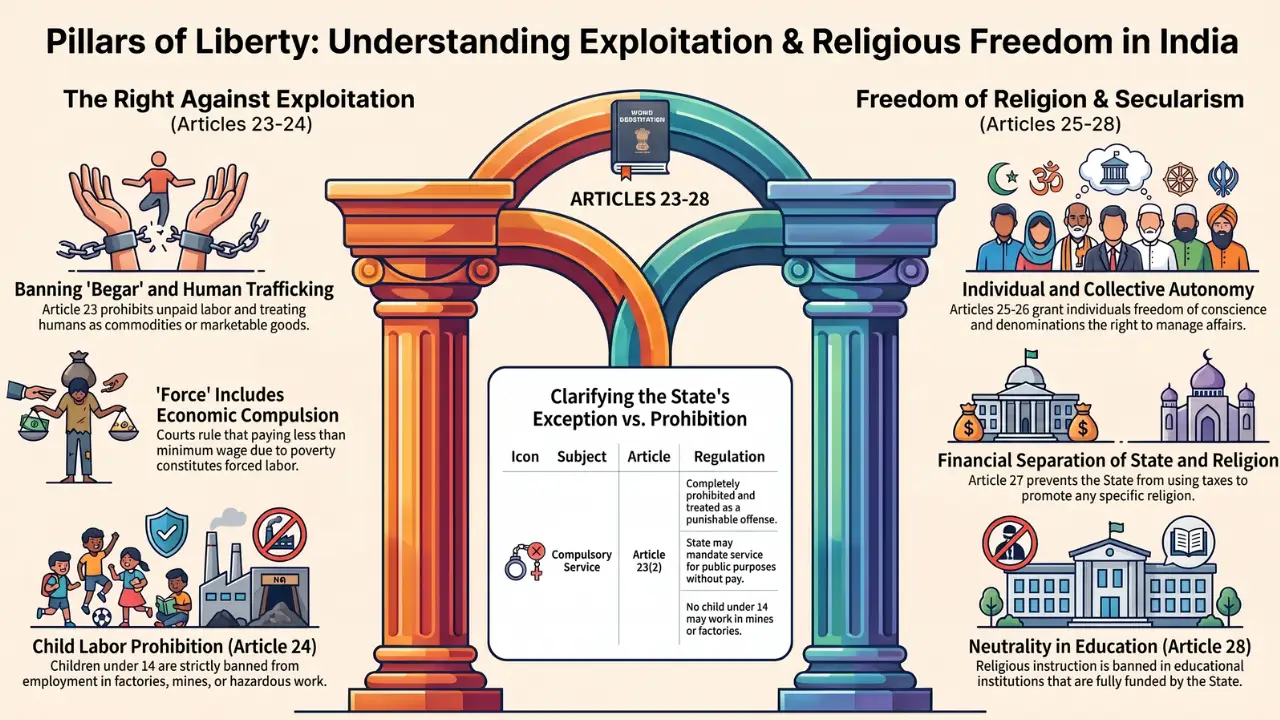
📌 Right Against Exploitation (Article 23 & 24): Quick Summary & Study Notes
These provisions protect human dignity by prohibiting forced labor, human trafficking, and the exploitation of children in hazardous industries.
- Article 23: Bans begar, forced labor, and human trafficking, though allows State-mandated public service.
- Article 24: Prohibits the employment of children below the age of 14 in factories, mines, or hazardous work.
- Judicial Expansion: Courts interpret economic compulsion (paying below minimum wage) as forced labor.
Right to Freedom of Religion (Article 25 & 26)
Guarantees individual freedom of conscience and the collective right of religious denominations to manage their own affairs.
- Article 25: Secures the right to profess, practice, and propagate religion, subject to public order, morality, and health.
- Article 26: Allows religious denominations to manage their religious affairs and administer secular properties.
- Essential Practices Doctrine: Courts intervene when practices are arbitrary or secular, protecting only the core, essential tenets of a faith.
Taxation and Religious Instruction (Article 27 & 28)
Ensures the financial and educational separation of State and religion, forming the bedrock of Indian secularism.
- Article 27: Prohibits the State from compelling citizens to pay taxes dedicated to promoting any specific religion.
- Article 28: Bans religious instruction in fully State-funded educational institutions, maintaining secular public spaces.
- Tax vs. Fee: The State can charge a fee for secular administrative services provided to religious endowments.
📖 Right Against Exploitation (Article 23 & 24): Detailed Q&A
1. Right Against Exploitation (Article 23 and Article 24)
Under Article 23 of the Constitution, the term 'begar' refers to which of the following practices?
Begar strictly denotes a historical system of forced labor where an individual is compelled to work without receiving any wages.
Hide Explanation Hide All Explanations
- Defining the Practice of Begar: The term 'begar' specifically denotes a historical and oppressive system of forced labour where an individual is compelled to work without receiving any wages or remuneration whatsoever. Historically, landlords, local rulers, and wealthy elites imposed begar on marginalised communities, extracting physical labour without any financial compensation. The inclusion of this specific prohibition in the Constitution was deemed necessary to dismantle these exploitative traditional structures and ensure that social justice reached the most vulnerable populations in the country.
- Constitutional Eradication and Dignity: The Constitution strictly prohibits this practice, categorising it as a severe violation of human dignity and personal liberty. It ensures that no citizen or non-citizen can be forced to work against their will for free, placing the right against exploitation firmly within the fundamental rights framework. By explicitly banning begar alongside human trafficking, the drafters of the Constitution aimed to create an egalitarian society where manual labour is respected and adequately compensated, regardless of a person's social or economic standing.
- Statutory Enforcement and Penalties: Any contravention of this constitutional rule is treated as a punishable offence. The Parliament is empowered under Article 35 to enact specific laws to penalise those who force others into unpaid labour. Consequently, legislations such as the Bonded Labour System (Abolition) Act, 1976, were enacted to give statutory teeth to Article 23, ensuring that state machinery actively identifies, rescues, and rehabilitates victims of begar while prosecuting the offenders.
In the landmark case of Sanjit Roy v. State of Rajasthan (1983), the Supreme Court ruled that paying less than the minimum wage for relief work amounts to what?
The Supreme Court ruled that compelling a person to work for less than the statutory minimum wage constitutes forced labor due to economic compulsion.
Hide Explanation Hide All Explanations
- Judicial Expansion of Forced Labour: The Supreme Court broadly interpreted the meaning of 'forced labour' to encompass situations beyond mere physical coercion. It concluded that compelling a person to work for less than the statutory minimum wage directly violates Article 23. The Court recognised that force is not solely physical or legal; economic compulsion, such as extreme poverty, destitution, and hunger, can force a vulnerable person to accept wages far below the minimum acceptable level, which is inherently unconstitutional.
- Exploitation During Natural Calamities: In this specific case, the State argued it was providing employment under a famine relief statute and therefore was justified in paying lower wages to accommodate more workers. However, the Court firmly decided that the State cannot take undue advantage of the helplessness of affected people by paying them inadequate wages during a crisis. The judgment reinforced that constitutional rights do not remain suspended during natural calamities, and the State remains obligated to prevent economic exploitation.
- Upholding Fundamental Human Values: The ruling established a lasting precedent that labour must always be properly and legally compensated. Every form of forced labour, regardless of the socio-economic justification provided by the employer or the State, opposes basic human values and violates fundamental human dignity. This interpretation ensures that the minimum wage laws in the country carry constitutional weight, protecting the poorest segments of the workforce from systemic abuse.
Based on the Supreme Court's ruling in People’s Union for Democratic Rights v. Union of India (1982), how is the word 'force' interpreted under Article 23?
The Supreme Court expanded 'force' to include economic compulsions where poverty forces a person to work against their will.
Hide Explanation Hide All Explanations
- The Asiad Workers Case: This landmark judgment, commonly known as the Asiad Workers case, arose when construction workers engaged for the Asian Games were paid less than the minimum wage. The Supreme Court took this opportunity to comprehensively interpret the ambit of Article 23. The Court observed that the scope of Article 23 is vast and unlimited, striking at forced labour in whichever form it may manifest.
- Recognising Economic Compulsion: Justice Bhagwati explicitly held that the word 'force' under Article 23 has a very wide meaning. It does not merely encompass physical violence or the threat of legal penalisation; it critically recognises economic circumstances that leave a person with no alternative but to provide labour. When poverty and destitution force a person to work against their will on less than minimum wage, it constitutes forced labour just as much as if a physical weapon were used to compel them.
- Liability of Private Individuals: Furthermore, the Court directed the government to take necessary steps for punishing the violation of the fundamental rights of the citizens guaranteed under Article 23 by private individuals. This established that the State has a positive obligation to intervene when private contractors exploit workers, cementing the horizontal application of this fundamental right across the private sector.
Which of the following is a valid exception to the prohibition of forced labour under Article 23(2)?
The State can impose compulsory service for public purposes without pay, provided it doesn't discriminate on religion, race, caste, or class.
Hide Explanation Hide All Explanations
- The Public Purpose Exception: Article 23(2) provides a specific and narrow exception that allows the State to impose compulsory service for public purposes. This implies that the government possesses the constitutional authority to mandate citizens to perform critical duties, such as military conscription for national defence or compulsory social service during emergencies, without violating the prohibition on forced labour.
- Financial and Legal Mechanics: When the State imposes such compulsory service for the benefit of the public, it is not constitutionally obligated to pay wages for that specific service, differentiating it from illegal begar. However, this imposition must be enacted through proper legal channels, as a mere executive order is insufficient to compel citizens into public service without parliamentary or legislative backing.
- The Rule Against Discrimination: A crucial safeguard embedded within this exception is the strict prohibition on discriminatory practices. While imposing this duty, the State is forbidden to make selections or grant exemptions based solely on grounds of religion, race, caste, or class. This ensures that the burden of compulsory public service is shared equitably among the populace, preventing the State from targeting specific minority or marginalised groups to perform uncompensated labour.
The prohibition of 'traffic in human beings' under Article 23 includes which of the following activities?
Traffic in human beings strictly bans treating human lives as marketable goods to be bought or sold.
Hide Explanation Hide All Explanations
- Commodification of Human Lives: The phrase 'traffic in human beings' refers fundamentally to treating human lives as marketable goods. It strictly bans the buying, selling, or letting of men, women, and children as if they were movable property or chattels. This constitutional prohibition addresses deeply rooted historical abuses and aims to protect the bodily autonomy and personal liberty of every individual within the nation's borders.
- Combating Immoral Purposes: The definition of human trafficking is interpreted broadly by the judiciary to include the trafficking of women and children for immoral purposes, such as forced prostitution, sexual slavery, and traditional exploitative practices like the devadasi system. In cases like Vishal Jeet v. Union of India (1990), the Supreme Court observed that human trafficking is both a social and socio-economic issue, directing the State to focus heavily on the rescue and rehabilitation of victims from red-light areas.
- Implementation Through Statutes: To enforce this constitutional mandate, Parliament is empowered to enact stringent penal laws. The primary legislation in this regard is The Immoral Traffic (Prevention) Act, 1956, which criminalises acts that result in the illicit trafficking of human beings. This statutory framework is essential for providing law enforcement agencies with the necessary tools to dismantle trafficking networks and prosecute offenders severely.
Based on the Supreme Court ruling in Deena v. Union of India (1983), what is the legal status of extracting labour from prisoners without paying them?
Extracting labor from prisoners without equitable wages is deemed unconstitutional forced labor under Article 23.
Hide Explanation Hide All Explanations
- Protecting Prisoner Dignity: The Supreme Court has consistently clarified that prisoners do not forfeit their fundamental human rights upon incarceration. Extracting heavy manual labour from prison inmates without providing proper financial compensation is fundamentally unjust and violates their basic dignity. The jurisprudence dictates that rehabilitation, not systemic exploitation, should be the goal of the penal system.
- Classification as Forced Labour: In the landmark judgment delivered by Chief Justice Chandrachud, it was explicitly held that taking labour from prisoners without paying proper remuneration amounts to 'forced labour,' which is strictly prohibited by Article 23 of the Constitution. The State cannot utilize the prison system as a source of free labour to subsidize public works or private contracts.
- Entitlement to Reasonable Wages: The ruling firmly established that prisoners are legally entitled to receive reasonable and equitable wages for the work they perform while serving their sentences. The Court noted that it has a constitutional duty to enforce this claim, ensuring that the State pays inmates a fair wage that can be used to support their families outside or saved for their eventual reintegration into society.
Against whom can a citizen enforce their Right Against Exploitation under Article 23?
Article 23 uniquely provides horizontal application, protecting individuals from exploitation by both State entities and private persons.
Hide Explanation Hide All Explanations
- Horizontal and Vertical Application: Unlike many other fundamental rights that exclusively protect individuals from government overreach, Article 23 is unique in its dual applicability. It protects citizens and non-citizens alike against exploitation by both the State and private persons. This horizontal application is crucial because exploitation, trafficking, and forced labour are overwhelmingly perpetrated by private contractors, landlords, and organized criminal networks rather than direct state actors.
- The State's Positive Obligation: Because this right applies against private citizens, it places a positive constitutional obligation on the State. The government cannot merely abstain from exploiting citizens; it must actively intervene, deploy law enforcement, create stringent laws, and take punitive actions to abolish practices like trafficking and begar wherever they occur in the private sector.
- Judicial Enforcement and Intervention: The courts have consistently held that if a private entity engages in bonded labour or pays less than minimum wages, the State's failure to stop it constitutes a violation of Article 23. In public interest litigations, the judiciary routinely orders state governments to identify, release, and rehabilitate labourers trapped by private entities, reinforcing the universal enforceability of this right.
According to Article 24 of the Constitution, what is the minimum age below which a child cannot be employed in a factory or mine?
Article 24 establishes a firm constitutional baseline banning the employment of children below the age of fourteen in hazardous environments.
Hide Explanation Hide All Explanations
- Establishing a Constitutional Baseline: Article 24 explicitly and unambiguously states that no child below the age of fourteen years shall be employed to work in any factory or mine. This creates a firm, non-negotiable constitutional baseline for child protection in the country, prioritizing the health, safety, and educational development of children over economic output or cheap labour requirements.
- Scope Beyond Factories and Mines: The prohibition extends significantly beyond just factories and mines; it explicitly includes engagement in 'any other hazardous employment'. This ensures that young children are kept out of a wide variety of dangerous environments, such as construction sites, railway operations, and chemical plants, that could permanently harm their physical and mental development.
- Enforceability and Public Health: This provision operates directly in the interest of public health and the safety of life. It is designed to ensure that the tender age of children is not abused due to familial economic necessity. Furthermore, the Supreme Court has declared that the right of a child against exploitation is enforceable even in the absence of specific implementing legislation, allowing immediate judicial intervention to rescue children from hazardous work.
Under the Child Labour (Prohibition and Regulation) Amendment Act, 2016, the employment of adolescents is banned in hazardous occupations. How does the Act define an 'adolescent'?
The 2016 Amendment categorizes a person who has completed 14 years but not 18 years of age as an adolescent.
Hide Explanation Hide All Explanations
- Redefining Age Categories: The Child Labour (Prohibition and Regulation) Amendment Act, 2016, brought significant modernization to existing labour laws by introducing a new, specific legal category called 'adolescent.' An adolescent is defined under the Act as a person who has completed 14 years of age but has not yet completed 18 years of age. This categorization aligns domestic law with international child protection standards.
- Expanding the Prohibition: The 2016 amendment drastically strengthened existing laws by completely forbidding the employment of children (those strictly below 14 years of age) in all occupations and processes, completely removing the distinction between hazardous and non-hazardous work for this age group. The only narrow exceptions permit children to assist in non-hazardous family enterprises strictly after school hours or during vacations.
- Protections and Stringent Penalties: While adolescents (14 to 18 years) are legally allowed to join the workforce, the Act strictly bans their employment in designated hazardous occupations and processes, such as underground mining and handling highly inflammable substances. To enforce these new standards, the amendment introduced stringent penalties, mandating imprisonment and significant financial fines for employers who illegally hire children or adolescents in hazardous work.
In which landmark case did the Supreme Court order the payment of compensation by employers for children working in the hazardous match and fireworks industry in Sivakasi?
In M.C. Mehta v. State of Tamil Nadu, the Supreme Court penalized employers for exploiting children in the Sivakasi fireworks industry.
Hide Explanation Hide All Explanations
- Confronting the Sivakasi Crisis: The landmark Public Interest Litigation of M.C. Mehta v. State of Tamil Nadu (1996) directly confronted the severe exploitation of thousands of children employed in the hazardous matchbox and fireworks manufacturing industries in Sivakasi. The Supreme Court recognized this widespread violation of Article 24 as a pressing national problem, strongly criticizing the state machinery's prolonged failure to implement existing child protection laws.
- Financial Accountability for Employers: To create a powerful deterrent, the Supreme Court ordered the offending industrial employers to pay a substantial compensation of ₹20,000 for every child they had illegally employed in their factories. This financial penalty mechanism was groundbreaking, ensuring that employers faced immediate and severe economic consequences for exploiting child labour in hazardous conditions.
- Mandating State-Sponsored Rehabilitation: The Court directed that the collected compensation be deposited into a dedicated Child Labour Rehabilitation-cum-Welfare Fund. Furthermore, the judgment explicitly linked the ban on child labour with the right to education, emphasizing the State's constitutional duty under the Directive Principles to provide free education, basic nutrition, and holistic rehabilitation to ensure rescued children did not relapse into the labour market.
Which legislative act explicitly prohibits the employment of children below the age of 14 years in industrial premises manufacturing specific tobacco products?
The Beedi and Cigar Workers Act of 1966 explicitly protects children under 14 from the hazardous tobacco sector.
Hide Explanation Hide All Explanations
- Targeting Hazardous Nicotine Exposure: The Beedi and Cigar Workers (Condition of Employment) Act, 1966, was enacted specifically to address the exploitative and deeply hazardous conditions prevalent in the unorganized tobacco sector. The manual rolling of beedis exposes workers, especially young children, to toxic nicotine dust, severe respiratory issues, and stunted growth, necessitating targeted legislative intervention to satisfy the mandate of Article 24.
- Strict Age Prohibitions: To secure the welfare and prosperity of children, the Act lays down a strict and specific prohibition against the employment of any child under the age of 14 years in any industrial premises where beedis and cigars are manufactured. This prohibition operates regardless of whether the manufacturing is done in a large factory setting or a smaller, localized industrial premise.
- Alignment with International Obligations: The enactment of this specific statute reflects India's broader commitment to aligning its domestic labour regulations with international human rights instruments, such as the UN Convention on the Rights of the Child (1989). By systematically closing off specific hazardous sectors like tobacco manufacturing to child labour, the legislative framework provides actionable pathways to enforce the Right Against Exploitation.
2. Right to Freedom of Religion (Article 25 and Article 26)
Under Article 25(1) of the Constitution, what does 'freedom of conscience' fundamentally imply?
Freedom of conscience grants the absolute internal liberty to determine one's spiritual or moral beliefs free from state interference.
Hide Explanation Hide All Explanations
- The Inner Mental Domain: Freedom of conscience refers to the absolute, untouchable inner freedom of an individual to mold, develop, and determine their relationship with their concept of God, spirituality, or morality in whatever manner they desire. It is the foundational cognitive liberty that precedes any outward religious practice. While the physical practice and propagation of religion can be heavily regulated by the State, the internal belief itself remains completely immune to state interference.
- An Inclusive and Universal Guarantee: This constitutional freedom is uniquely broad and inclusive; it guarantees rights to all persons residing in India, applying equally to citizens and non-citizens. Furthermore, it protects the beliefs of theists, atheists, and agnostics alike, ensuring that individuals have the right to reject religious dogma just as strongly as others have the right to hold it.
- The Bedrock of Secular Pluralism: This inner freedom forms the core bedrock of India's secular democratic fabric. It ensures that every individual has the personal liberty to choose their spiritual path without facing systemic disability, penalty, or state-sponsored coercion. The explicit protection of conscience prevents the establishment of state-mandated orthodoxy, promoting a pluralistic society where diverse worldviews coexist peacefully.
In the landmark case of Rev. Stainislaus v. State of Madhya Pradesh (1977), how did the Supreme Court definitively interpret the word 'propagate' in Article 25?
The Supreme Court clarified that propagation allows for the sharing and exposition of religious tenets, not the fundamental right to convert others.
Hide Explanation Hide All Explanations
- Dissemination vs. Conversion: In resolving a critical constitutional question, a five-judge Constitution Bench led by Chief Justice A. N. Ray clarified that the right to 'propagate' religion strictly means the right to transmit, spread, or disseminate one's religious beliefs through the intellectual exposition of its tenets. The Court examined the dictionary definitions and constitutional debates, concluding that propagation is about education and sharing information, not achieving conversions.
- Protecting the Conscience of Others: The Court explicitly ruled that Article 25 does not grant an individual the fundamental right to convert another person to their own religion. The legal reasoning was deeply anchored in the concept of equal rights: because freedom of conscience is guaranteed to all persons equally, allowing one person a fundamental right to convert another would directly impinge on the prospective convert's freedom of conscience.
- Legitimizing Anti-Conversion Statutes: Because forced conversions, or conversions achieved through fraud and allurement, can violently disrupt the social fabric and lead to communal tension, the Court upheld the validity of state-level anti-conversion laws. The ruling established that the State possesses the legislative competence to regulate and penalize exploitative conversions under its mandate to maintain 'public order'.
According to the Supreme Court, why are State legislatures constitutionally competent to enact anti-conversion laws that penalise conversions by 'force, fraud, or allurement'?
Anti-conversion laws are constitutionally valid as they fall under the State's authority to maintain public order.
Hide Explanation Hide All Explanations
- The Public Order Justification: In the Stainislaus judgment, the Supreme Court observed that religious conversions achieved through manipulative tactics—such as physical force, deliberate fraud, or financial allurement—could easily ignite communal passions and disturb public tranquility. By classifying these exploitative conversions as a direct threat to peace, the Court shifted the legal focus from religious doctrine to the maintenance of social harmony.
- State List Authority: The Constitution places the primary responsibility of maintaining 'public order' squarely in the State List (Entry 1 of List II in the Seventh Schedule). Therefore, state governments have unquestionable legislative competence to create laws addressing issues that threaten this order. This jurisdictional clarity is why India has multiple state-level anti-conversion laws rather than a single central statute.
- Contemporary Legal Challenges: While the basic competence of states to enact these laws was upheld in 1977, modern anti-conversion statutes face intense legal scrutiny today. Contemporary challenges before the Supreme Court argue that recent laws use excessively vague definitions of 'allurement,' impose mandatory prior declarations that violate privacy, and reverse the burden of proof, thereby burdening genuinely voluntary and consensual conversions under the guise of public order.
The individual rights guaranteed under Article 25(1) are expressly subject to which of the following limitations?
Religious freedoms are constitutionally restricted by considerations of public order, health, morality, and other fundamental rights.
Hide Explanation Hide All Explanations
- Subordination to Public Welfare: The freedom to profess, practice, and propagate religion is not an absolute right. The framers of the Constitution expressly subordinated this freedom to specific state interests to ensure that religious practices do not undermine the stability and welfare of a democratic society. The State can restrict religious practices if they disturb public order, violate established standards of public morality, or severely endanger public health (such as regulating large gatherings during a pandemic).
- Subordination to Fundamental Rights: Crucially, the text of Article 25 dictates that religious freedom is subject to 'the other provisions of this Part' (Part III of the Constitution). This means religious practices can never be used as a shield to violate other fundamental rights, such as the right to equality before the law (Article 14) or the prohibition of untouchability (Article 17). Religious practices that inherently violate the dignity and equality of citizens are unconstitutional.
- Regulatory Power over Secular Activities: Additionally, Article 25(2) grants the State explicit power to make laws regulating or restricting any economic, financial, political, or other secular activity that may be associated with a religious practice. This ensures that while pure religious rituals are protected, the commercial and administrative operations surrounding those rituals must comply with the general secular laws of the land.
Which specific practice is constitutionally recognized as an integral part of the profession of the Sikh religion under Explanation I of Article 25?
The Constitution specifically acknowledges and protects the wearing and carrying of kirpans as an essential religious practice of Sikhism.
Hide Explanation Hide All Explanations
- Protecting the Articles of Faith: Explanation I of Article 25 explicitly and unequivocally states that the wearing and carrying of kirpans (a ceremonial sword or dagger) shall be deemed to be included in the profession of the Sikh religion. This constitutional carving ensures that a core physical manifestation of the Sikh faith is protected under the fundamental right to profess and practice religion freely, without facing interference from standard public security regulations.
- Preventing Legal Conflicts: By embedding this explanation directly into the constitutional text, the drafters preemptively resolved potential conflicts between general state arms regulations and the essential religious practices of the Sikh community. It serves as a permanent constitutional acknowledgment of the unique tenets of Sikhism, ensuring that practitioners can observe their faith authentically in public life.
- Broadening the Definition for Reform: Furthermore, the architecture of Article 25 includes Explanation II, which serves a different purpose: social reform. It clarifies that for the purposes of state intervention to throw open Hindu religious institutions to all classes, the term 'Hindus' shall be construed broadly to include persons professing the Sikh, Jaina, or Buddhist religions, ensuring that social reform measures reach across related sub-continental faiths.
In Bijoe Emmanuel v. State of Kerala (1986), the Supreme Court protected the right of Jehovah's Witnesses students who refused to sing the National Anthem. On what primary grounds was this decided?
The Court protected the students' right to silence, noting that forced singing against deeply held religious beliefs violated Articles 19 and 25.
Hide Explanation Hide All Explanations
- The Conflict of Conscience and Civic Duty: The case arose when three children belonging to the Jehovah's Witnesses faith stood respectfully during the daily singing of the National Anthem at their school but firmly refused to sing it. Their deeply held religious beliefs forbade them from participating in any rituals or recitations that amounted to worshipping any entity or authority other than their God. Viewing this silence as unpatriotic, the school authorities expelled the children.
- Protecting Silence and Faith: The Supreme Court intervened, noting critically that the children never insulted or disrupted the anthem; standing in respectful silence adequately fulfilled their civic duty under the law. The Court ruled that compelling them to sing against their genuine, conscientiously held religious beliefs explicitly violated their fundamental right to freedom of religion under Article 25, as well as their freedom of speech and expression under Article 19(1)(a), which inherently includes the right to remain silent.
- The True Test of Democracy: Justice O. Chinnappa Reddy delivered a profound observation that resonated through Indian jurisprudence: the real test of a true democracy is the ability of even an insignificant, highly marginalized minority to find its identity and protect its beliefs under the country's Constitution. The judgment underscored that enforced patriotic conformity cannot override genuine religious conscience in a secular, tolerant society.
Recent judicial shifts post-Stainislaus, notably relying on Article 21 (Right to Privacy), highlight what critical aspect regarding religious conversion and choice?
Modern rulings frame the choice of faith and decisional autonomy as deeply protected elements of an individual's personal liberty and privacy.
Hide Explanation Hide All Explanations
- Evolution of Privacy Jurisprudence: While the 1977 Stainislaus judgment focused heavily on state power and the maintenance of public order, recent Supreme Court rulings have dramatically expanded the understanding of religious freedom through the modern lens of privacy and decisional autonomy. The landmark Right to Privacy judgment (K.S. Puttaswamy v. Union of India, 2017) formally recognized that 'decisional privacy' and absolute personal autonomy over one's deepest beliefs are inseparable from the right to life and liberty under Article 21.
- Affirming Personal Liberty in Faith: Subsequent high-profile cases, such as Shafin Jahan (2018) and Salamat Ansari (2020), heavily relied on this privacy framework. These courts firmly affirmed that an adult's freedom to choose their faith, just like the freedom to choose their life partner, is a non-negotiable core aspect of their personal liberty that the State cannot casually interfere with.
- Challenging Bureaucratic Overreach: This profound shift in constitutional interpretation forms the foundation for current legal challenges against stringent state anti-conversion laws. Legal scholars and petitioners argue that modern statutory requirements—such as mandating 30 to 60 days of prior notice to a District Magistrate before changing one's faith—blatantly violate a citizen's fundamental right to privacy and decisional autonomy by placing deeply personal choices under invasive state surveillance.
Article 26 guarantees specific institutional rights to every 'religious denomination.' According to the Supreme Court's established tests, which of the following criteria is required for a group to be considered a religious denomination?
The Supreme Court requires a religious denomination to have a common faith, a unified organization, and a distinctive name.
Hide Explanation Hide All Explanations
- Establishing Institutional Identity: The Constitution grants powerful institutional rights under Article 26 but refrains from defining what constitutes a 'religious denomination.' Consequently, the Supreme Court developed a rigorous three-part test to identify one, ensuring that only legitimately organized faith groups receive these specific, elevated constitutional protections.
- The Three-Pronged Criteria: The first foundational condition is that the group must be a collection of individuals united by a common faith or a system of beliefs and doctrines which they regard as conducive to their spiritual well-being. Secondly, the group must possess a common structure or organization; shared spiritual sentiment alone is legally insufficient to claim institutional rights. Finally, the group must be designated by a distinctive, recognizable name.
- Application in the Auroville Case: The stringency of this test was demonstrated in the famous Auroville case (S.P. Mittal v. Union of India, 1983). The Supreme Court applied these criteria and concluded that the Sri Aurobindo Society did not qualify as a religious denomination. The Court held that Aurobindo's teachings constituted a broad philosophy rather than a distinct religion, meaning the society could not claim the protections of Article 26 against government intervention.
What critical legal distinction did the Supreme Court establish in the Shirur Mutt Case (1954) regarding the rights under Article 26?
The Shirur Mutt ruling separated absolute religious autonomy from secular property administration, which the State can regulate.
Hide Explanation Hide All Explanations
- Creating Two Separate Legal Domains: In the landmark Shirur Mutt case, the Supreme Court was tasked with resolving the tension between state regulation and religious autonomy. The Court drew a sharp, defining line between a denomination's fundamental right to manage its own affairs in 'matters of religion' (Article 26(b)) and its lesser right to administer its property (Article 26(d)).
- Absolute Autonomy in Religious Affairs: The Court emphatically held that a denomination enjoys near-absolute autonomy over its 'matters of religion.' This means the core rituals, ceremonies, doctrines, and modes of worship cannot generally be interfered with, audited, or altered by legislative or executive action. The State has no business dictating how a faith should conduct its spiritual affairs.
- State Regulation of Secular Assets: Conversely, the administration of property, the management of massive trust funds, and the leasing of land are entirely secular activities. Therefore, the State is constitutionally permitted to enact laws regulating how religious property is managed to prevent fraud and mismanagement. However, the State cannot entirely strip the denomination of its property administration rights; it can only regulate it 'in accordance with law'.
Which judicial doctrine, born out of the Shirur Mutt Case, requires courts to look into the tenets of a religion to decide if a practice receives constitutional protection?
The Essential Religious Practices doctrine allows courts to assess whether a ritual is a core tenet deserving constitutional protection.
Hide Explanation Hide All Explanations
- Origins and Purpose of the Doctrine: The 'Essential Religious Practices' (ERP) doctrine was fashioned by the Supreme Court for the very first time in the 1954 Shirur Mutt case. Faced with claims that every minor ritual and secular administrative act was protected by religious freedom, the Court established this test to filter out secular or superstitious practices from genuine constitutional protection.
- Determining What is Essential: Under this doctrine, the Court determined that what constitutes an 'essential' part of a religion must be ascertained with reference to the core doctrines, scriptures, and historical tenets of that religion itself. If a practice is found to be peripheral, optional, or merely a later addition not integral to the faith's survival, it can be heavily regulated or outright banned by the State without violating Article 25 or 26.
- Contemporary Dilemmas and Criticism: Over decades, this doctrine has been applied in cases ranging from the Ananda Margis' tandava dance to the acquisition of mosque land in Ayodhya. However, it faces intense criticism from legal experts. Critics argue the doctrine places secular judges in a theological dilemma, forcing them to act as religious scholars determining what believers should find essential, rather than protecting what believers actually hold sacred.
In the Shayara Bano v. Union of India (2017) case, why did the Supreme Court strike down the practice of instantaneous Triple Talaq (talaq-e-biddat)?
Instant Triple Talaq was struck down because it was manifestly arbitrary and lacked constitutional protection as an essential religious practice.
Hide Explanation Hide All Explanations
- Challenging Arbitrary Divorce: The constitutional challenge in Shayara Bano centered on the practice of talaq-e-biddat (instant triple talaq), a unilateral system allowing a Muslim man to instantly and irrevocably divorce his wife by uttering the word 'talaq' three times. The petitioners argued that this sudden, unappealable severing of marriage deeply violated the fundamental rights to equality, dignity, and personal liberty guaranteed under the Constitution.
- Application of the ERP Test: The Supreme Court heavily utilized the 'Essential Religious Practices' doctrine to evaluate the constitutional claim that this practice was protected under freedom of religion. Through rigorous theological and legal analysis, the Court examined whether this specific, instant form of divorce was a core, unalterable tenet mandated by the Islamic faith and the Quran.
- The Groundbreaking Ruling: A multi-judge bench determined that instant triple talaq is an irregular and frowned-upon practice in theology, and certainly not an essential religious practice in Islam. Therefore, it does not enjoy the protective shield of Article 25. Stripped of religious protection, the practice was struck down as being manifestly arbitrary and violative of fundamental rights, representing a major triumph for gender justice within personal law frameworks.
How did the Supreme Court resolve the constitutional conflict between the State's power to open Hindu temples to all classes (Article 25(2)(b)) and a religious denomination's right to manage its own religious affairs (Article 26(b))?
The Court applied harmonious construction to ensure social reform while safeguarding the religious autonomy of denominations.
Hide Explanation Hide All Explanations
- The Constitutional Collision: In the complex case of Sri Venkataramana Devaru v. State of Mysore (1958), a direct and severe conflict arose between two powerful constitutional provisions. The State Government sought to throw open a particular temple to all Hindus, including marginalized castes, to ensure social equality and reform under Article 25(2)(b). Conversely, the specific denomination managing the temple claimed the absolute right to exclude outsiders to manage its own religious affairs and rituals under Article 26(b).
- Applying Harmonious Construction: To resolve this deadlock, the Supreme Court utilized the established legal principle of 'harmonious construction.' This doctrine dictates that when two constitutional provisions seem to contradict, they must be interpreted in a way that gives effect to both, ensuring that neither provision is completely destroyed or rendered meaningless.
- The Balanced Compromise: The Court achieved this balance by ruling that the temple must generally be thrown open to all classes of Hindus, thereby fulfilling the paramount constitutional mandate of social reform and eradicating untouchability. Simultaneously, the Court protected the core of the denomination's autonomy by allowing them to retain exclusive control over specified, highly sacred ceremonies during particular religious occasions, successfully balancing radical social equality with the preservation of minority religious freedom.
In which landmark 1994 judgment did the Supreme Court definitively state that secularism is a basic feature of the Constitution, thereby ruling that an anti-secular state government can be dismissed?
The S.R. Bommai case established secularism as an unalterable basic feature, authorizing the dismissal of overtly anti-secular state governments.
Hide Explanation Hide All Explanations
- Redefining Centre-State Relations: The S.R. Bommai v. Union of India (1994) judgment is monumental not just for curtailing the arbitrary misuse of President's Rule under Article 356, but for its profound declaration regarding the ideological identity of the Indian State. The nine-judge bench firmly cemented the principle that the State must remain rigorously neutral in matters of religion and treat all faiths equally, officially declaring secularism to be an unalterable basic feature of the Constitution.
- Political Accountability for Secularism: The Court made a groundbreaking assertion with massive political implications: if a democratically elected state government engages in activities that are overtly anti-secular, it is actively acting contrary to the fundamental constitutional mandate. Such actions—including the failure to protect religious minorities or actively mixing state resources with religious dogma—provide wholly valid constitutional grounds for the President to dismiss the state government.
- Severing Religion from Politics: The judgment heavily emphasized that religion and politics cannot be mixed in a secular democracy. It declared that political parties appealing to religion for electoral gain, or relying on religious identity for political sustenance, subvert the core intent of the Constitution. This ruling provides the overarching ideological framework for interpreting the Right to Freedom of Religion, ensuring that no religious right is interpreted in a way that allows the creation of a theocratic state.
3. Taxation and Religious Instruction (Article 27 and Article 28)
Why are financial contributions levied by the State on religious endowments for their secular administration considered legally valid, despite the prohibitions in Article 27?
State levies on religious bodies are valid if they are a 'fee' for secular administrative services, unlike prohibited religious 'taxes'.
Hide Explanation Hide All Explanations
- Deconstructing the Financial Levy: Article 27 prevents the State from using its coercive power of taxation to bankroll any particular faith. However, the Supreme Court draws a very sharp legal distinction between a 'tax' and a 'fee.' A tax is a compulsory exaction imposed for general public purposes without any direct return service to the payer, and its proceeds merge into the general revenue of the State. Article 27 specifically and exclusively bars a tax.
- The Quid Pro Quo Requirement: A fee, on the other hand, fundamentally involves a quid pro quo—a direct correlation and specific service rendered in return for the payment. The money collected through a fee must be earmarked specifically for that service and not merged into the general revenue pool. If the government provides a service, it can charge a fee for it, even to a religious institution.
- Secular Administration Services: In landmark cases like the Shirur Mutt judgment, the government levied annual financial charges on Hindu religious institutions to cover the costs of a government-appointed commissioner tasked with auditing and managing their secular financial affairs. Since these funds were used strictly to meet the administrative cost of providing this secular oversight—and not for promoting or maintaining the religion itself—the courts ruled they were valid fees, not taxes, and therefore did not violate Article 27.
Article 27 of the Constitution prohibits the State from compelling any person to pay taxes for what specific purpose?
Article 27 protects taxpayers from being forced to financially support the promotion or maintenance of any specific religion.
Hide Explanation Hide All Explanations
- The Core of Financial Secularism: Article 27 ensures that the State cannot use its formidable coercive power of taxation to collect money that is specifically earmarked for the promotion or maintenance of any particular religion or religious denomination. This provision is a crucial financial cornerstone of Indian secularism, ensuring the separation of the state treasury from religious propagation.
- Protecting the Taxpayer's Conscience: The primary rationale behind this article is to protect the individual taxpayer's freedom of conscience. It mandates that public funds, collected involuntarily from taxpayers of various diverse faiths (as well as those holding no faith), cannot be used to bankroll, subsidize, or favor one specific religious faith over others. No citizen should be forced to financially support a religion they do not believe in.
- The Equal Treatment Caveat: It is legally notable that the prohibition applies strictly if the tax favors a particular religion. If the State were to theoretically use general tax funds to benefit all recognized religions equally, without any discrimination or preference, it might not technically violate the exact wording of this specific article. However, in practice, such equal funding of religion by the State is exceedingly rare and heavily scrutinized under the broader secular mandate of the Constitution.
According to Article 28(1), what is the definitive constitutional rule regarding religious instruction in educational institutions wholly maintained out of State funds?
Article 28 completely bans religious instruction in any educational institution entirely funded by the State.
Hide Explanation Hide All Explanations
- Absolute Prohibition: Article 28(1) mandates a complete, total, and unconditional prohibition of religious instruction in any educational institution that is wholly maintained out of State funds. This is the strictest category within Article 28, allowing no room for compromise or localized school board decisions.
- No Room for Consent: Unlike other clauses in Article 28 that allow for religious instruction if the student or parent provides voluntary consent, there is absolutely no provision for voluntary participation here. Even if every single student and parent in the school unanimously consents, religious instruction cannot be imparted in these specific institutions.
- Securing Secular Public Spaces: The fundamental constitutional rationale is to ensure that taxpayer money, which belongs to citizens of all faiths equitably, is never used to propagate or instruct any specific religion in public schools. This clause is vital for maintaining the secular character of state-run education, ensuring that public schools remain inclusive, neutral spaces for academic learning rather than divisive centers for religious indoctrination.
Under Article 28(2), religious instruction is permitted in an educational institution if it is administered by the State but was originally established under what specific condition?
If an institution was founded by a religious trust mandating religious instruction, it is allowed even if currently administered by the State.
Hide Explanation Hide All Explanations
- Honoring Founders' Intent: Article 28(2) provides a highly specific and narrow exception to the general ban on religious instruction in state-run facilities. It applies exclusively to educational institutions that are currently administered by the State, but were originally founded and established by a religious trust or private endowment.
- The Superiority of the Trust Deed: If the original foundational terms of that specific trust or endowment explicitly require that religious instruction must be imparted in the institution, the State is constitutionally bound to honor those historical terms. Even though the State has taken over the secular administration of the school, it cannot overwrite the religious stipulations laid down by the original private founders.
- Balancing Autonomy and Administration: This provision strikes a delicate, pragmatic balance between constitutional secularism and institutional autonomy. It ensures that historic religious endowments and philanthropic educational initiatives are not effectively destroyed or stripped of their identity when financial or administrative difficulties force the State to take over their management. In these specific institutions, imparting the stipulated religious instruction is fully permitted.
For educational institutions recognised by the State or receiving aid out of State funds, what does Article 28(3) strictly require before a student can participate in religious instruction?
Participation in religious instruction in State-aided or recognized private schools must be strictly voluntary and require consent.
Hide Explanation Hide All Explanations
- The Principle of Voluntary Participation: Article 28(3) governs the middle ground of educational institutions: those that are not fully funded by the State, but either receive partial State aid or rely on official State recognition to operate. Because these are essentially private institutions operating with state support, they are allowed to conduct religious instruction or religious worship on their premises.
- Consent is Non-Negotiable: However, a strict constitutional safeguard is applied: no person attending the institution can be compelled or required to participate in this religious instruction or worship against their will. The participation must be entirely voluntary. Furthermore, if the student is a minor, they cannot legally participate in the religious instruction unless explicit, voluntary consent is provided by their parent or legal guardian.
- Protecting the Vulnerable Student: This clause brilliantly protects the individual freedom of conscience of students attending private but government-aided schools. It ensures that financial aid or official recognition given to an institution does not inadvertently become a tool for coerced religious participation, protecting students from facing academic penalties for refusing to participate in the school's religious activities.
In Aruna Roy v. Union of India (2002), how did the Supreme Court distinguish between prohibited 'religious instruction' and permissible 'value-based education'?
The Court ruled that the academic study of religious philosophy for value-based education is distinct from unconstitutional religious indoctrination.
Hide Explanation Hide All Explanations
- Challenging the National Curriculum: The nuances of Article 28 were heavily tested in a Public Interest Litigation that challenged the National Curriculum Framework for School Education (NCFSE). The petitioners argued that the framework's inclusion of education regarding various religions violated the strict secular mandate of Article 28, fearing it would introduce religious indoctrination through the backdoor.
- Defining Indoctrination vs. Academics: The Supreme Court clarified the crucial difference between instructing and educating. The Court defined 'religious instruction' as teaching the specific customs, ways of worship, and rituals of a religion with the explicit aim of indoctrination and compulsion. This form of teaching is what Article 28 prohibits in state-funded schools.
- Upholding Value-Based Education: In contrast, the Court upheld the NCFSE, stating that the objective, academic study of religious philosophy and the historical essentials of all religions for the purpose of imparting broad, value-based education is fundamentally different from religious instruction. The judgment emphasized that knowing about different religions fosters tolerance, secularism, and social harmony, and is perfectly valid and necessary within the constitutional framework of Article 28.