

French East India Company (1664): Founder, Factories & MCQ
The French East India Company was formed by Jean-Baptiste Colbert under the royal charter of King Louis XIV.
Established in August 1664, it was officially named the Compagnie Française des Indes Orientales. Colbert, serving as Finance Minister, designed it as a heavily state-sponsored enterprise funded by the royal treasury. Its primary goal was to bypass intermediaries and capture a lucrative share of the Asian spice and textile trade, directly competing with the established British and Dutch East India Companies in the Indian subcontinent.
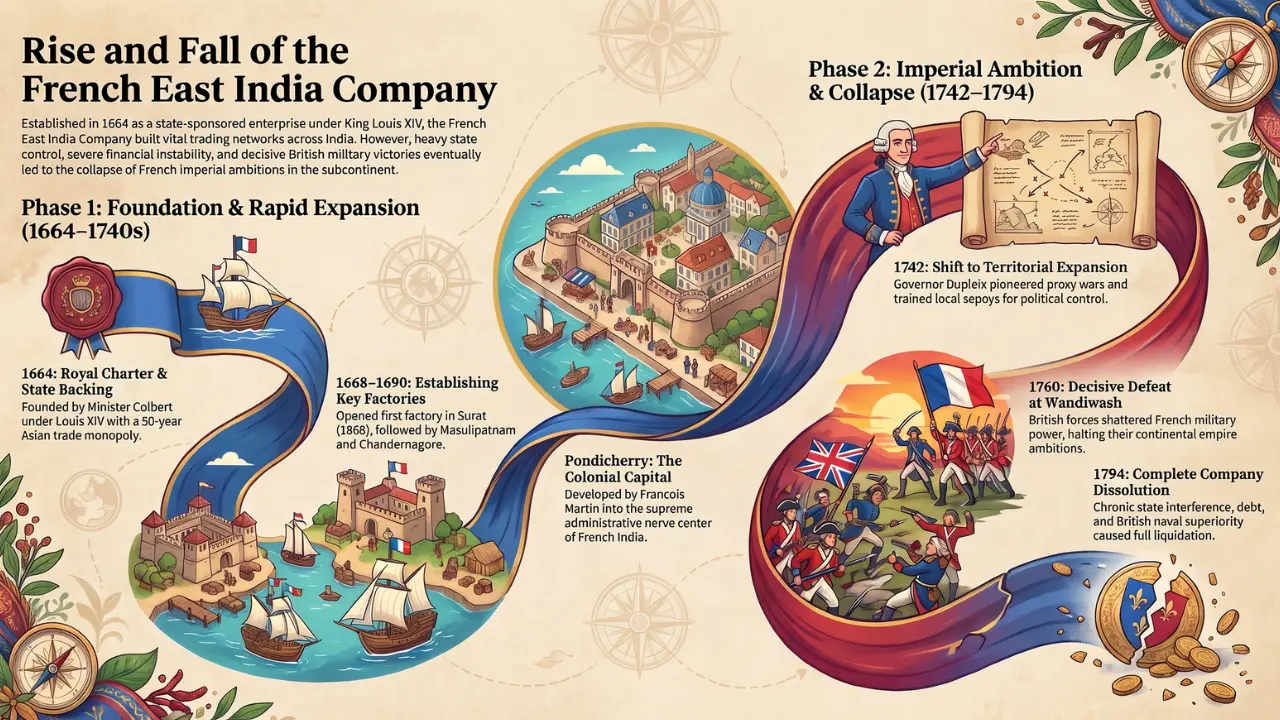
📌 French East India Company: Ambition, Expansion, and Decline: Quick Summary & Study Notes
A comprehensive overview of the commercial ambitions, geopolitical struggles, and ultimate downfall of the French colonial enterprise in India.
- Foundation & Monopoly: Established by Jean-Baptiste Colbert under King Louis XIV in 1664 as a highly state-sponsored enterprise with a maritime monopoly.
- Strategic Expansion: Expanded rapidly with key settlements in Surat, Masulipatnam, and the central administrative hub of Pondicherry.
- Imperial Ambition: Under Governor Dupleix, the focus shifted from commerce to territorial control, initiating proxy wars and utilizing indigenous sepoy mercenaries.
- Decline & Legacy: Chronic financial instability, lack of naval power, and defeats by the British led to the company's dissolution, though a cultural legacy remained until 1954.
📖 French East India Company: Ambition, Expansion, and Decline: Detailed Q&A
1. Foundations of the French Commercial Enterprise
Who is the founder of the French East India Company?
Jean-Baptiste Colbert founded the company to capture global trade wealth for France under mercantilist principles.
Hide Explanation Hide All Explanations
- The Vision of the Founder: Jean-Baptiste Colbert, serving as the Finance Minister to King Louis XIV, is universally recognized as the primary architect and founder of the French East India Company. He perceived the immense wealth being generated by the English and Dutch maritime fleets in the East and realized that France required a similar vehicle to project its economic power globally.
- State-Sponsored Enterprise: Unlike the British and Dutch models, which relied heavily on private joint-stock investments and operated with significant autonomy, Colbert designed the French enterprise as a state-sponsored entity. He successfully persuaded King Louis XIV to provide the foundational royal charter and significant financial backing, ensuring that the monarchy held ultimate control over the company's strategic direction.
- Strategic Commercial Objectives: The primary objective of this new commercial vehicle was to capture a lucrative share of the highly competitive Asian market. Colbert's long-term strategy involved not only economic enrichment through the trade of spices, textiles, and indigo but also the establishment of a robust French geopolitical presence in the Eastern Hemisphere.
- Long-term Implications: This structural foundation ultimately set the stage for centuries of intense imperial rivalry in the Indian subcontinent against other well-established European powers.
The French East India Company was formed by the charter of which monarch?
King Louis XIV issued the royal charter in 1664 and provided significant financial backing.
Hide Explanation Hide All Explanations
- Royal Patronage and Financial Backing: The French East India Company was officially formed by a royal charter issued during the reign of King Louis XIV in 1664. The monarch's direct financial investment was critical for launching the initial maritime expeditions, as he personally funded three million livres of the initial fifteen million livres capital to offset early losses and encourage reluctant private investors.
- Structural State Dependency: Because the charter was issued directly by the absolute monarch, the company lacked the agile, independent decision-making capabilities enjoyed by its European rivals. The French company was fundamentally structurally dependent on the French Crown for both its leadership appointments and its ongoing financial survival.
- Grant of Maritime Monopoly: Through this sweeping royal charter, King Louis XIV granted the newly formed company a fifty-year monopoly on all French trade across the Indian and Pacific Oceans. This legal decree gave the organization exclusive rights to negotiate treaties with foreign rulers, conduct international trade, and establish fortified commercial settlements across the designated regions without domestic French competition.
- Consequences of Royal Control: While providing initial security, this deep royal involvement heavily bureaucratized the company's operations, making it difficult to adapt to sudden market shifts in Asia.
The French East India Company established its operations in which year?
The company was established in 1664, making France a late entrant into the Asian trade market.
Hide Explanation Hide All Explanations
- Late Entry into the Asian Market: The company was formally established in August 1664, making the French the last of the major European maritime powers to enter the highly competitive Asian trade market. The English East India Company had already been established in 1600, and the Dutch East India Company followed closely in 1602.
- Consolidation of Earlier Ventures: At the exact time of its foundation, the new enterprise did not start entirely from zero; it absorbed several earlier, fragmented, and largely unsuccessful French trading operations. These included the operations of the Compagnie de Madagascar and the Compagnie de Chine.
- Initial Capitalization Challenges: The initial capital for the East India Company was ambitiously set at fifteen million livres, divided into shares of one thousand livres each. However, the French merchant class was highly skeptical of the venture's viability, leading to slow public investment.
- Strategic Impact of Late Entry: Entering the market decades after the British and Dutch forced the French to aggressively seek out unexploited opportunities and alliances in a heavily contested region.
What was the official original name of the Francisi East India Company?
The company was officially named Compagnie Française des Indes Orientales to designate its eastern commercial mandate.
Hide Explanation Hide All Explanations
- Official Nomenclature and Scope: The official French name bestowed upon the enterprise upon its formal creation in 1664 was the Compagnie Française des Indes Orientales. This translates directly to the French East India Company, explicitly defining its geographic and commercial mandate.
- Distinction from Western Operations: The deliberate inclusion of the word 'Orientales' (Eastern) was crucial for administrative and legal clarity. It served to sharply differentiate this entity from the Compagnie des Indes Occidentales (French West India Company), which was also established in the same year.
- Subsequent Restructurings: Throughout its turbulent history, the company underwent several severe financial crises that necessitated major restructurings and name modifications. In 1719, seeking to save the struggling enterprise, it was absorbed by the Scottish economist John Law's grand financial system and became part of the broader Compagnie des Indes.
- Legacy of the Name: Despite later absorptions into broader financial systems, the original identity remained synonymous with French colonial ambitions and trade in Asia.
When did French came to India?
The French initiated their physical presence in India with a major expedition that departed in 1667.
Hide Explanation Hide All Explanations
- Launch of the First Expedition: While the overarching company was legally founded in France in 1664, the French officially initiated their physical presence in India when a major, heavily equipped maritime expedition was dispatched in 1667.
- Arrival on the Subcontinent: The ambitious expedition successfully navigated the perilous sea routes to reach the western coast of India, eventually arriving at the bustling, cosmopolitan port city of Surat.
- Strategic Command of the Fleet: This pivotal maiden expedition was placed under the seasoned command of François Caron. His extensive prior experience, having spent over three decades working for the rival Dutch East India Company in Asia, made him the most qualified candidate to lead the French entry.
- Establishing the Foothold: This monumental journey ultimately paved the way for the logistical setup of their first factory in Surat the following year.
2. The First Establishments
Where in India was the first French factory established?
The first French factory was established in Surat, a premier center for international trade under the Mughal Empire.
Hide Explanation Hide All Explanations
- Strategic Selection of Surat: The first factory of the French in India was deliberately established in Surat, which was at the time the premier center for international maritime trade under the vast Mughal Empire. It was the most logical and strategically sound starting point due to its highly developed commercial infrastructure.
- Initiation of Commercial Operations: Setting up operations in Surat allowed the newly arrived French merchants to immediately plug into the lucrative Mughal commercial network. The factory initially focused its capital on procuring high-demand Indian commodities such as fine textiles, indigo, and various spices.
- Navigating Fierce Competition: By establishing their very first base in Surat, the French willingly inserted themselves into a highly competitive and often hostile environment. The English and the Dutch already possessed well-established, fortified factories in the exact same city.
- Enduring Significance: Surat acted as the critical proving ground for French merchants to quickly adapt to local customs and establish vital commercial relationships.
French came to India in which year to establish their first factory?
The French officially established their first functioning trading factory in Surat in 1668.
Hide Explanation Hide All Explanations
- The Foundation Year: Although the initial exploratory expedition departed from France in 1667, the year 1668 is universally recognized by historians as the year the French officially established their first functioning factory in India.
- Securing Mughal Permissions: Before physical operations and trading could begin in 1668, the French delegation had to carefully navigate regional diplomacy to secure the necessary permissions from the local Mughal authorities. Operating a factory required an official royal decree, known as a firman.
- The Definition of a Factory: In the historical context of seventeenth-century European colonialism, the 1668 establishment in Surat was absolutely not a manufacturing plant. It was a 'factory' in the traditional mercantile sense—a secure, often fortified warehouse and trading station.
- Operational Commencement: The legal acquisition of the firman and the subsequent opening of this trading post marked the true beginning of French commercial activity in the subcontinent.
Who founded the first French factory in India?
François Caron, an experienced merchant, founded the first French factory in Surat.
Hide Explanation Hide All Explanations
- Leadership of the Initial Expedition: François Caron, a highly experienced merchant of Huguenot descent, was the individual responsible for personally founding the first French factory in India. He was specifically recruited and heavily compensated by Jean-Baptiste Colbert.
- Prior Experience with the Dutch: Before defecting to the French enterprise, Caron had spent over thirty years working loyally for the rival Dutch East India Company (VOC). He had risen through the ranks to serve as the Director-General of the VOC in Asia.
- Executing a Successful Establishment: Under Caron's shrewd leadership, the French delegation successfully navigated the notoriously complex local politics of Surat. His proven ability to secure essential trading rights and rapidly organize the physical infrastructure of the factory laid the essential groundwork.
- Lasting Impact: His unparalleled expertise in Asian trade dynamics gave the fledgling French enterprise the immediate credibility it needed to survive in a fiercely guarded market.
Who was the head of French company when it first established its presence in India?
François Caron was the first Director-General and head of the French company in India.
Hide Explanation Hide All Explanations
- Role as Director-General: When the French East India Company began its physical operations in Asia, François Caron was officially appointed as its first Director-General. In this supreme executive capacity, he was the absolute head of the company's affairs in India.
- Aggressive Expansion Policies: As the head of the company, Caron emphatically did not limit French ambitions solely to the western port of Surat. Recognizing the urgent strategic need to diversify their trading posts, he immediately initiated bold plans to expand to the eastern Coromandel Coast.
- Tragic End of Tenure: Caron's dynamic leadership came to an abrupt end during a period of escalating maritime conflict with the Dutch. After suffering military setbacks on the Coromandel Coast, he was recalled to Europe in disgrace and tragically died at sea.
- Pioneering Vision: Despite his controversial and tragic departure, Caron's initial aggressive expansion strategy set a lasting precedent for future French colonial ambitions in the East.
Where was the second French factory in India established?
The second French factory was established at Masulipatnam on the Coromandel Coast in 1669.
Hide Explanation Hide All Explanations
- Expansion to the Eastern Coast: Following their initial commercial success on the western coast in Surat, the French East India Company proactively sought to expand its footprint to secure access to different textile markets. In 1669, they established their second major factory at Masulipatnam.
- Securing the Royal Decree: To operate legally and safely in Masulipatnam, the French had to engage in complex regional diplomacy separate from the Mughal Empire. They successfully obtained a valuable patent, or firman, directly from the Sultan of Golconda.
- The Role of Marcara: The establishment of the Masulipatnam factory was masterfully spearheaded by Marcara, a skilled Persian merchant who had originally accompanied François Caron on the initial 1667 expedition from France.
- Strategic Diversification: This pivotal move to the eastern coast diversified the company's trading portfolio, giving them vital, untaxed access to high-demand Coromandel textiles.
3. The Rise of Pondicherry and Regional Expansion
Which city was known as the nerve center and capital of the French empire in India?
Pondicherry served as the central administrative and commercial capital for all French colonial possessions in India.
Hide Explanation Hide All Explanations
- Foundation and Rapid Growth: Acquired initially as a small plot of land in 1673 and formally established as a settlement in 1674, Pondicherry rapidly grew to become the most vital and populous settlement for the French in India.
- Central Administrative Headquarters: Pondicherry served as the absolute central administrative capital for all French colonial possessions scattered across the subcontinent. The powerful Governor-General of French India permanently resided here, alongside the Conseil Supérieur.
- Epicenter of Rivalry with the British: Because of its immense strategic location and tremendous economic value, Pondicherry became the primary military target for rival European powers. It served as the central staging ground for French military operations during the devastating Carnatic Wars.
- A Symbol of French Power: The fortified city stood as the ultimate symbol of French imperial prestige, acting as a direct, heavily armed counterweight to the nearby British stronghold of Madras.
Which city is called France of India?
Pondicherry is famously called the 'France of India' due to its distinct colonial architecture and cultural heritage.
Hide Explanation Hide All Explanations
- Enduring Cultural Nicknames: Pondicherry is widely celebrated in modern times and affectionately referred to as the 'France of India' or 'India's Little France.' It has also earned the prominent title of 'The French Riviera of the East'.
- Unique Architectural Legacy: The city earned these evocative nicknames largely due to its highly unique urban planning and meticulously preserved architecture. The French laid out the town on a strict, orderly grid pattern, building elegant villas and grand administrative buildings.
- Lingering Cultural Influence: Even many decades after the formal end of colonial rule, the distinct French cultural essence remains deeply embedded in the city's daily life, including the active use of the French language.
- Tourism and Preservation: Today, this carefully preserved colonial aesthetic continues to draw international visitors seeking a unique and legally preserved blend of French and Indian cultures.
Who is considered the real founder of Pondicherry?
Francois Martin is considered the true founder for transforming Pondicherry into a flourishing permanent settlement.
Hide Explanation Hide All Explanations
- Transformation of the Territory: While Bellanger de l'Espinay initially took up residence in the general area in 1673, it was the visionary administrator Francois Martin who is historically recognized as the true founder and developer of the colony.
- Strategic Development and Fortification: Under Martin's diligent and highly capable leadership, Pondicherry was extensively fortified against both land and sea attacks. He managed to maintain excellent, mutually beneficial relations with local Indian rulers.
- Stewardship Through Severe Crisis: Martin skillfully guided Pondicherry through severe early existential challenges, including its devastating capture by the Dutch military in 1693, later resuming his post to oversee immense prosperity.
- Architect of Prosperity: His ability to attract thousands of indigenous merchants, weavers, and artisans to voluntarily settle within the borders laid the foundation for decades of commercial growth.
The Treaty of Ryswick (1697) resulted in the return of Pondicherry to the French from which European power?
The Treaty of Ryswick mandated that the Dutch return Pondicherry to the French after its capture in 1693.
Hide Explanation Hide All Explanations
- The Devastating Dutch Capture: During the broader European conflict known as the Nine Years' War, fierce colonial hostilities inevitably spilled over into the Indian theater. In 1693, heavily armed Dutch forces laid a brutal siege to and successfully captured Pondicherry.
- Complex European Peace Negotiations: The exhausting conflict in Europe finally concluded with the signing of the Treaty of Ryswick in September 1697. This comprehensive treaty mandated the strict mutual restoration of all colonial territories captured during the war.
- The Delayed Handover: Although the treaty was officially signed in 1697, the actual physical transfer of power in India was deliberately delayed by local commanders. The entrenched Dutch garrison stubbornly held onto the heavily fortified settlement until 1699.
- Restoration of Power: The eventual return of the settlement allowed the French to rebuild their shattered commercial network on the Coromandel Coast under the resumed leadership of Francois Martin.
Which French factory was established in Bengal in 1690?
Chandernagore was established in 1690 as a major French commercial settlement in the wealthy Bengal region.
Hide Explanation Hide All Explanations
- Securing the Wealthy Territory: The French East India Company quickly recognized the immense agricultural wealth and trading potential of the fertile Bengal region. In 1690, Chandernagore was firmly, permanently established as a major commercial settlement.
- Navigating Mughal Permission: The strict legal right to develop and fortify the colony was granted directly by the powerful Mughal subahdar of Bengal, eventually solidified under the rule of Shaista Khan.
- Unprecedented Commercial Prosperity: Chandernagore quickly evolved into one of the absolute most profitable French factories in all of India. It became a vital, bustling center for the export of Bengal's highly prized commodities like silk and saltpetre.
- Regional Rivalry: Its booming export business directly challenged the growing British commercial dominance at nearby Calcutta, setting the stage for future regional conflicts.
4. The Shift to Imperial Ambition and Decline
Who was the most famous Governor-General of the French colony in India, known for his political ambitions?
Joseph-François Dupleix aggressively shifted French policy in India from commerce to territorial and political expansion.
Hide Explanation Hide All Explanations
- A Dramatic Shift in Imperial Policy: Joseph-François Dupleix was appointed as the supreme Governor-General of French India in 1742. Under his highly ambitious leadership, the French East India Company dramatically shifted its primary focus away from purely commercial trade.
- The Innovation of the Sepoy System: Dupleix is historically renowned for pioneering the brilliant military strategy of training indigenous Indian mercenaries (sepoys) in strict European military discipline and tactics to intervene in local dynastic disputes.
- The Tragic Eventual Recall: Despite his early brilliance, Dupleix's sprawling wars completely drained the company's fragile finances. Frustrated by the lack of profit, the French home government unceremoniously recalled him to Paris in 1754.
- Legacy of Imperialism: Although recalled in disgrace, his aggressive geopolitical strategies laid the conceptual groundwork for the broader European territorial colonization of India.
The First Carnatic War ended in 1748 with which treaty?
The Treaty of Aix-la-Chapelle ended the First Carnatic War and mandated the return of Madras to the British.
Hide Explanation Hide All Explanations
- The Global Conflict Context: The First Carnatic War (1746–1748) was not an isolated incident but rather a direct Indian extension of the massive War of the Austrian Succession raging in Europe.
- The Stunning French Capture of Madras: During the height of the conflict, French forces led brilliantly by Governor Dupleix and the naval commander Admiral La Bourdonnais successfully besieged and captured the major British settlement of Madras in 1746.
- The Frustrating Terms of the Treaty: The war finally concluded with the signing of the Treaty of Aix-la-Chapelle in October 1748. Under the strict terms of this international peace agreement, the victorious French in India were forced to restore Madras to the British.
- Strategic Frustration: This exchange heavily frustrated French officials in India, who saw their hard-fought local victories traded away for distant European geopolitical interests in North America.
Which battle proved to be the decisive defeat for the French empire in India?
The Battle of Wandiwash in 1760 permanently shattered French military power in the Indian subcontinent.
Hide Explanation Hide All Explanations
- The Climax of the Third Carnatic War: The highly decisive Battle of Wandiwash took place on January 22, 1760, during the bitter climax of the Third Carnatic War. This violent conflict was the primary Indian theater of the global Seven Years' War.
- Superior British Military Leadership: The British forces were expertly and ruthlessly commanded by General Sir Eyre Coote. They engaged and comprehensively destroyed the French army, which was led by the impetuous and highly unpopular Count Thomas Arthur de Lally.
- Devastating Strategic Consequences: The devastating, total loss at Wandiwash permanently shattered French military power and morale in the subcontinent. It directly led to the subsequent, inevitable siege and fall of the French capital of Pondicherry in 1761.
- The End of an Era: This disastrous defeat effectively closed the door on the French dream of establishing a continental political empire in India, shifting the balance of power permanently to the British.
The Treaty of Paris (1763) imposed what major restriction on French factories in India?
The treaty strictly forbade the French from fortifying their settlements or maintaining standing armies in India.
Hide Explanation Hide All Explanations
- The End of the Seven Years' War: The Treaty of Paris was officially signed in 1763, formally ending the devastating global conflict known as the Seven Years' War between Britain and France.
- The Absolute Ban on Fortifications and Troops: The most crippling and strategically disastrous stipulation of the treaty was that the French were strictly forbidden from ever fortifying their settlements or maintaining standing military armies in India.
- Permanent Reduction to Commercial Entities: By entirely stripping the French of their military and defensive capabilities, the treaty successfully and permanently neutralized them as a political threat. The once-mighty French East India Company was permanently reduced to a purely commercial enterprise.
- British Hegemony: These harsh terms paved the way for absolute British political supremacy, leaving the British East India Company with totally unrivaled political power across the region.
Which of the following was NOT one of the five primary French establishments in India?
Cochin was primarily a Portuguese and later a Dutch stronghold; it was never a sovereign French establishment.
Hide Explanation Hide All Explanations
- The Core of the Five Major Enclaves: By the time the French colonial empire finally stabilized following the turbulent wars of the late 18th century, it was strictly comprised of five primary, geographically scattered establishments: Pondicherry, Chandernagore, Mahe, Karaikal, and Yanam.
- Strategic Geographic Distribution: These five enclaves were highly strategically located to maximize access to diverse maritime trade routes. They spanned the eastern Coromandel Coast, the western Malabar Coast, and the wealthy Bengal delta.
- The Historical Status of Cochin: While the French certainly traded extensively across the entire Malabar coast, the city of Cochin was historically primarily a heavily fortified stronghold of the Portuguese, and it was later captured by the Dutch.
- Consolidation of Territory: The inability to capture ports like Cochin confined the French to their five established enclaves for the remainder of their long colonial tenure in India.
5. The Twilight of French Rule and Legacy
How long did France rule in India?
The overall French presence spanned about 281 years, with a continuous 138-year period of stable rule in Pondicherry.
Hide Explanation Hide All Explanations
- The Total Duration of the Colonial Presence: The overall presence of the French in India spans an impressive, turbulent period of approximately 281 years. This historical calculation begins with the establishment of their first major settlement at Chandernagore in 1673/1674 and concludes in 1954.
- The Era of Continuous, Peaceful Rule in Pondicherry: Local historical records and cultural narratives often cite a continuous, entirely uninterrupted period of direct French rule in Pondicherry lasting exactly 138 years following the final defeat of Napoleon in 1815/1816.
- The Protracted End of the Colonial Era: Unlike the British, who rapidly transferred power across the subcontinent in 1947, the French colonial administration stubbornly lingered for several years post-independence, requiring extensive democratic negotiations.
- A Lasting Impact: This extensive timeline reflects both dramatic periods of aggressive imperial expansion and long eras of quiet, stable commercial administration.
When did the De Facto transfer of French territories to the Indian Union occur?
The practical, de facto transfer of French territories to India occurred on November 1, 1954.
Hide Explanation Hide All Explanations
- Complex Post-Independence Negotiations: Following India's monumental independence from Britain in 1947, the newly formed sovereign Indian government immediately initiated intense, prolonged diplomatic negotiations with France to integrate the remaining pockets.
- The Decisive Referendum at Kizhur: Mounting local pressure and a highly monitored democratic referendum in the village of Kizhur resulted in the overwhelming majority of the local population voting explicitly in favor of merging with the Republic of India.
- The Official Date of Transfer: As a direct result of the referendum and bilateral agreements, the de facto (in practice) transfer of physical administration for the territories took place on November 1, 1954.
- Commemorating the Merger: This date remains highly significant in the region, celebrated annually as De Facto Merger Day to mark the practical end of colonial rule.
The Treaty of Cession, which made the transfer of French territories legally binding (De Jure), was ratified in which year?
The treaty was formally ratified by the French Parliament and entered into absolute legal force in August 1962.
Hide Explanation Hide All Explanations
- Drafting the Ultimate Treaty: Although practical administration was peacefully handed over in 1954, legal sovereignty technically remained with France. To resolve this, the 'Treaty establishing De Jure Cession of French Establishments in India' was drafted in May 1956.
- The Delay in Parliamentary Ratification: Under international law, the signed treaty required formal legislative ratification. Due to severe domestic political shifts and crises in France, the French Parliament delayed the ratification of this specific treaty for several years.
- Finalizing Legal Integration: The official instruments of ratification were finally exchanged, and the treaty officially entered into absolute legal force on August 16, 1962, legally integrating the territories into the Union of India.
- Conclusion of Sovereignty: This historic ratification officially erased the last vestiges of French sovereign claims over any Indian territory, permanently concluding their colonial presence.
6. Comprehensive Colonial Assessment
What was the defining characteristic of the French East India Company compared to the British East India Company?
The French company was fundamentally defined by its heavy dependence on state control and royal financing.
Hide Explanation Hide All Explanations
- The Burden of Monarchy and State Control: The most profound, defining difference between the French and British companies was their fundamental governance and ownership structure. The French East India Company was created directly by the state and funded heavily by the royal treasury.
- Crippling Bureaucratic Inefficiencies: Because it was essentially operated as a vast government department rather than a nimble business, the company suffered constantly from severe bureaucratic inertia and divided loyalties among its administrators.
- Severe Financial Vulnerability: This intense state dependency meant that whenever the French government faced domestic financial crises or engaged in massively expensive European land wars, vital funding for the East India Company was immediately slashed.
- Ultimate Strategic Disadvantage: This rigid state oversight severely hindered the company's ability to compete with the highly autonomous, aggressively profit-driven British enterprise.
Which of the following items was NOT a primary export of the French factories in India?
Heavy machinery was not exported from India; the trade focused on textiles, spices, and agricultural goods.
Hide Explanation Hide All Explanations
- The Core of the Commercial Commodities: The primary, overarching objective of the French factories in India was to procure cheap raw materials and highly exotic luxury goods, consisting mainly of finely woven cotton cloth, delicate muslin, and vibrantly painted fabrics known as chintz.
- Massive Agricultural and Natural Exports: In addition to the booming textile trade, the French aggressively traded in highly valuable agricultural commodities and raw natural resources like indigo, saltpetre, and black pepper.
- The Pre-Industrial Trade Reality: This vast intercontinental trade occurred well before the massive technological shifts of the Industrial Revolution had mechanized global production, meaning heavy machinery was absolutely not an Indian export commodity.
- Economic Focus: The French relied entirely on India's rich agricultural output and highly skilled traditional artisanal labor rather than any mechanized production facilities.
Which French settlement was established on the Malabar Coast in 1725?
Mahe was occupied and established in 1725 to secure direct access to the lucrative western spice trade.
Hide Explanation Hide All Explanations
- Securing a Strategic Western Location: While Pondicherry and Chandernagore firmly anchored French maritime influence on the eastern side of the subcontinent, the company desperately required a strategic, fortified foothold on the western Malabar Coast. In 1725, they established the settlement of Mahe.
- Immense Commercial Value: The Malabar Coast was renowned globally for its incredibly abundant, high-quality production of black pepper, cardamom, and other rare spices. Mahe allowed the French to source these directly at local prices.
- Continued Colonial Integration: Mahe proved to be highly resilient and remained a vital, profitable part of the French colonial network for over two centuries despite being geographically cut off from Pondicherry.
- Strategic Autonomy: It fiercely maintained its distinct French administrative and cultural identity until it was finally transferred to the Indian Union in 1954.
When did the French East India Company undergo its final dissolution?
The company was finally abolished and liquidated by the revolutionary government in 1794.
Hide Explanation Hide All Explanations
- The Devastating Loss of Monopoly: Following the disastrous military defeats of the Seven Years' War and insurmountable debt, the French Crown formally and legally revoked the company's long-standing monopoly on Asian trade in 1769.
- A Brief, Doomed Reorganization: The company was briefly reconstituted as an entirely new financial entity in 1785, issuing tens of thousands of new shares, but the bloated firm struggled in a highly competitive, free-market environment.
- The Final Abolition by the Revolution: The final, fatal death knell for the struggling company came during the radical political upheaval of the French Revolution (1789). The revolutionary government viewed the company as a deeply corrupt symbol of royal privilege.
- End of Corporate Colonialism: The revolutionary policies steadily weakened the organization, leading to its complete legal and financial dissolution and liquidation in 1794.
The administration of French India was governed by which highest local authority based in Pondicherry?
The Conseil Supérieur, based in Pondicherry, was the supreme administrative and judicial body for French India.
Hide Explanation Hide All Explanations
- Centralized Administrative Structure: To efficiently govern their geographically scattered territories in India, the French established a highly centralized local administration based entirely in the heavily fortified capital of Pondicherry.
- Unprecedented Scope of Power: The highest governing body was the Conseil Supérieur. It was vested by the Crown with immense authority, handling civil administration while functioning as the supreme judicial court for the colonies.
- A Symbol of Absolute Authority: The establishment of this powerful council was highly indicative of the standard French approach to colonialism, strictly mirroring the bureaucratic and legal frameworks of mainland France.
- Legal Continuity: This system allowed the state to maintain incredibly strict, unyielding control over the local indigenous populace and the company's own trade agents.
What was the primary reason for the ultimate failure of the French empire in India compared to the British?
Chronic state interference and lack of consistent financial support starved the French company of vital resources.
Hide Explanation Hide All Explanations
- Chronic Financial Instability: The French East India Company's heavy, structural reliance on the French government was undeniably its fatal flaw. During major European conflicts, the French Crown diverted vital funds away from the distant Indian colonies.
- Devastating Naval Inferiority: Maintaining a global maritime empire required a dominant navy. The British Royal Navy was vastly technologically and numerically superior to the French Navy, easily resupplying British bases while blockading French forces.
- The Fatal Neglect of Commerce: While the British never lost sight of generating massive commercial profits, French political leaders often neglected their core trading business in favor of pursuing incredibly costly, prestige-driven political intrigues.
- Cumulative Downfall: The severe combination of financial starvation, naval weakness, and misplaced strategic priorities ultimately bankrupted the company and sealed the fate of the French colonial enterprise.
The Second Carnatic War (1749-1754) ended with the signing of which treaty?
The Treaty of Pondicherry was signed in 1754 to end the proxy conflicts of the Second Carnatic War.
Hide Explanation Hide All Explanations
- The Nature of Proxy Conflicts: The Second Carnatic War was highly unique because it was not sparked by a formal declaration of war in Europe, but rather by intense, localized proxy conflicts within India as both companies heavily intervened in local succession disputes.
- The Abrupt Recall of Dupleix: The proxy war proved immensely expensive and yielded no definitive military victory for the French. Fearing complete corporate bankruptcy, the cautious French home government abruptly recalled the ambitious Governor-General Dupleix in 1754.
- The Conciliatory Terms of Peace: Seeking immediate conciliation, the new conservative leadership swiftly negotiated and signed the Treaty of Pondicherry in 1754. Both companies formally promised to permanently cease interference in internal Indian political disputes.
- Temporary Ceasefire: This landmark agreement provided a brief, fragile pause in the brutal Anglo-French struggle for continental supremacy before global hostilities resumed.